
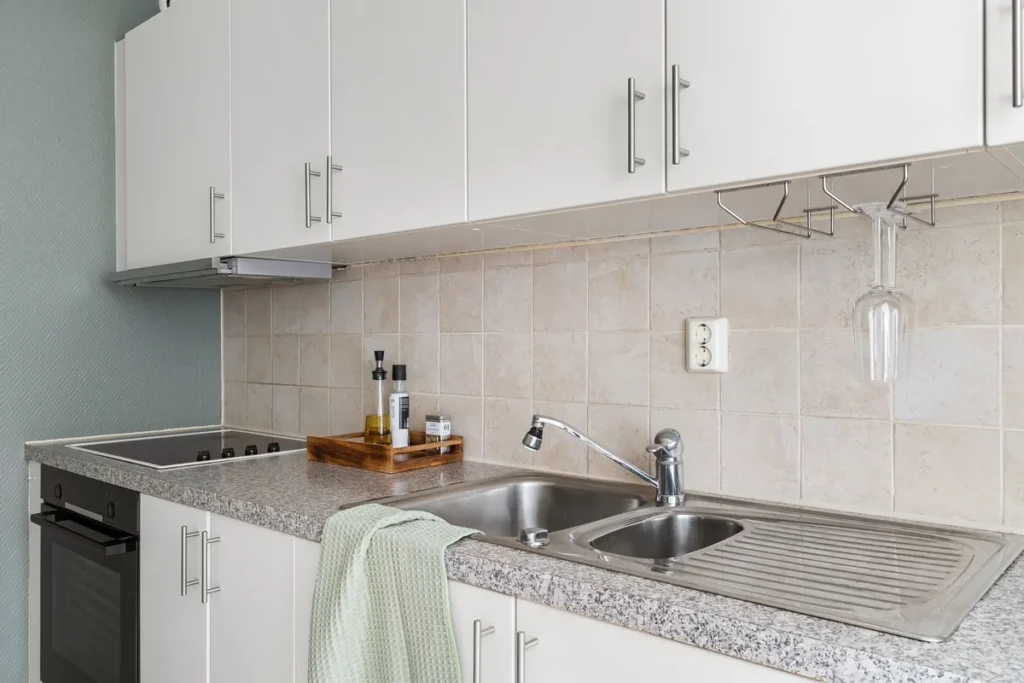
These eleven under sink organization ideas are conditional options, not a layout every cabinet should use. Start with safe storage conditions and required access to pipes, controls and equipment. Product labels and the actual installation can rule out an apparent gap before you consider a bin.
Protect required access and suitable storage conditions before filling space.
Key takeawaysFour checks before considering an organizer
- Conditions and contents: pause for a leak, unknown spill, damage or moisture near electrical parts; check what may be stored here.
- Protected access: identify controls, equipment and required operating and maintenance spaces before measuring storage.
- Usable space: record remaining width, depth, height and the route through the cabinet opening—not only side widths or trap height.
- Exact installation: verify support, mounting, load and loaded movement; a door that closes is only one check.
A sink cabinet may contain plumbing, a disposal, filters, hoses or electrical components as well as household supplies. Do not assume that every space around them is suitable storage or that every cleaning product belongs here.
Keep cleaning products closed in their original labeled containers, following each label’s storage conditions. Poison Control advises separating cleaners from food and medications. A pantry-food bin or an open high shelf is not automatically an appropriate substitute.
The options below separate fit, access, secure storage and mounting questions. They are not physical test results, plumbing instructions or certification of a particular organizer.
If supplies change before a busy cooking period, check the actual stock and storage requirements. A calendar month does not determine what this cabinet should hold.
How do you measure the space under a kitchen sink?
If the cabinet is safe to approach, identify the pipes, valves, equipment and protected service spaces first. Ask the landlord or a qualified professional if their requirements are unclear. Measure only possible storage areas that remain; do not disconnect or push components aside.
Record the lowest obstruction over the proposed footprint and the access required around it. The space below a trap is not automatically a storage strip: the tray and contents, retrieval motion and maintenance needs all matter.
Measure usable depth, width, height and the opening, including the front lip, hinges and door movement. For a sliding or rotating unit, compare its complete loaded travel as well as its closed footprint.
Choose contents by label, safe storage and household needs, not a mandatory one-open-plus-one-spare limit or weekly-use rule. Never combine products or decant them into matching bottles to make the arrangement look simpler.
Which under sink organization ideas work around a center drain?
A center drain may leave separate side areas, but hoses, valves and service requirements can reduce or eliminate them. These options apply only after protected spaces and suitable contents have been established.
Two narrow stacking units, one on each side
Consider narrow units only if the exact model’s footprint, loaded height, supports and retrieval path work. Use stacking only where designed and instructed, with its connectors and load limits. Do not cut or modify an organizer around pipes to force a fit.
Map protected access before storage gaps
Record the actual controls, equipment and required operating/service spaces, then the usable width, depth, height and opening that remain. A gap below the trap is not automatically a storage strip.
A turntable in a back corner
A turntable is an option only when its entire loaded rotation clears pipes, hoses, equipment, the door and protected access. Diameter alone does not establish fit: tall bottles can project, tip or need extra handling space. Keep all contents closed in their original containers.
A low tray under the trap
A low tray may hold suitable nonhazardous items only where the actual installation permits storage and handling. Do not automatically place dishwasher tablets or loose packets here. Follow their original packaging and secure-storage instructions; a tray below a drain does not provide chemical protection.
What works on a disposal or a crowded pipe layout?
A disposal, filter or dispenser can need operating, ventilation, replacement and service space beyond its visible outline. Consult the actual equipment instructions before treating nearby space as available. Leave uncertain areas unused.
A clear lane to the shutoff valves
Identify and protect the actual approach and working space for controls and equipment. Do not promise a seconds-long shutoff or assume one under-sink valve stops every leak. Do not exercise an unfamiliar, stuck, corroded or leaking valve as an organizing test; ask a qualified plumber or landlord about identification and safe procedures.
Pull out bins on the side away from the disposal
Compare a sliding bin’s closed and fully extended loaded envelope, cabinet mounting, support, opening and hinge clearances with the actual installation. A bin shorter than the disposal is not automatically suitable. Keep the whole motion clear of plumbing, wiring and required access.
How do you use the door and the walls under a sink?
A door or side panel is not automatically available mounting space. Check panel construction, finish, permitted fixings, loaded movement and the exact holder’s instructions before considering an attachment.
Hooks or a slim rail on the inside of the door
Use a hook or rail only when its instructions cover the intended item, mounting surface, load and conditions. A wet item’s weight and clearance matter, but “lightweight” or a removable label does not establish suitability or damage-free removal. Check rental permission and finish restrictions; do not improvise a fixing.

A purpose-built bottle holder, only where verified
Do not hang spray bottles by their triggers from a general-purpose tension rod. A bottle trigger is not an assumed load-bearing hanger. Consider only a purpose-built holder whose instructions cover the actual original containers, supports, surfaces, loads and clearances; otherwise use suitable stable storage instead.
How do you handle depth, leaks, and safety?
The following options address different questions, not guaranteed leak prevention or child safety. Deal with an active leak, unknown spill or damaged installation before putting storage back.
Clear bins sorted by task
A clear bin can group suitable closed products if it meets their storage requirements and leaves required access clear. It is not verified chemical containment or a substitute for secure storage. Stackable pantry bins for a rental concern a different intended use; food-storage suitability does not approve a bin for cleaners under a sink.
A carry caddy for the daily cleaning set
A caddy may carry a manageable set of suitable closed original containers and tools during use. Check the caddy’s intended use and load. Keep it under control and return products to appropriate secure storage; a portable open caddy is not a child-resistant storage system.

A suitable liner, only after concerns are resolved
A mat or tray is not a leak repair, a guarantee against cabinet damage or a diagnostic test. EPA’s leak guidance includes looking for water outside fittings and seeking plumbing help when needed. Moisture on a liner does not identify its source. Do not wipe an unknown spill or touch wet electrical parts; resolve the concern with appropriate help before covering or reloading the area.
Appropriate locked storage when children may have access
CPSC’s poison-prevention guidance says to keep chemicals and cleaning supplies in a locked cabinet or box out of children’s reach, in original child-resistant containers. A high shelf alone is not an equivalent, and dish soap is not a blanket exception. Follow each product’s label and appropriate secure storage even when no child currently lives in the home; hardware is not a substitute for those requirements.
What goes wrong with under sink storage?
One possible issue is more stock than the intended storage can accommodate. The number of open bottles does not prove why it happened or establish the most common failure.
Review the actual stock, users and label requirements before buying more. Do not merge partly used cleaners, impose a fixed one-spare rule or move refills beside pantry food. Any alternative location must provide the product’s required conditions and appropriate secure storage.
Storage that obstructs controls or maintenance access needs reassessment. Keep protected spaces clear, but do not treat a monthly mat check as leak detection assurance. A dry-looking cabinet does not prove there is no leak.
A width or height match alone can miss the opening, hinge, loaded motion or installation requirements. If an organizer interferes with the cabinet or equipment, do not force it in or operate it that way.
How do you choose from this list?
You may need one option, several or none. Start with safe conditions and eliminate candidates with unclear support, mounting, chemical-storage or access requirements before considering a purchase.
- Resolve concerns first: pause for leaks, unknown spills, damage or moisture near electrical parts; seek appropriate help.
- Protect operating and service spaces: establish the actual controls and equipment requirements before measuring storage gaps.
- Check contents and security: follow labels and original packaging, separate cleaners from food and medications, and use appropriate locked storage out of children’s reach.
- Compare the complete arrangement: usable dimensions, opening, support, mounting, load and loaded movement must all suit the exact installation.
- Leave uncertain space unused: a mat, trial load, small gap or closing door cannot establish safety.
For a wider stock review, the free home reset offers organizing prompts. It does not determine chemical-storage suitability or replace plumbing or electrical guidance. No purchase is needed to use the checks in this article.
Check contents, access and the complete installation
Resolve leaks or unknown spills first. Follow labels and appropriate secure storage. Then compare exact support, mounting, load and loaded movement. A mat, empty lane or door that closes cannot approve the arrangement.
Frequently asked questions
What should you keep under a kitchen sink?
Keep only items whose labels and safe-storage needs can be met without obstructing controls, equipment or maintenance. Keep cleaners in closed original labeled containers away from food and medications. No weekly-use or one-spare rule approves an item for this cabinet.
How do you organize under a sink with a garbage disposal?
Consult the exact disposal and associated equipment instructions for protected access and space requirements. Measure remaining usable areas plus the opening and loaded movement. Do not place storage against equipment, hoses or electrical parts, and leave uncertain space unused until clarified.
Is it safe to keep cleaning products under the sink?
The absence of children living in the home does not by itself make an arrangement safe. Follow product labels and appropriate secure storage. CPSC advises locked storage out of children’s reach for chemicals and cleaners, in original child-resistant containers. A high shelf alone, an open caddy or dish soap exception is not equivalent.
How do you stop leaks from ruining under sink storage?
A mat cannot stop or repair a leak or guarantee protection. If you see moisture, damage or an unknown spill, pause storage work and get appropriate help. Do not touch unknown liquid or wet electrical parts. Identify safe water-shutoff arrangements before an emergency with qualified guidance, not by testing unfamiliar valves.
Written by the SetsQuick Team. First published .
© SetsQuick. This article and its images may not be copied or republished without permission. To report reuse, see our DMCA page.
Was this guide helpful?
Save it for later or send it to someone