
Over the Door Shoe Organizer vs Shoe Rack: Which Fits
A narrow closet gives you one door and very little floor, and the shoes are on both. This page settles the choice with four measurements: door clearance, door height, usable rod length and floor depth. You pick by the number that fails first, not by the photograph.
Four calls that end this comparison
- Check door clearance first. An over the door organizer only works if the door still closes on it without rubbing the frame.
- Measure the closet floor with the door shut. A freestanding shoe rack takes depth you may need for the hanger swing.
- Weight decides placement. Light flats and trainers go on the door, boots and heavy soles stay on the floor.
- Count pairs before you buy. Under about ten pairs one unit is enough, above that you are choosing which one goes where.
Which one fits a narrow closet?
The over the door organizer wins when the closet floor is already spoken for and the door is solid. The shoe rack wins when the floor is free and the shoes are heavy. Narrow closets usually have a busy floor, which is why the door gets looked at first.
The door is the largest unused surface in the room. Closet door height is generally 80 inches, and homes with nine or ten foot ceilings may use 84 or 96 inch doors. That is vertical space you are paying for either way.
A rack answers a different problem. It holds weight at the bottom of the closet, takes boots without sagging, and can be moved out when you leave. A narrow tall shoe rack keeps the footprint small, which is the only version worth considering in a narrow space.
Neither unit fails on looks. They fail on clearance, and clearance is a number you can take in two minutes with a tape measure.

How do you measure your space before choosing?
Four numbers, written down before you open any listing. Measure with the closet loaded, since an empty closet lies about what it can take.
- Door clearance: close the door and measure the gap between the door face and the nearest thing inside, at hip height and again at knee height.
- Door height and width: measure the door itself, not the opening, because the organizer hangs on the door.
- Usable rod length: measure between the brackets, not wall to wall, then divide by hanger thickness for real capacity.
- Floor depth: measure from the back wall to the door face with the door shut, then take two inches off for the clothes that hang over it.
The rod sets the geometry of everything below it. A closet rod is normally set 66 inches from the floor to the bottom of the rod, and 12 inches out from the back wall, and the average reach in closet is about 24 inches deep.
Capacity comes from the rod, not the room. A standard hanger is about 18 inches wide, so usable rod length rather than closet width sets how much can hang. Divide your rod length by your own hanger thickness and you get pairs of shoulders, which tells you how much floor the clothes will overhang.
One more rule for awkward bays. When something splits the bay, a return wall, a bracket or a radiator, two narrow units beat one wide unit, and a unit with removable legs beats a fixed frame.
The decision table
Six decision points, and the measurement that settles each one. The last column is what no product listing prints, because it belongs to your closet rather than to the product.
Check the rod height row against your own home
- Floor space. Over the door organizer: Uses none. Shoe rack: Uses the full footprint. The measurement that settles it: Floor depth with the door shut.
- Door still closes. Over the door organizer: Only with clearance to spare. Shoe rack: Always. The measurement that settles it: Gap between door face and nearest item.
- Heavy boots. Over the door organizer: Sags and swings. Shoe rack: Holds them low and stable. The measurement that settles it: Weight per pocket against weight per shelf.
- Pairs visible at a glance. Over the door organizer: All of them, in one wall. Shoe rack: Front row only on deep shelves. The measurement that settles it: Door height against rack tier count.
- Clothes overhang. Over the door organizer: Unaffected. Shoe rack: Blocked by hanging hems. The measurement that settles it: Rod length divided by hanger thickness.
- Moving out. Over the door organizer: Lifts off, no trace. Shoe rack: Carries out assembled or flat. The measurement that settles it: Door thickness and bracket type.
Where does the over the door organizer win?
It wins on visibility. Every pair faces you at once, so you stop digging, and a closet shoe rack organizer hung on the door turns dead surface into the most used storage in the room. Nothing on the floor means you can vacuum without moving furniture.
It wins in rentals too. No drilling, no floor claim, and it lifts off in one motion on moving day. Over hook models suit hollow doors, while a bracket model suits a solid door that closes with room to spare.

On a bad week, the door pockets are what keep the floor clear, because a pocket takes one pair in one second with no aiming. A rack asks you to place shoes neatly, and neatness is the first thing that goes when the week is bad.
It loses on weight and on bulk. Trainers with thick soles fill a pocket and then push the door out of true, so heavy pairs belong lower down.
Where does the shoe rack win?
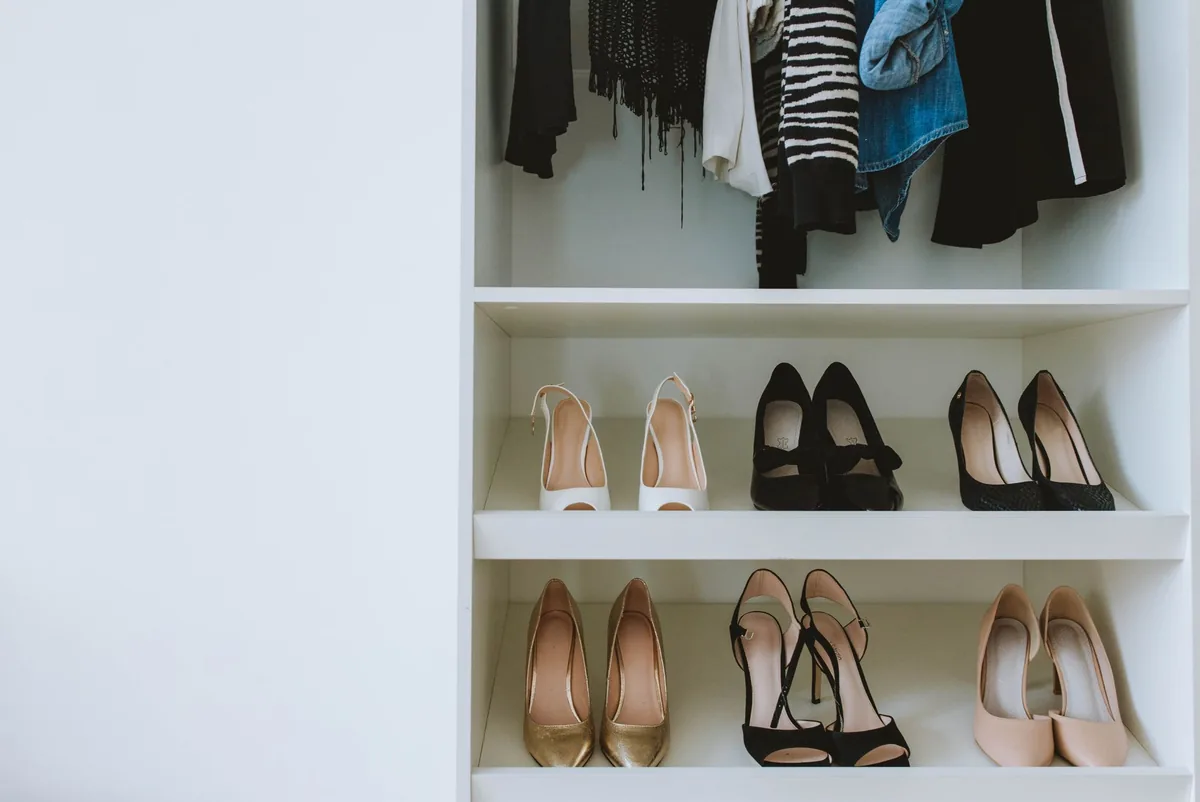
A rack wins on load and on lifespan. A freestanding shoe rack in wood or engineered wood carries boots and work shoes without flexing, and a wood shoe rack takes a knock better than fabric. Shoe rack engineered wood models cost less and hold shape if you keep them dry.
It also wins where the door is not an option. Sliding doors, louvre doors and doors that open against a wall all rule out hanging storage. A narrow vertical shoe rack then fits the strip beside the hanging clothes, which is usually the only free floor in a narrow closet.
Shopping is simple once you have your floor depth. Narrow shoe rack ikea listings, shoe rack ikea sizes, home depot shoe rack pages and a 3 tier bamboo shoe rack all publish the footprint, so your number filters the options fast. A bamboo shoe rack suits damp rooms better than fabric does.
The catch is depth. A closet shoe rack sits where your clothes hang, so the hems rest on the top tier, and that top tier stops being used within a month.

What goes wrong with each one?
Four failures cover both units. Each shows an early sign in the first fortnight, which is your window to fix it rather than replace it.
- Door rub. Early sign: a mark on the door frame. Cause: organizer depth larger than the clearance you measured at hip height only.
- Hook slip. Early sign: the organizer sits crooked after a week. Cause: hooks sized for a thinner door, or weight loaded at one end.
- Hem creep. Early sign: the top tier of the rack holds nothing. Cause: rack depth measured without the clothes hanging.
- Rack walk. Early sign: the rack sits away from the wall. Cause: shoes pushed in from the front until the frame shifts.
Hem creep is the one people accept for years. Measure the floor depth with the door shut and the clothes in place, then take two inches off, and the top tier stays usable.
Filing on edge fixes the drawers in the same closet, and the organize tupperware lids deep method transfers directly to folded clothes. Container choices follow the same rule everywhere: choose what fits the shelf and what you can reach without moving another item.
Buying containers before sorting is why it did not last, and shoes are the clearest case. Retire the pairs you have not worn in a year before you measure anything. More sequences sit in the closet systems hub.
Questions people ask
Is a collapsible shoe rack storage organizer worth it?
It is worth it for temporary needs and for guests, not for daily shoes. Collapsible frames flex under weight, so the tiers sag once boots go on. Buy one if you move often or store seasonal pairs, and keep daily shoes on something rigid.
Check that it folds flat enough to slide behind the hanging clothes.
Does a revolving shoe rack for a closet save space?
Only in a corner, and only with real clearance around it. A revolving unit needs a full circle of free space, so a narrow closet rarely gives it room. Measure the widest point of the spin, not the base, then add two inches. If the number beats your floor depth, use tiers instead.
What should I check on an adjustable shoe rack for a closet?
Check the tier spacing at its smallest setting, because that is where boots stop fitting. Then check whether the frame stays square when you change the spacing, since the adjustment is where cheap racks fail. An adjustable rack earns its price if the same unit can hold flats in summer and boots in winter.
When is a large shoe rack for a closet the wrong buy?
When it is wider than your usable rod length, or deeper than your floor depth with the door shut. A large rack in a narrow closet blocks the hanging clothes and turns the whole space into a shoe store.
Two narrow units placed either side of the hanging section hold the same pairs and stay reachable.
Can I use a narrow shoe rack for an entryway instead?
Yes, and it often solves the closet by taking the daily pairs out of it. A shoe organizer for entryway use needs a wipeable top tier and a footprint that clears the door swing. Keep three pairs per person there, and send the rest back to the closet, or the entryway becomes the new problem.