How to Organize Tupperware Lids in a Deep Drawer
The lids are loose in the bottom of a deep drawer, and you are holding a container while you dig. This page puts every lid on its edge in one filed rank, gives you the three measurements that decide the divider, and names the failure that brings the pile back. One drawer, one hour.
Decide these three things before you buy a divider
- Lids stand on edge, never flat. A flat lid is a lid you will lift ten others to reach.
- A deep drawer is height you mostly cannot use for lids, so plan one filed rank and give the leftover height to the bases.
- Retire any lid with no matching base today. That single edit is worth more than any organizer you can order.
- Measure the drawer opening, not the drawer front, then buy the divider that clears it by half an inch.
Why do tupperware lids beat a deep drawer?
A deep drawer rewards tall items and punishes flat ones. Lids are flat, light and slippery, so they slide under everything heavier and end up in a layer at the bottom. Depth gives them more room to hide, which is why the deepest drawer in the kitchen usually holds the worst mess.
The drawer itself tells you what it was built for. Utensil drawers are typically 3 to 6 inches high and pot drawers 8 to 12 inches, which decides whether a tray or a divider fits. A pot drawer holding lids is a pot drawer doing the wrong job.
Width is on a grid too. Kitchen drawer widths run from 12 to 36 inches in three inch increments, because cabinet boxes are built on a three inch module. Dividers sold in three inch families therefore fit more drawers than the listing photos suggest.
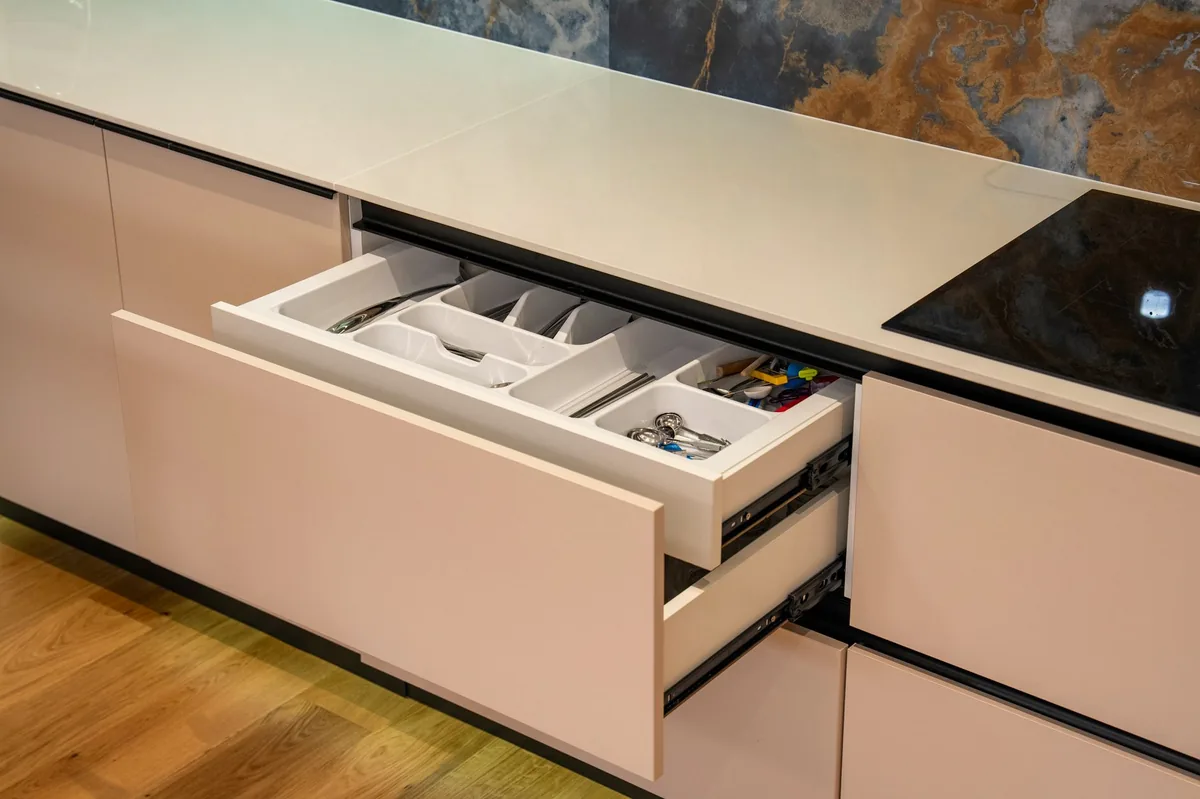
So the fix is not a better container. The fix is turning the lids ninety degrees and holding them there, which is a divider job and a sorting job, in that order.
How do you organize tupperware lids in a deep drawer?
Six steps. Do the whole drawer in one sitting, because a half sorted lid drawer refills itself by the next wash.
- Empty the drawer onto the counter. Every lid, every base, nothing left behind as a keeper.
- Measure the drawer opening itself, never the drawer front and never the old box, because the front overlaps the frame. Write down width, depth and clear height.
- Match every lid to a base. Orphans leave the kitchen now, not into a bag for later.
- Sort the survivors into three families by shape: round, rectangular, and everything odd.
- Stand each family on edge in its own lane, largest at the back, smallest at the front, so a single look finds the size.
- Give the leftover depth behind the lanes to nested bases, and stop filling at three quarters full. A drawer packed to the edge stops being used.
Subtract half an inch from the width you measured before you order a divider. That half inch is what lets the divider drop in and lift out with one hand, instead of wedging against the frame and racking every time the drawer closes.
Bases can live elsewhere if the drawer is tight. Nested bases stack well in a cupboard, and what to check on stackable bins rental covers the shapes that nest instead of stack.
The five minute version
No divider, no tape, five minutes. This buys you a usable drawer tonight and leaves the real sort for the weekend.
- Pull out every lid, and put back only the ones whose base you can see in the same kitchen.
- Stand them on edge against the left wall of the drawer, biggest first, and let them lean.
- Wedge a loaf tin, a small box or a folded tea towel behind the rank so it cannot fall flat again.
A leaning rank is not a system, but it holds for about a fortnight. That is long enough to learn which sizes you actually reach for before you spend anything.
What goes wrong with a lid drawer?
Four failures, and each one shows itself in the first two weeks. Catch the early sign and you fix the drawer instead of buying a second organizer.
- The rank falls flat. Early sign: one lid lies down at the end of the lane. Cause: lanes wider than the lid, no back stop.
- The divider walks. Early sign: a gap opens at the side after a week. Cause: no grip at the base, or a divider cut for a wider drawer.
- Lids too tall to close. Early sign: the drawer catches at the last inch. Cause: clear height measured empty, not with a lid standing in place.
- The orphan creep. Early sign: two lids with no base by the second week. Cause: keeping the bag of maybes instead of retiring them.
The one that ends the system is orphan creep. Lids outlive their bases, so the drawer refills with things that fit nothing, and the rank loses its order. Retire on sight, every wash day, and the drawer stays solved.
Corner cabinets have their own version of this problem, since a turntable hides things by rotation rather than by depth. If yours turns a corner, measure the cabinet opening, usable depth, and the space behind the hinge before choosing a turntable.

Which divider fits your drawer height?
Height decides the hardware, so measure before you shop. The last column is the part no listing prints: what quietly fails at each height.
Measured with a lid standing in the lane, not with the drawer empty
- 3 to 4 inches. What can stand on edge: Small round and square lids only. Divider that holds it: Fixed low tray with short fins. What fails at this height: Large lids lean out and block the drawer front.
- 5 to 6 inches. What can stand on edge: Most everyday lids. Divider that holds it: Adjustable spring loaded dividers. What fails at this height: Dividers walk if the base has no grip.
- 7 to 8 inches. What can stand on edge: Every lid, plus one rank of shallow bases. Divider that holds it: Tall pegs or a vertical file rack. What fails at this height: Height above the lids fills with loose items.
- 9 to 12 inches. What can stand on edge: Lids at the front, nested bases behind. Divider that holds it: File rack at the front, open bay at the back. What fails at this height: Bases get stacked too high and tip on opening.
- Over 12 inches. What can stand on edge: This drawer is wrong for lids. Divider that holds it: Move lids to a shallower drawer. What fails at this height: Depth swallows everything flat, again.
Materials matter less than grip and width. A bamboo kitchen drawer organizer looks better and slides more, so check for feet or a liner. Target kitchen drawer organizer and home depot drawer organizer listings both publish outside dimensions, and ikea drawer organiser kitchen sizes follow the same three inch logic.
The drawer sits inside a standard box, which is why those sizes repeat. Base cabinets are 24 inches deep and 34.5 inches high, in widths from 12 to 48 inches, so a divider that fits one kitchen usually fits the next one you live in.
Do desk and closet drawer organizers work for lids?
Sometimes, and it is worth checking before you buy kitchen specific hardware. Desk drawer organizers are built shallow and modular, so a desk drawer organizer ikea tray can hold small round lids well. The honeycomb drawer organizer shape suits socks and cosmetics, not flat lids, because a hexagon wastes the long dimension a lid needs.
A muji drawer organizer set works on the same principle of one item type per box, which is the part worth copying. An attachable desk drawer tray is the wrong choice here, since it hangs rather than sits, and a lid rank needs a floor.
Ikea drawer organizer clothes dividers are too soft to hold an edge.
Shoe storage tempts people for the same reason, and a shoes drawer cabinet insert really does file things on edge. The catch is depth, since shoe inserts are built for a longer footprint than a lid. Use the principle, buy for the measurement, and keep any drawer storage organizer that already fits.
Pick one drawer and finish it. Organize your home day sweeps and organize my life plans fail on lids because they are the smallest, dullest job in the kitchen. More sequences sit in the kitchen and pantry hub.
Questions people ask
What are some creative ways to organize your kitchen storage lids?
Use a vertical file instead of a box. A dish rack, a magazine file or a tension rod set across the drawer all hold lids on edge for very little money. Another option is a lid rank inside the cupboard door, provided the door clears the shelf. Creative here means vertical, not decorative.
Are the home edit drawer organizers right for lids?
They hold lids if the insert has narrow lanes and a back stop. The style favours clear boxes in matching sizes, which photographs well and works when the lane width matches your largest lid. Check the inside width, not the outside, and skip any insert with lanes wider than the lid you own most of.
Does the home edit large drawer approach suit a deep drawer?
Only if you split the drawer front to back. A large drawer styled as one open bay puts lids back in a pile, so divide it into a lid rank at the front and a base bay behind. Keep the front rank shallow enough to see into from standing height, and label the bay edge.
Where do lids belong in the best way to organize a kitchen?
Next to the dishwasher or the sink, because that is where lids arrive. Store lids and bases within one step of each other, and keep the drawer above knee height so you can see the rank without crouching. Proximity to the wash point beats proximity to the fridge every time.
Can this method help with the best way to organize a closet drawer?
Yes, filing on edge transfers directly. Folded clothes stand in ranks the same way lids do, so you see every item from above instead of lifting the top layer. The measurement changes, since closet drawers are usually shallower, so measure the opening there too before ordering any divider.