
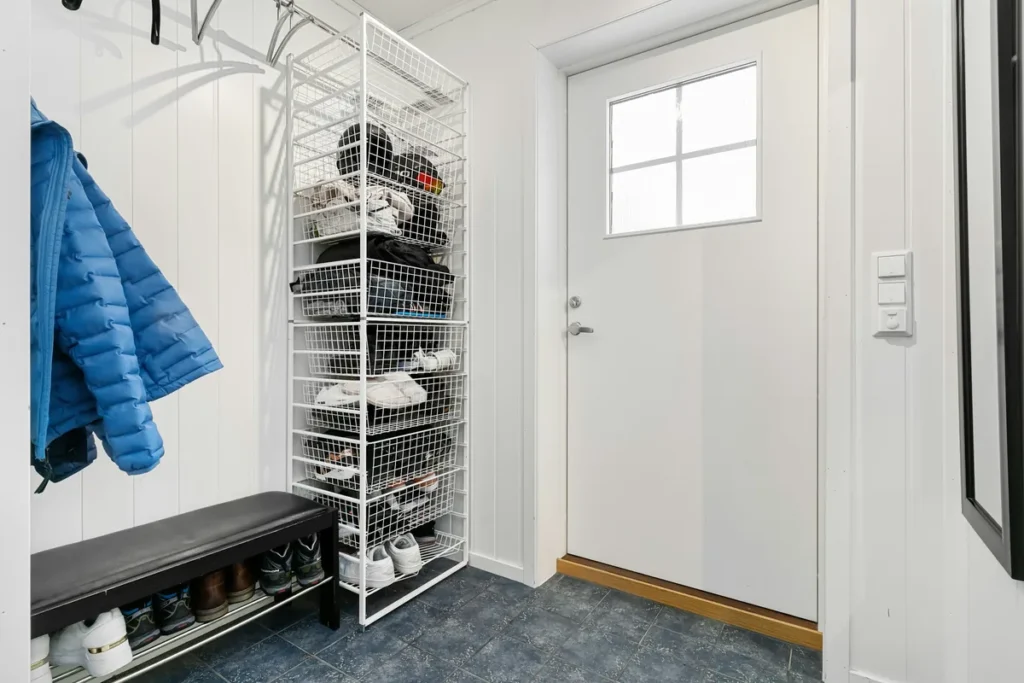
Choose an over-the-door shoe organizer vs shoe rack by checking a complete plan: permitted installation, usable operating space and the actual shoes. A door organizer is an option only when the organizer, door and hardware support the intended use. A floor rack also needs suitable load limits, stability and a clear door-and-retrieval route. A full floor or a light shoe does not make either plan automatically suitable.
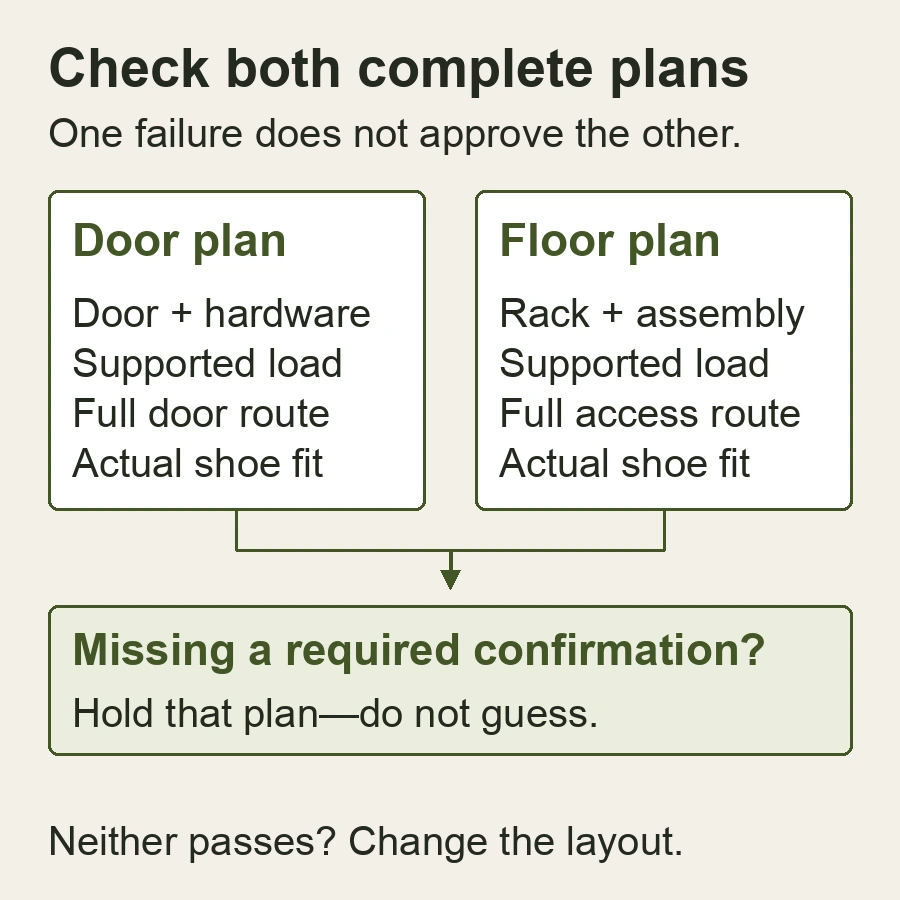
Make three checks for each option: installation and support, operation and access, then shoe fit and useful capacity. If a critical requirement is unresolved, keep that option on hold. Failing one option does not approve the other.
Key takeawaysCheck the whole plan before choosing
- Check the exact product first: confirm door and hinge compatibility, load limits, and unobstructed closing and latching.
- Check the full operating route: include opening, closing and latching, retrieval, hanging clothes and the loaded storage—not just a closed footprint.
- Match the actual shoes: confirm pocket or shelf fit and supported loads; weight alone does not select a storage location.
- Count useful positions: record the footwear you need to store and which positions you can actually reach, rather than relying on a headline pair count.
Narrow closets put two kinds of storage in direct competition. The floor is the natural place for shoes, but it is also where hanging clothes end, where bags land, and where a vacuum needs to reach. The door is empty, but it moves every time you use the closet.
“Over the door” describes a mounting location, not one construction. Some organizers have pockets; others have rigid shelves or a supported track. A floor shoe rack is a separate structure that may have its own assembly, load and anchoring requirements. Compare the actual designs rather than assuming all door storage behaves like a fabric pocket organizer.
Neither location wins by name alone. Check the instructions and return terms for the exact item before buying; do not assume every assembled or filled product has the same return restrictions. Keep a record of the requirement that makes a proposed arrangement pass, fail or remain unresolved.
The comparison follows the SetsQuick SETS order: Sort, Edit, Type, Store. Identify the shoes you still need, including occasional-use or protective pairs. Decide where each group belongs before buying storage; frequency of wear alone is not a reason to discard a needed pair.
Over the door shoe organizer vs shoe rack: which fits a narrow closet?
A door organizer may free floor space, but it also projects from a moving surface. Check its actual depth with the intended shoes, the whole swing route, adjacent storage and closing hardware. A clear floor does not establish door compatibility, and a door-mounted unit does not necessarily put every pair at eye level or within everyone’s reach.
A suitable floor rack avoids adding the organizer’s load to the door, but can still interfere with the door, a walking route or hanging clothes. Its load limits, assembly and any required anchoring must suit the intended use. Being made of metal, wood or another material is not proof of stability or capacity.
Door type alone does not settle compatibility. Check the exact organizer’s permitted door construction, thickness, hinge and load requirements, including clear opening and closing. Sliding, folding and other doors may have very different hardware; use only an explicitly compatible product, not a universal rule based on door style.
Footwear shape matters alongside weight. Check each boot’s height, sole length, opening and drying needs against the actual storage instructions. Do not assume a pocket fits a pair, a rack holds every heavy boot or every door-mounted design is unsuitable for boots. A named product category is not a load or fit approval.
How do you measure the closet before choosing?
Record the closet as it is normally used, with its clothes and other belongings in place. Separate the closed-space measurement from the opening, retrieval and return route. A paper outline can flag an obstruction, but it is not a loaded compatibility or safety test.
- Door-side space: record the actual door construction, hardware and nearest obstructions, then check the loaded organizer’s depth and full movement route.
- Hook and frame fit: obtain the permitted door thickness, clearances and mounting method for the exact product. A gap that accepts a loose hook does not establish the loaded arrangement.
- Floor depth and door route: measure the usable area with the door in its relevant positions, including where the door or organizer passes a proposed rack.
- Floor width and reach: include fixed storage, hanging clothes, access to shoes and any assembly or anchoring clearances required for the rack.
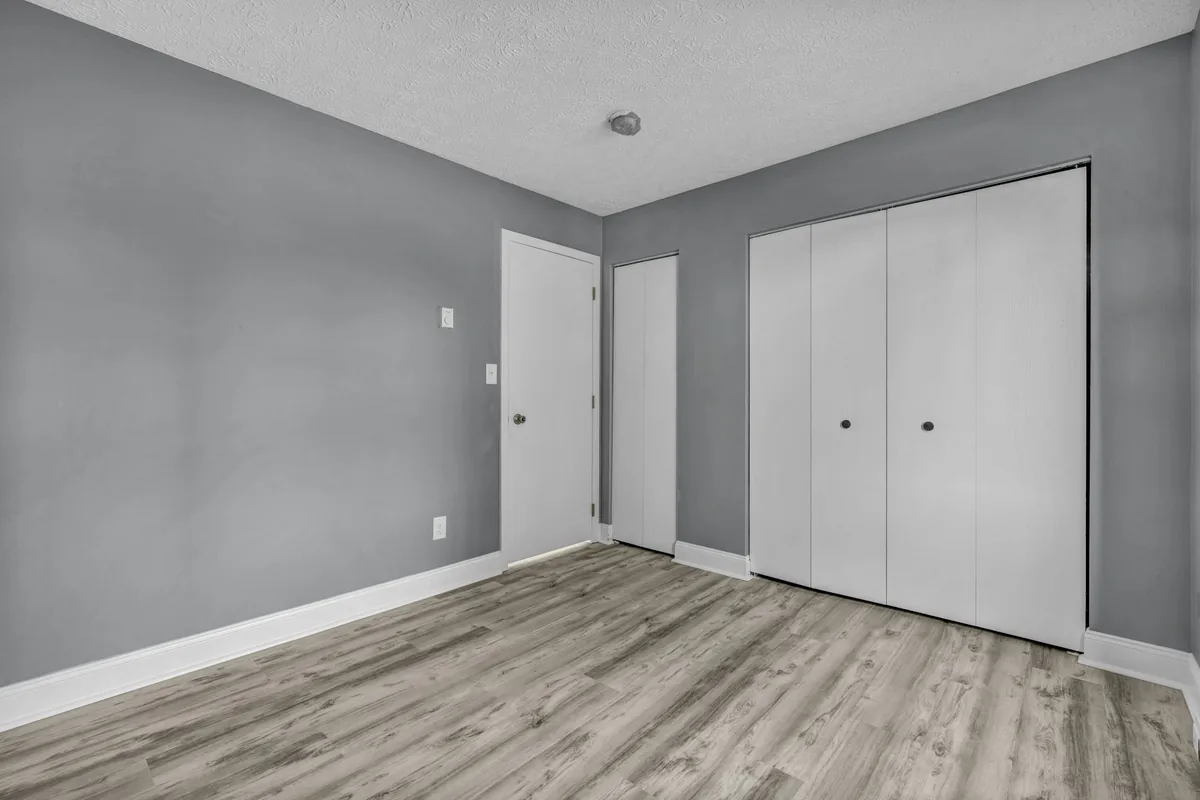
A cardboard strip can flag a clearance problem, but it does not reproduce the exact hook, loaded leverage, door-edge strength or hinge capacity. Use the actual organizer’s dimensions and instructions and confirm the door and hardware permit the intended load. If a requirement is unknown, choose another location rather than treating a single-hook trial as approval.
Confirm the door’s construction and the door, hinge and organizer manufacturers’ load and fixing requirements. Spreading shoes evenly or choosing light pairs does not establish compatibility. Do not use the organizer if it damages the door, obstructs its movement or lacks a suitable rated installation.
For the rack, note where clothes hang over the floor. A rack placed under long coats or dresses becomes hard to reach, and the top tier tends to collect fabric instead of shoes.
How do the two options compare?
Compare the two complete proposals below. Each has a different installation and operating route; neither passes because the other fails. This is a planning comparison, not a test of a particular door, hinge, rack or organizer.
| Check | Door organizer plan | Floor rack plan |
|---|---|---|
| Support | Exact organizer, door and hardware must permit the intended mounting and load | Exact rack must suit the load, assembly and any required anchoring |
| Operating space | Loaded depth, swing, closing and latching must work | Full footprint must leave the door route, walking space and retrieval clear |
| Shoe fit | Actual shoes must fit the permitted pockets or shelves without improvised loading | Actual shoes must fit usable shelves and permitted loads |
| Visibility | Count only positions the intended user can identify and reach | Check each row and tier; a rear row may be hidden |
| Cleaning and care | Follow the organizer, footwear and door care directions | Follow rack and footwear care directions; retain access to the floor |
| Unresolved requirement | Hold this plan and obtain the missing confirmation | Hold this plan and obtain the missing confirmation |
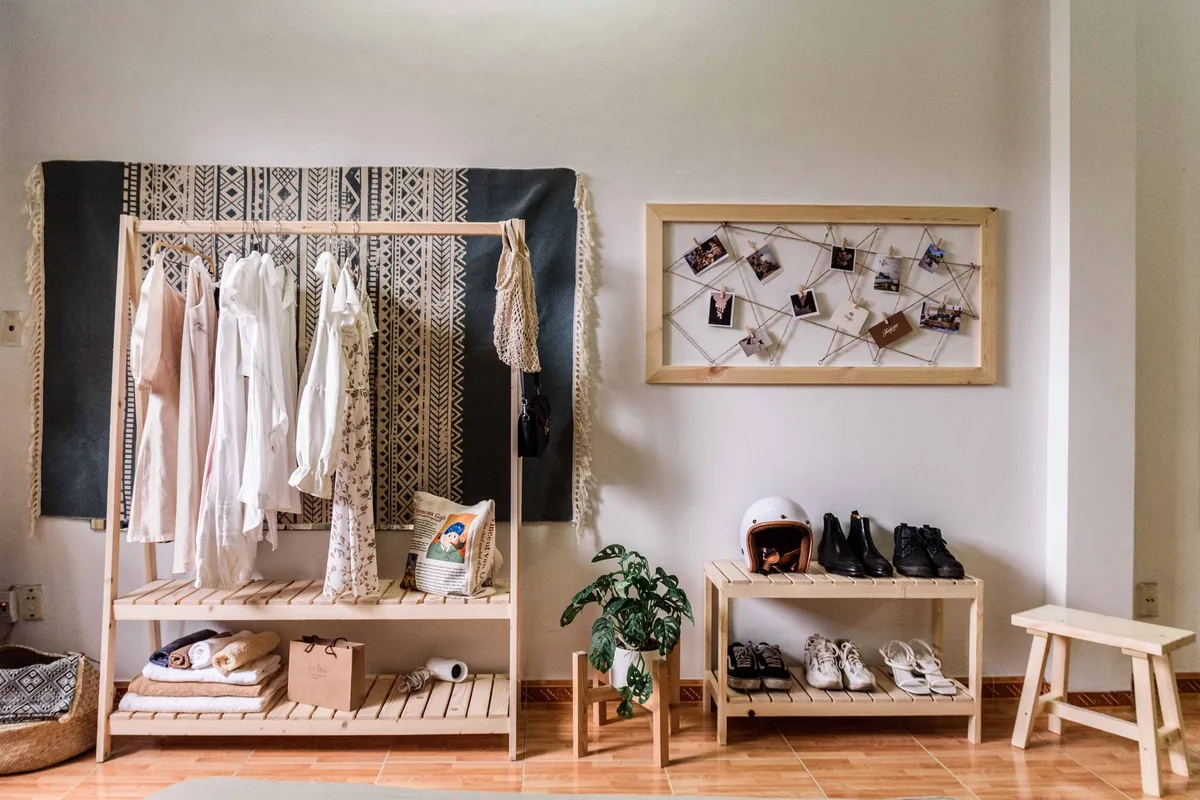
If both plans meet their requirements, compare the shoe positions you can use, the opening routine and the care involved. If only one passes, consider that complete plan. If neither passes, choose a different location or layout rather than forcing a purchase.
You can combine the options only after checking their interaction: a loaded door organizer may pass in front of a floor rack, and either can obstruct retrieval. Two individually suitable products do not establish that their combined layout works.
When can a door organizer be useful?
A suitable door-mounted layout can make shoes easier to identify without adding a floor footprint. Check the actual positions from the intended user’s reach, including the highest and lowest pockets or shelves. Do not count a position as useful just because the organizer advertises space for it.
For a rental, confirm both the installation requirements and any permission needed. Some products use over-door brackets, while other arrangements require additional fixing or a different mounting method. “No drilling” is not a guarantee of no marks or suitable loading, and a loose hook should not be padded or modified unless the manufacturer explicitly allows it.
Keeping shoes off the floor may help you clean beneath them, provided the loaded door can still move as required and the organizer itself can be cared for as instructed. Do not treat a visually clear floor as evidence that the mounting or access is suitable.
The limitation is the actual permitted load, shoe fit and projection—not a universal ban on a footwear category. If pockets distort, the frame shifts or shoes project into the door route, stop using the affected arrangement and check the instructions rather than accepting those signs as normal.
For example, Whitmor’s over-door shoe-rack instructions describe an assembled frame with shelves and over-door brackets, not just fabric pockets. Elfa’s On Door Storage instructions specify a particular wallband, door fit and mounting arrangement. These examples show why the actual instructions matter; neither establishes a universal door capacity or approves a different product.

When can a floor rack be useful?
A suitable floor rack avoids loading the door, but material alone does not establish strength or long-term stability. Check the exact rack’s load limits, assembly and any anchoring requirements. Keep heavy items low and do not assume every metal, wood or bamboo rack can carry heavy boots.
A floor rack is an alternative where an approved door organizer cannot be installed. Confirm that the rack fits without obstructing the door, walkway or access to other storage; a narrow footprint is not enough on its own.
Adjustable shelves can help only where the exact rack permits the proposed arrangement. Follow its assembly, locking and load instructions after any change. If it wobbles, shifts or does not remain assembled as instructed, stop using it and obtain the appropriate model-specific guidance; a visual check alone is not a safety approval.
Racks lose on depth, because a rack sits where clothes hang, so long garments can rest on the top tier and make it unusable. If the hanging section reaches low, choose a shorter rack or place it in the part of the closet with only short clothes above it.
Width matters alongside depth and height. Check access to the closet’s corners and hanging clothes, and the route for lifting shoes out. Compare one or more rack positions on those requirements; two narrow racks are not automatically better than one wide rack.
What goes wrong with each one?
Treat rubbing, slipping, distortion or unexpected movement as a reason to stop and investigate, not as a normal trial to work through. Do not keep loading an arrangement to discover its limit, force a door to latch or improvise extra supports.
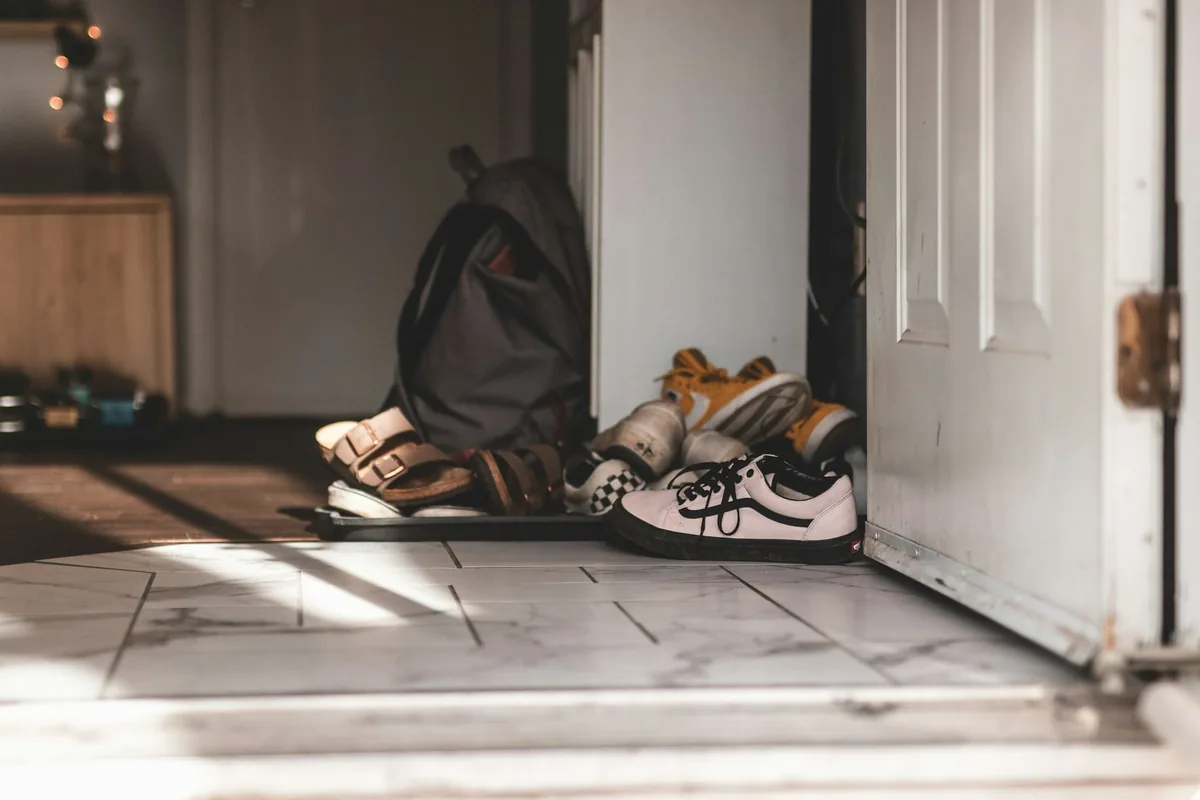
Door rub or latch resistance: stop using the affected organizer and keep the door’s required function unobstructed. Confirm the exact hook, loaded projection and door compatibility. Removing a heavy pair or choosing a thinner-looking product does not by itself resolve the cause.
Hook slip or a shifting frame: stop using the affected arrangement and follow the manufacturer’s assessment or replacement guidance. Even loading or a hook that appears to match the door does not prove that its support is suitable. Do not add unapproved padding, adhesive or fasteners as a repair.
Hem creep: hanging clothes gradually settle on the rack’s top tier. The early sign is an empty top tier covered by fabric. Move the rack under shorter clothes or choose fewer tiers.
Rack drift or instability: stop using the affected rack until its assembly, floor position, permitted loading and any anchoring requirements have been checked. Pushing it back or putting more weight on a lower tier is not a substitute for resolving unexpected movement.
Hanging fabric on a rack is an access problem, not proof that either storage type is the right choice. Check the actual hanging length and door route before buying. Move or redesign the layout only where the whole arrangement remains suitable.
How do you compare the three checks?
Write a separate record for each proposed plan. The checks are cumulative: a pass on shoe fit does not cancel an unresolved mounting requirement, and an approved installation does not make an obstructed operating route usable.
- Installation and support: identify the product and the required mounting, load, door or rack conditions. Record what still needs manufacturer confirmation.
- Operation and access: check the full loaded arrangement, opening and closing, retrieval, return and access to adjacent storage.
- Shoe fit and capacity: check the actual footwear and count only usable positions. Keep the intended care and storage conditions with that record.
- Decision: use only a complete passing plan; an unknown critical fact stays unresolved.
- Neither passes: choose another location or layout rather than automatically switching to the other product type.
For more closet storage choices, see how Elfa vs IKEA Boaxel compare for a small closet on a tight budget. You can also browse more closet guides for related setups.
After a suitable installation, normal use can reveal organizational friction such as inaccessible shoes or awkward returns. Follow the specified inspection and care instructions; a short trial does not establish load capacity, long-term stability or installation safety. Stop using the affected arrangement if it behaves unexpectedly.
Frequently asked questions
Can an over the door shoe organizer damage a door?
It can, if the hook, loading or door is unsuitable. Follow the exact organizer, door and hinge requirements rather than assuming a hollow or solid door has a universal capacity. Stop using it if there is rubbing, distortion, looseness or difficulty latching. Light shoes and even loading do not replace compatibility checks.
Do over the door shoe organizers work on closet doors?
Only use an organizer on door types and hardware expressly supported by its instructions, with suitable thickness, clearances and load capacity. There is no universal rule that all hinged doors work or all sliding or folding doors fail. A cardboard or single-hook trial can flag clearance trouble but cannot prove loaded compatibility.
Which is better for boots, a door organizer or a rack?
Choose by the exact product’s intended use, supported loads and usable shoe space, not by a blanket rule that all boots belong on a rack or no door unit can hold them. A low suitable rack or tray may be an option, but it must fit the footwear and leave the operating route clear. Follow the footwear’s own drying and care directions.
How many pairs should a narrow closet hold?
There is no universal pair count. Record the shoes you need to keep and count the positions you can actually use and reach. Include occasional-use or protective footwear where needed, and plan a suitable identified home for any shoes stored elsewhere. A headline capacity does not prove the intended pairs fit.
Can you use both a shoe rack and a door organizer?
Only if both products meet their own requirements and the combined loaded arrangement also works. Check the door’s full route, closing and latching, rack stability and access to the shoes. Two individually suitable products do not establish that the shared layout is suitable.
Sources
Manufacturer instruction examples checked November 1, 2026. Whitmor’s shelf-frame and bracket example and Elfa’s specified wallband arrangement demonstrate product-specific requirements; they are not a universal installation method, load rating or recommendation for an unverified door. The checks here are editorial planning aids, not an installation or load test.
- Whitmor over-door shoe-rack assembly instructions, manufacturer PDF hosted by The Home Depot.
- Elfa On Door Storage mounting instructions, manufacturer PDF hosted by Megaflis. Follow the current instructions supplied for the actual product rather than transferring this example to another model.
Written by the SetsQuick Team. First published · Last updated .
© SetsQuick. This article and its images may not be copied or republished without permission. To report reuse, see our DMCA page.
Was this guide helpful?
Save it for later or send it to someone