

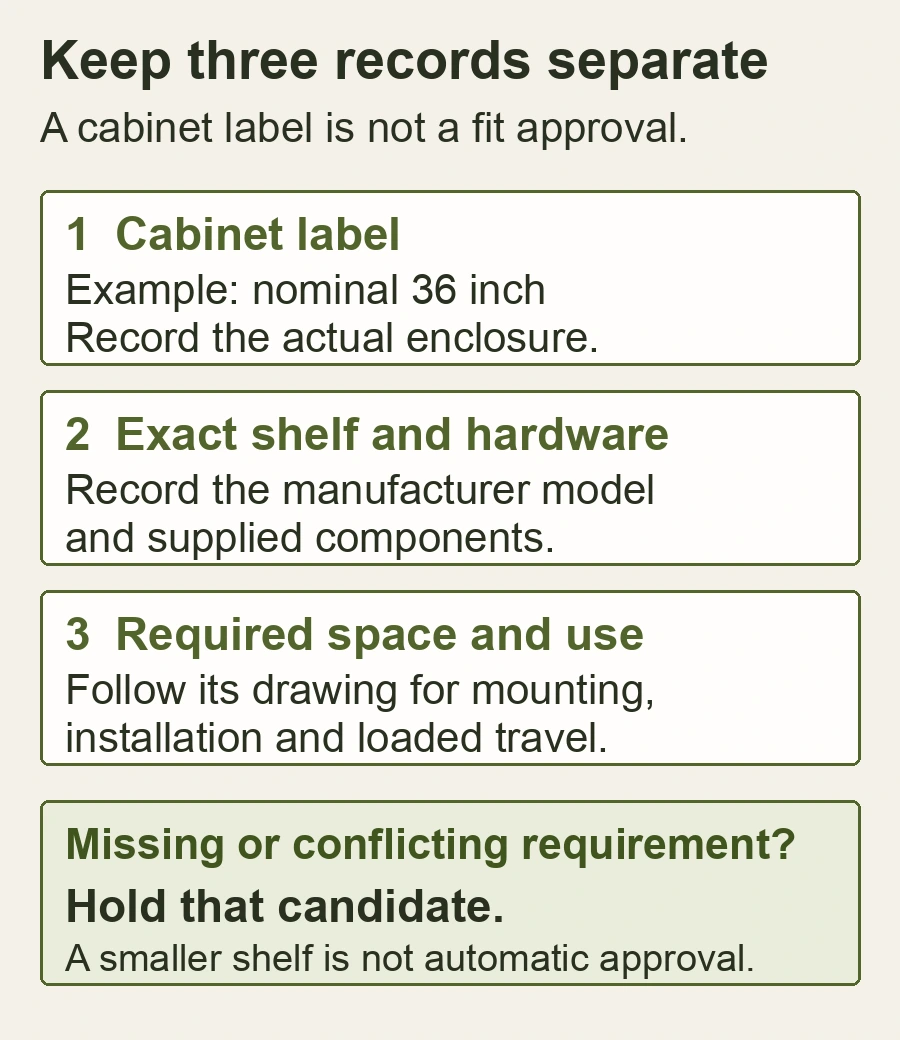
Choose a 36 inch corner cabinet lazy Susan by checking the complete storage system, not by matching two advertised numbers. Keep the cabinet label, shelf dimensions and model-specific required space as separate records. The right candidate must suit the doors, mounting, installation route, loaded movement and intended contents. A freestanding spinning tray is not an interchangeable replacement for installed corner-cabinet hardware.
Key takeawaysKeep the cabinet label, product size and required space separate.
Use five checks: cabinet and door type; exact model requirements; installation route; operating and retrieval space; permitted support and loading. If a critical requirement is unresolved, hold that candidate. A smaller tray, a different shape or a pullout needs its own checks rather than automatic approval when another option fails.
36 inch corner cabinet lazy Susan: the short answer
Door behavior helps identify a system to investigate. Kidney-shaped models commonly use separate hinged doors; a door-mounted pie-cut assembly has a different attachment arrangement. A diagonal or blind-corner cabinet raises different geometry questions. Use these descriptions to find the right instructions, not to approve every product bearing the same shape name.
Check the enclosure at every intended shelf height, including the frame, hinges, supports, pipes and other obstructions. A paper or cardboard outline can flag a collision, but it does not establish mounting strength, loaded clearance or a permitted installation method. Never force a mechanism or alter a door to make a template pass.
First identify the cabinet you actually have
Open both doors and watch what happens. Do not start with the product name on an old invoice. Start with the moving parts in front of you.
- Separate hinged doors: record how they open and where hinges project; compare products intended for that actual arrangement.
- Doors attached to the mechanism: identify the existing assembly, attachment and adjustment requirements before considering a replacement.
- Diagonal opening: record the full enclosure and door movement; a full-circle or D-shaped label alone does not establish compatibility.
- Blind corner: record the narrow opening and sideways storage area. A half-moon or pullout is a different candidate, not an automatic solution.
The manufacturer’s Rev-A-Shelf 6472-series page asks users to distinguish face-frame from frameless construction and measure width, depth and height while accounting for obstructions. The page did not expose a selected variant’s complete specifications during this review. Its general measuring guidance is not an exact-model fit approval.

How to measure a 36 inch corner cabinet
Remove loose contents only where this can be done safely, without dismantling an installed mechanism. Record measurements where each intended part and its contents must travel. Keep an unresolved obstruction or inaccessible measurement in the record rather than filling it by assumption.
- Record both usable interior directions at the intended shelf heights; label where each measurement was taken.
- Record frame, hinge and other projections separately from the clear enclosure measurements.
- Match each labelled requirement in the exact model’s drawing; the smaller of two spans is not a complete sizing rule.
- Measure clear height from the cabinet floor to the underside of the countertop or any fixed rail.
- Measure the narrowest clear door opening after accounting for hinges and the face frame.
- Trace the door sweep and check where knobs, latches, and hinge arms enter the cabinet.
Do not subtract a universal allowance from 36 inches or divide available space by a tray diameter. A shelf’s advertised diameter is not its complete mounting envelope, the required cabinet space or the path its rigid parts need during installation. Keep every required dimension with the drawing that defines it.
Check the installation route, not just the opening
If useful, compare a non-load-bearing outline of the proposed parts with the enclosure and opening, without reaching into a moving mechanism. It can reveal an obvious obstruction only. A paper shape that enters or rotates does not prove the rigid product can be assembled, mounted, loaded or used there.
A cabinet can have room for an assembled tray while its door opening is too small for installation. Before buying, ask whether the chosen model can be installed with the countertop already in place and whether every rigid part can pass through the opening. Follow its assembly instructions; do not assume a split or flexible tray is available.
Kidney vs pie cut vs full circle
Kidney shape: check models for independent doors
For a kidney-shaped candidate, compare the actual cutout, mounting positions, shelf movement and door clearance in its instructions. Do not assume that the cutout clears every right-angle opening or that installation and adjustment will be more forgiving than another system.
Compare the kidney model’s required interior dimensions with the measurements at every intended shelf height. If hinges or the face frame obstruct its sweep, a different size or organizer may be needed. Do not assume that stepping down to the next advertised diameter resolves the shaft or installation requirements.
Pie cut: check door attachment and movement
The retailer listing for Rev-A-Shelf 6942-28-11-52 describes door attachment as part of that pie-cut system. That is a reason to check the actual door and assembly requirements, not a universal conversion recipe or a recommendation for every nominal 36-inch cabinet.
Identify the installed model and obtain compatible replacement instructions before changing a door-mounted assembly. Similar shape or diameter does not establish interchangeability. If a conversion is proposed, obtain confirmation for that complete cabinet, door and hardware arrangement rather than transferring attachments by appearance.
Full circle and D shape: compare the complete outline
Full-circle and D-shaped designs have different outlines, but neither name proves a clear operating path or greater useful capacity. Compare the exact enclosure, mounting and loaded movement. A continuous circle on paper does not show whether the intended user can retrieve the contents.
For a blind corner, evaluate the actual system designed for that enclosure. A half-moon or pullout may bring contents toward an opening, but its mounting, support, loaded travel and retrieval requirements still need confirmation. Do not buy one merely because a standard rotating shelf does not fit.
Material and shelf details that matter daily
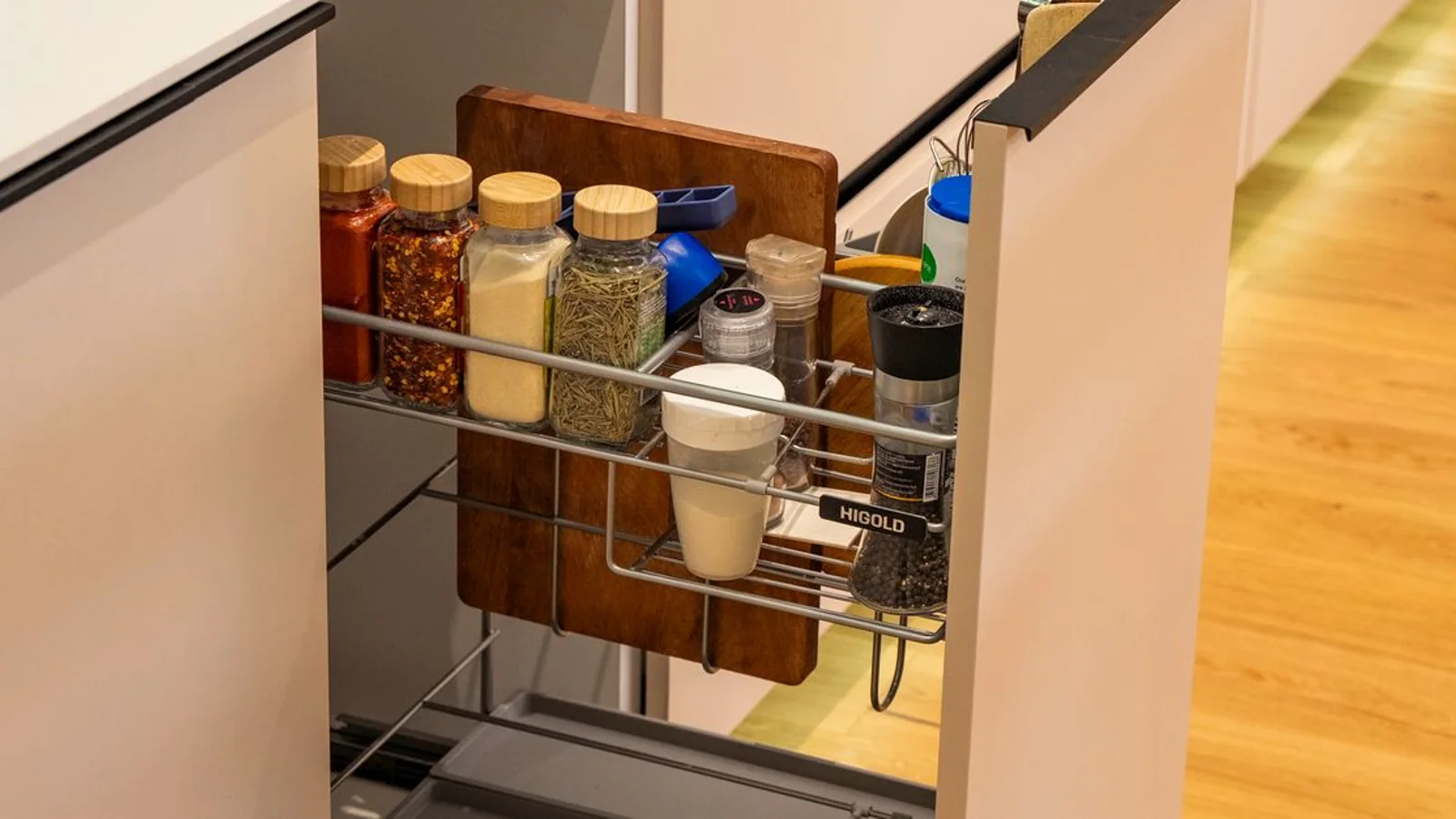
Compare daily-use features alongside the installation and space requirements.
- Rim and contents: check whether the actual containers remain within the permitted arrangement. A raised rim does not guarantee that bottles cannot slide, tip or collide.
- Linked or independent movement: verify how the exact shelves and doors move together, rather than inferring it from the shelf count.
- Adjustable shaft: must include your measured clear height. Use the exact model’s stated shaft and mounting requirements; there is no universal height range to assume.
- Load definition: confirm whether a stated limit applies per shelf, to the assembly or to a specified arrangement. The supporting cabinet and mounting must also meet the instructions.
- Replacement parts: confirm exact part compatibility and current support before relying on repairability; similar-looking hubs or shelves are not necessarily interchangeable.
Compare the actual material, finish and care instructions. Polymer does not mean every part can be washed, wood does not establish a stronger rim, and wire does not establish permitted loads or container stability. Record any required liner or accessory as part of the exact system, not an improvised addition.
What should go on each shelf?
Plan the actual contents within the system’s permitted load and placement requirements, including bins and other added organizers. Check the entire loaded movement and retrieval route. Do not assume that putting a heavy item low or near the shaft approves its loading or resolves unexpected movement.
- Each shelf: record the actual items and any organizer, their loaded size and weight, and the model’s applicable limits.
- Container position: include the tallest and widest projections through the complete movement, not only the empty tray outline.
- Cutout and opening: keep the specified operating path clear; frequent use does not make an obstructing item suitable.
- Placement: follow the model’s instructions; a shorter distance to the center post is not a universal loading allowance.
Group small items only where the complete loaded container arrangement remains permitted and accessible. Sort the contents before deciding whether new organizers are needed. Our pantry container buying checklist covers a different product choice. For plastic food-container lids, see organizing lids in a deep drawer rather than assuming the corner mechanism is the best home for them.

When a lazy Susan is not the best answer
If the cabinet or installed mechanism is damaged, shifts, scrapes or no longer works as instructed, stop using the affected arrangement and obtain the appropriate manufacturer or qualified assessment. Do not continue loading it to find a limit, improvise a support or treat a smaller load as proof that the cause is resolved.
Consider the intended user’s reach and ability to control and retrieve the actual contents. A pullout also needs a suitable installation and full loaded travel. Hidden volume or an unobstructed empty opening does not by itself establish usable storage.
Keeping existing fixed shelves may be reasonable when their condition, permitted loads and access suit the items. A handled tray or basket adds its own weight and retrieval requirements; it is not automatically a more secure way to move an appliance or a group of heavy containers.
When a model listing disagrees with itself
The retailer page for 6942-28-11-52 lists a 26–31-inch height in its specifications and a 26–32-inch internal-cabinet range in its description. These are not interchangeable approvals. Do not choose the larger value, average them or invent an extra clearance allowance. Confirm the correct current drawing and the components supplied for the exact manufacturer model before using either range.
The listing also separates its retailer SKU from the manufacturer’s part number. Record both where useful, but do not treat a retailer identifier or a similar series name as proof of compatible parts. This example explains a reason to hold a candidate; it does not recommend that unit for your cabinet.
Record the exact model before ordering
| Check | What to record |
|---|---|
| Model and instructions | Manufacturer, model/SKU, drawing version or date, and source link |
| Cabinet and doors | Corner geometry; separate or attached doors; obstructions at every intended shelf height |
| Required space | Compare every labelled required dimension with your own measurements |
| Installation route | Whether each rigid part fits through the opening with the countertop in place |
| Mounting and load | Specified shaft range, fixing points, applicable shelf/system limits and any placement restrictions |
| Unresolved detail | Write it down and get an answer before purchase; do not fill a missing value by guessing |
This is a decision record, not a verified model ranking or an installation guide. Product dimensions and conflicting retailer descriptions are not a substitute for the current instructions supplied for the exact model and components. No cabinet installation, load or durability test was performed for this guide.
Frequently asked questions
Will a 32 inch lazy Susan fit every 36 inch corner cabinet?
No. A nominal 36 inch cabinet label does not establish the usable interior, door sweep, mounting points or installation opening. Check the exact model’s drawing and assembly route; even a template that rotates is not a complete installation check.
Is a kidney or pie cut lazy Susan better?
Neither is universally better. Door attachment and movement help identify candidates, but the exact cabinet, hardware and model instructions must agree. A kidney or pie-cut shape name alone does not establish fit, conversion compatibility or permitted loading.
Can I install a 32 inch shelf after the countertop is in place?
Sometimes. The interior may hold it even when the door opening cannot admit the assembled shelf. Confirm that the chosen model is designed for retrofit installation or that its pieces can pass through the opening before assembly.
How many shelves should I choose?
Choose from the exact system’s permitted configuration and the actual items, loaded movement and retrieval space. Two shelves are not a universal default, and adding or removing a tier may change assembly requirements. Do not divide clear height by a desired shelf count to approve an unverified arrangement.
Sources
Sources checked November 1, 2026. Manufacturer measuring advice and retailer-listed features are identified separately. The dynamic manufacturer page did not provide a selected variant’s full specification in the material retrieved; the retailer’s conflicting height descriptions remain unresolved. No dimensional model recommendation or cabinet conversion is approved by this guide.
- Rev-A-Shelf 6472 series: general cabinet-construction, width, depth, height and obstruction checks; not a selected model’s complete drawing.
- Woodworker’s Hardware: 6472-32-11-52 listing: independently hinged doors and separately rotating shelves described by a retailer. Not an installation document verified here.
- Woodworker Express: 6942-28-11-52 listing: door-mounted description and the unresolved 26–31 versus 26–32-inch height wording. No price or availability comparison is made.
Written by the SetsQuick Team. First published · Last updated .
© SetsQuick. This article and its images may not be copied or republished without permission. To report reuse, see our DMCA page.
Was this guide helpful?
Save it for later or send it to someone