
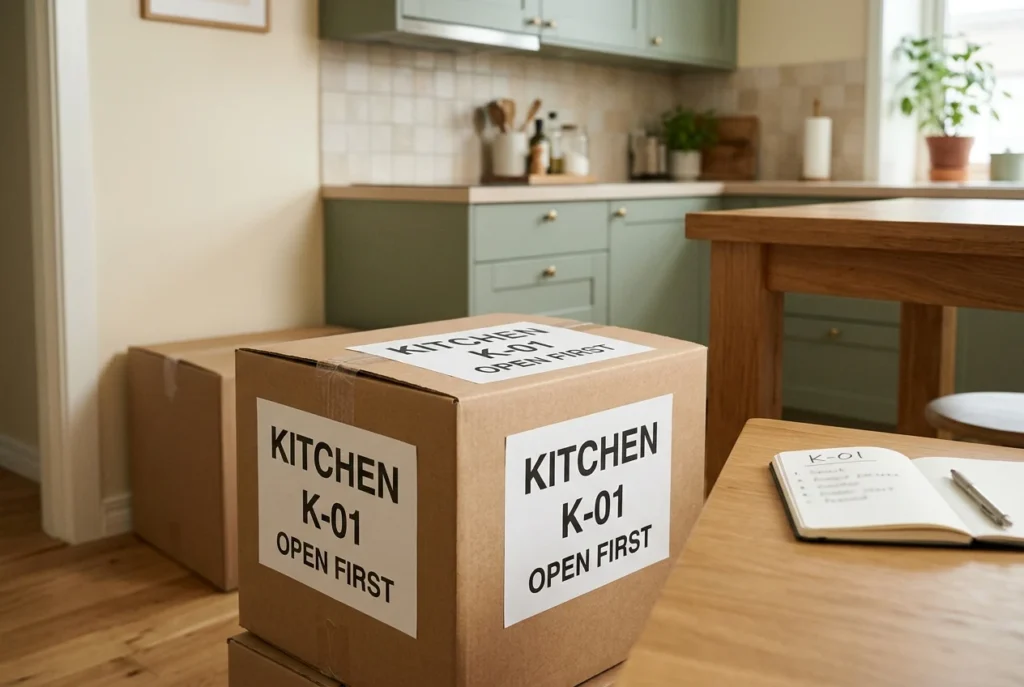
To label moving boxes for a small apartment, give each box a unique ID, a destination zone, and an unpacking priority. Write those details on the top and two sides, then keep a separate inventory that connects the ID to the contents. In a studio, “bedroom” and “living room” may be the same room; a destination such as “sleeping area—bedside” tells the person carrying the box what to do next.
Cover image: AI-generated fictional label example, not a real move or a packing test.
The useful label is a delivery instruction, not a complete inventory. Put the destination, box ID, and opening priority on the outside. Keep detailed contents and sensitive information in your own record. Color can help, but the written words must still make sense without it.
This guide adapts a moving company’s labeling advice into an illustrative zone-and-priority worksheet. The examples are fictional, not a record of a real move.
How should you label moving boxes for delivery?
Use the first three fields on every box. A brief, non-sensitive contents group is optional; keep detailed contents in your private inventory:
- Destination: the room or practical zone in the new apartment, not necessarily the room the items came from.
- Box ID: a unique code such as K-01 that appears in your inventory.
- Opening priority: OPEN FIRST, NEXT, or LATER, defined by what you actually need after arriving.
- Optional contents group: a short, non-sensitive description such as “everyday dishes.”
Ace Relocation recommends room-and-contents labels, numbered boxes with an inventory, priority markings, and labeling more than one side. Its packing and labeling guide is the basis for those general practices. The destination-zone system below adapts them to an apartment with shared spaces. Unlike Ace’s room-and-contents approach, it makes a brief contents group optional; it does not guarantee that belongings will not be lost or damaged.
What can a label with an optional contents line look like?
Destination: Kitchen
Box ID: K-01
Contents: Everyday dishes
Open: FIRST
If you write a handling instruction such as FRAGILE, keep it separate and readable. A label does not replace appropriate packing, a suitable box, or your mover’s instructions.
How do you label boxes when a studio has no separate rooms?
Choose destinations that someone can identify without knowing how you plan to decorate. “Bedside,” “desk area,” and “kitchen cupboards” are more useful than “my things.” Do not invent a separate color or code for every shelf.
Start with the places where boxes can actually be delivered without blocking access. Check the building’s moving arrangements and your mover’s requirements; a labeling plan is not permission to stage boxes in corridors, stairways, or shared exits.
Which zones are worth separating?
- Kitchen: dishes and cooking items that belong near the cupboards.
- Sleeping area: bedding and bedside items.
- Bathroom: the items you want taken directly to the bathroom storage area.
- Desk area: work supplies that belong at the desk.
- Storage destination: a specific approved place for items you will not unpack immediately.
These are examples, not a required five-zone system. A one-bedroom apartment might need ordinary room names; a studio might need only three zones. If a destination does not yet exist, write an agreed temporary location instead of sending every uncertain box to the center of the room.
How do you decide which boxes to open first?
Work backward from your first evening and the next necessary activity. Ask: “What will I need before I can reasonably unpack the rest?” Use that answer rather than marking every box OPEN FIRST.
- FIRST: needed for a specific early task, such as making the bed or eating with the dishes you already own.
- NEXT: needed after the basics are usable.
- LATER: can remain boxed while you set up the apartment.
Keep items you must personally control—such as keys and essential documents—separate from the ordinary moving-box workflow. Ask your mover what it will not transport and what you should carry yourself; this guide does not provide a universal transport list for medicines, batteries, chemicals, or valuables.
Priority refers to opening a box, not automatically to where it goes in a truck. Coordinate loading, access, and delivery order with the mover rather than assuming that a label controls them.
What inventory should you keep off the box?
Use a paper list or a simple note you can access during the move. Match each record to exactly one physical box. Keep the outside description broad enough that it does not advertise sensitive contents.
What would three example inventory entries look like?
- K-01 — Kitchen. Everyday plates and cups. Open FIRST. Arrival: not yet checked.
- S-01 — Sleeping area. Bedding for the first night. Open FIRST. Arrival: not yet checked.
- D-01 — Desk area. Notebooks and desk supplies. Open NEXT. Arrival: not yet checked.
Copy this blank inventory entry:
- Box ID: __________
- Destination: __________
- Private contents: __________
- Opening priority: __________
- Arrival checked by / when: __________
- Issue or change to record: __________
Fictional example: these entries demonstrate the record, not recommended box sizes, weights, or packing combinations. Add your own contents and follow the packing requirements for them.
What happens if you reopen a packed box?
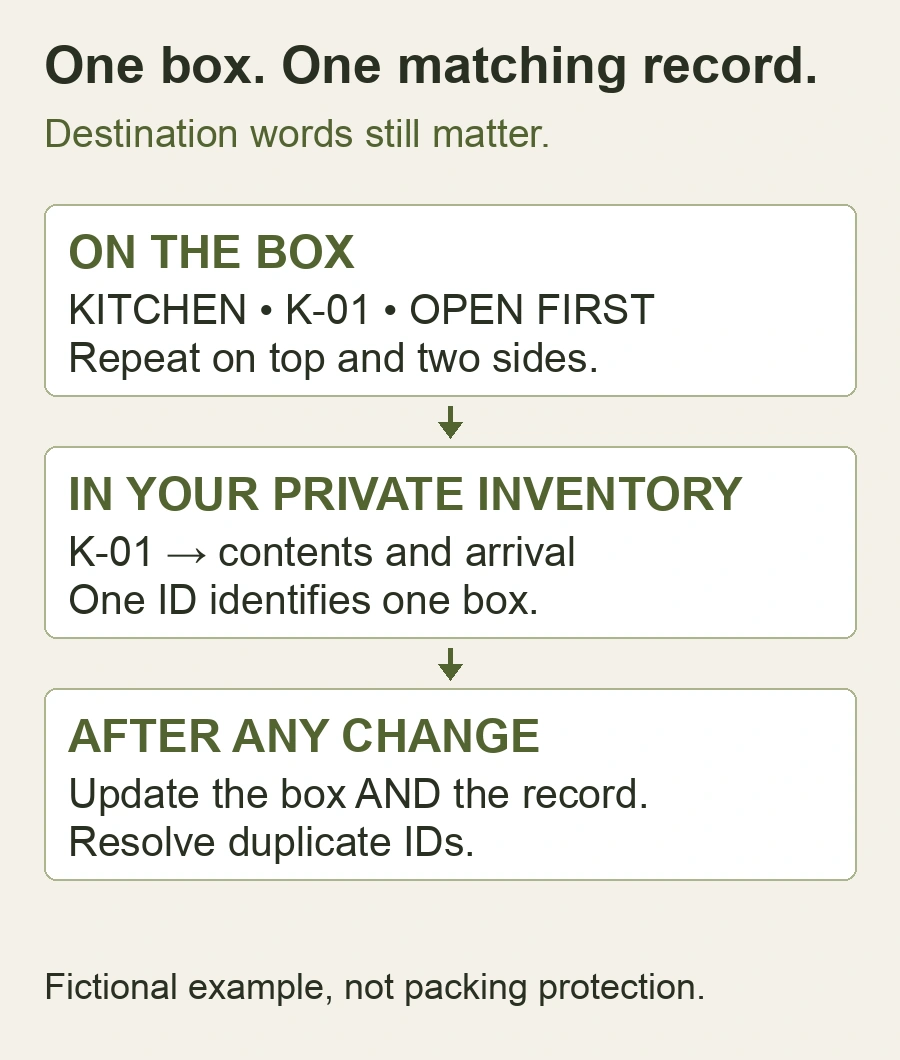
Update the inventory before resealing it. If the destination or priority changed, replace the old information on every labeled side. Keep the same box ID so it still matches the inventory, even if a prefix such as K- no longer matches the new destination; follow the written destination. Avoid giving one box two IDs: the person receiving it should not have to guess which one is current.
When reusing cartons, remove or clearly cover obsolete destination labels and barcodes that no longer apply. Do not conceal markings the mover requires you to retain. For sensitive details in a shared digital inventory, give access only to the people who need it; a QR code is optional, not a necessary part of this system.
How do you keep box IDs unique when several people pack?
Agree on who assigns IDs before sealing boxes. One option is a single shared list: each person claims the next unused ID before writing it on a box. Another is a separate prefix for each packer, such as A-K-01 and B-K-01. These are planning choices, not a requirement from the mover.
Whichever method you choose, write the full ID on both the box and its inventory entry. Before moving day, scan the list for repeated codes. If you find a duplicate, rename one box and correct every labeled side and the matching record. Do not solve the problem by leaving two different boxes under one inventory entry.
Do you need colored labels or a label maker?
No. Start with a readable marker and labels or tape suitable for the box surface. Try your lettering on the actual material before preparing the whole batch. If color helps, pair it with a written zone name so someone using a black-and-white copy of the inventory can still follow the system.
A label maker may be convenient for repeat labels, but it is not a prerequisite. If you already need one for longer-term organization, our home label-maker guide explains how to choose by tape type and intended use. Do not buy a machine solely because a moving checklist mentions labels.
How do you check the system before moving day?
- Read a label without the inventory. Can another person identify the destination and opening priority?
- Read it from a different side. Check the top and two sides while the box is still easy to handle; do not create an unstable stack just to test visibility.
- Find the ID in your record. There should be one matching entry, not two competing descriptions.
- Walk through the destination names. Make sure everyone helping understands “desk area” or “sleeping area.”
- Check arrivals by ID. Mark a box received only after you have actually seen it. Record an issue and follow your mover’s reporting process rather than assuming an unchecked box is missing.
What usually makes moving labels stop working?
- Everything says “miscellaneous.” Replace it with a destination, box ID, and opening priority; add a brief contents group only if it helps.
- Every box says OPEN FIRST. Name the actual task that makes each box urgent; move the rest to NEXT or LATER.
- Color is the only instruction. Add words and an ID.
- The inventory was never updated. Correct it when contents change, not after delivery.
- The label promises protection. FRAGILE does not supply cushioning or make a carton suitable for its contents.
Frequently asked questions
Should I number boxes by room or across the whole move?
Either can work if every ID is unique. K-01 and S-01 can identify an initial zone, but the written destination is the current instruction if the box moves elsewhere. A single sequence such as 001, 002, and 003 is simpler if room assignments may change. Pick one approach and use the same IDs in the inventory.
Where should I put moving-box labels?
Ace Relocation recommends the top and at least two sides. Put the same destination, ID, and opening priority on each labeled face. Choose a position that stays readable after sealing and follow any additional labeling requirements from your mover.
Should I list valuable items on the outside?
Keep outside descriptions general and record sensitive details privately. Coordinate the handling of valuables and documents with your mover rather than assuming that ordinary boxes are appropriate for them.
Can I use this system without buying anything?
Yes, if the marking supplies and paper you already have produce readable labels that stay attached to your boxes. The essential parts are consistent destination names, unique IDs, and an up-to-date record—not a particular brand of organizer.
What should you do next?
Your next step: label one box and create its matching inventory entry. Ask someone to tell you where it should go and when to open it. If either answer is unclear, fix the label before copying the system to the rest of the move.
Written by the SetsQuick Team. First published .
© SetsQuick. This article and its images may not be copied or republished without permission. To report reuse, see our DMCA page.
Was this guide helpful?
Save it for later or send it to someone