
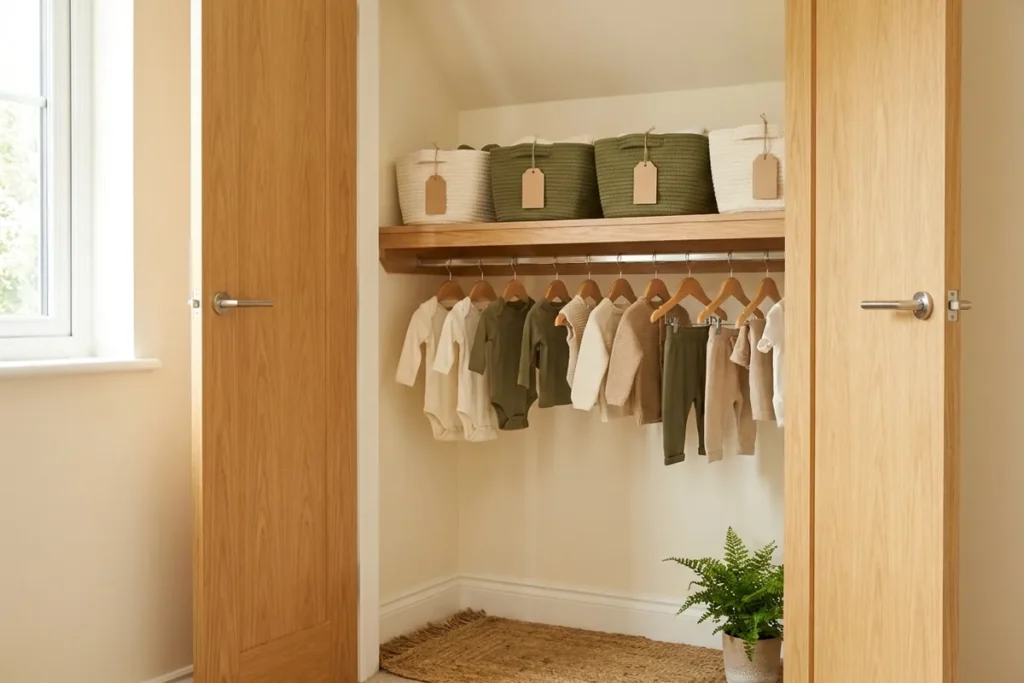
A baby’s closet can fill quickly as clothing and supplies change. Smart nursery closet organization gives every size its own location and keeps daily clothes easy for the caregiver to reach. Put the baby safely down before lifting bins, reaching overhead or using a step stool.
A useful nursery closet keeps clothes that fit within easy reach and makes the next size easy to find.
Key takeawaysFour decisions before you touch the closet
- Sort clothing into useful size groups, remembering that labels and fit vary by brand and garment.
- Choose which clothes to hang or fold based on space, fabric and your routine.
- Consider the space under the rod only if storage fits without creating a tip-over or climbing hazard.
- Set one rotation cue: decide now how you will recognize that it is time to size up.
Baby clothes are often short enough to leave some room beneath a hanging rod. Short garments can leave usable room below the rod, depending on the closet’s actual height and layout.
Babies grow at different rates, and sizing varies between brands. A flexible system makes it easier to move individual garments as their fit changes.
So the real goal is not a beautiful closet for a photograph. The goal is a closet that still functions late at night, when you need clean pajamas in the dark and genuinely cannot afford to go digging.
Why does a nursery closet fill up so fast?
Three separate streams pour into a nursery closet at once, and they rarely arrive in any useful order. Gifts appear in sizes you will not need for a year. Hand-me-downs arrive in mixed bags without labels. Daily clothes keep cycling through the wash every few days.
Left unmanaged, these three streams blend into a single pile. You end up with 3-month items sitting beside 18-month items, while the size you actually need hides somewhere in the middle. The closet looks completely full yet feels useless.
The remedy is to treat the closet as three zones instead of one undifferentiated space. Active sizes stay at eye level and within arm’s reach. Sizes arriving soon sit just above or beside that active zone. Sizes that are finished or still distant move into clearly labeled bins.
Once each stream has a dedicated home, the closet stops working against you. New gifts travel straight to the correct bin, hand-me-downs get sorted the moment they arrive, and clean laundry returns to one obvious destination every single time.
How do you set up nursery closet organization?
Put the baby in a safe, supervised place before lifting or rearranging. Clear one section at a time onto a clean surface away from the baby’s sleep space and walking paths.
Work the setup in a fixed order, so that nothing important gets skipped along the way. This sequence follows the SetsQuick method, Sort, Edit, Type, Store, adapted for a closet that changes as the baby grows.
Setup order: Sort clothing by a useful grouping, edit what the family no longer needs, separate the items you keep by type, and store each group in an accessible place.
Sorting by size is one useful starting point; type and season may also matter. Editing follows while every item is already in your hands and easy to judge. Only afterward do you decide what hangs and what folds, and finally where each group will live.
Keep those steps in the same order on every pass through the closet. A fixed order means noticeably less thinking later, and it prevents the whole setup from stalling halfway through when the baby suddenly wakes.
- Sort by approximate size, keeping in mind that a garment’s actual fit can differ from its label.
- Edit each stack: separate outgrown or unneeded items for appropriate donation, textile recycling, disposal or keepsakes; donate only clean, usable items.
- Type within the active size: divide the current size into hanging items and folding items.
- Store by zone: hang or fold items as practical and label bins with the size or range they contain.
Hang or fold clothes according to the garment and the space available. Either approach can work when the current items are easy to reach.
Label each bin with its contents or size range on the front so it can be identified without lifting it. A label you can read without lifting anything is a label you will still rely on when both hands are busy and the lights are low.
Where does the empty space under the rod go?
Space beneath short clothes may accommodate storage, but dimensions, access and safety vary by closet.
A compact dresser or cube shelf may fit beneath short clothes, provided it is anchored as its manufacturer requires and does not create climbing access. Stack bins only if designed and rated for that configuration. Put the baby in a safe location before lifting or repositioning storage.
Use the space safely: Check the closet’s dimensions and load limits. Anchor furniture as instructed, avoid unstable stacks and climbing access, and keep heavy items low.
Keep the lowest level simple, but do not treat soft bins as a safety guarantee: they can still tip, obstruct access or create climbing hazards. Keep small parts, cords and hazardous supplies inaccessible, and follow the storage manufacturer’s instructions for placement, stacking and anchoring. See CPSC Anchor It guidance for furniture tip-over prevention.
Use a high shelf only within its rated load and for light, infrequently handled items that can be retrieved safely. Keep heavy items low and away from children’s access.
That vertical split does the heavy lifting of nursery closet organization in a tight closet. Daily clothes live exactly where your hands already travel, while everything else waits patiently above and below until its turn finally arrives.
How do you rotate sizes without a full redo?
Rotation is truly the whole game in a nursery, and it collapses the moment it starts depending on memory. The trick is to establish a cue in advance, so the closet signals when to move rather than leaving you to track it manually.
A dependable cue is physical. Check individual garments for comfortable fit as the baby grows. Sizes differ between brands, and items may need to move at different times; the label and calendar are only guides.
Once the cue appears, the actual swap goes quickly. Move outgrown garments into the done bin and bring suitable next-size items into reach. Put the baby in a safe location before lifting bins or reaching overhead.
Rotation: Keep clothes that fit within easy reach, label the next sizes, and collect outgrown items separately. Sizes and fit vary, so move individual garments when needed rather than rotating everything at once.
Label a bin for every stage as you proceed, so clothes never sit loose on a shelf. When the done bin is full, decide whether to keep, donate, recycle or discard its contents as appropriate.
Repeat that short swap consistently and reliable nursery closet organization stops feeling like a project. It becomes a quick reset you perform a handful of times each year, with every pass keeping the active zone honest.
What breaks nursery closet organization?
One common problem is a mixed pile in which sizes are hard to find. The earliest sign is obvious, since you start pulling two or three garments before finding one that fits. Fix it by labeling bins with clear sizes or ranges and checking fit when needed.
Another problem is placing frequently used clothes out of easy reach. If you find yourself reaching up on tiptoe for daily clothes, the active size is clearly in the wrong zone. Move it to a convenient location that does not create a climbing hazard.
A third failure is the crowded closet that still feels empty of useful clothes. That usually means the done bin was never emptied, so outgrown sizes crowd out the active ones. A quick edit of anything stained or small clears it fast.
Dependable systems endure because they are tested against a real baby and a real laundry cycle, never a photo. Sort by size, claim the space under the rod, and establish a rotation cue you will genuinely notice in daily life.
For more tight-space systems, browse the small space organizing guides. You can also run the free reset checklist before you rebuild the closet from scratch.
What should a nursery closet hold besides clothes?
A nursery closet rarely holds clothing alone. In most small homes it also stores diaper backups, extra bedding, blankets, keepsakes, and baby gear that has no other home. Planning for those items up front keeps them from crowding the clothes you reach for every day.
Start with diaper and wipe backups, since they are the bulkiest supplies. Keep one open pack at the changing station and store the rest on a low closet shelf or in a floor bin. Buying one size ahead is fine, but stock more than two packs only if you have the room.
Store spare fitted crib sheets in a labeled drawer or fabric bag outside the sleep space. Blankets and other stored linens must remain outside the crib; CPSC recommends a bare sleep space with only a fitted sheet. Keep heavy backup bins low and use high shelves only within their rated capacity.
Keepsakes need a separate, clearly labeled box. Hospital hats, first outfits, and cards are easy to lose among everyday clothes. Give them one lidded box on the top shelf, and only add an item when you are sure you want to keep it for years.
Store baby gear according to its manufacturer’s instructions. Keep heavy items low and secure so they cannot fall or create climbing access; keep straps and cords out of children’s reach.
Good nursery closet organization treats each of these groups as its own zone. When clothes, supplies, bedding, keepsakes, and gear each have a set spot, the closet stays calm even as the baby collects more things.
Label every zone on the shelf edge or the bin front, not only on the lid. Labels on the side stay visible when bins are stacked, which matters at night when you are tired and looking for a clean sheet in the dark.
Review the closet zones once a month as well. Supplies change fast in the first year, and a zone that worked for diapers in size 1 may need more room when the packs get bigger.
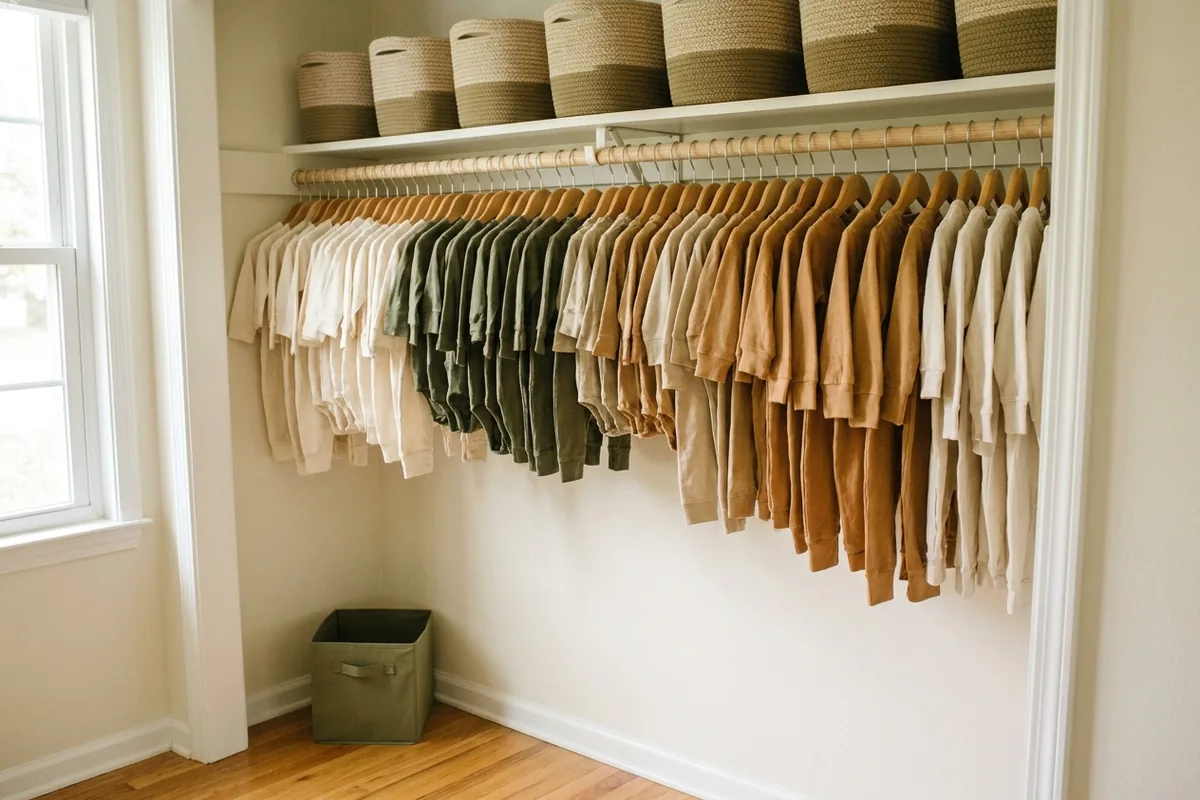
Labels: Use secure, readable labels on the front of containers. Keep loose ties, cords and small detachable parts out of a child’s reach.
Frequently asked questions
How should you organize a small nursery closet?
Sort garments by size, keep daily clothes within easy reach, and store other sizes in labeled bins. Use the space beneath short clothes only for stable, appropriately anchored furniture or manufacturer-approved bin configurations, not improvised stacks.
How do you store baby clothes by size in a closet?
Use labeled bins or sections for sizes or size ranges. Keep clothes that fit within safe reach and place upcoming sizes where the caregiver can retrieve them safely. Send outgrown sizes to a done bin outside the daily path, labeled clearly across the front.
When should you move a nursery closet up a size?
Check each garment’s fit as the baby grows. Move outgrown items individually and bring the next suitable sizes forward; labels and timing differ by brand and child.
What should go on the high closet shelf in a nursery?
Reserve the high shelf for items you rarely handle, such as the next-season coat, keepsakes, and backup supplies. Use light, secure containers within the shelf’s load limit and retrieve them safely. Keep heavier gear low and prevent climbing access.
What bins work best in a nursery closet?
Choose bins that fit the shelf and the manufacturer’s intended use. Soft-sided bins are not automatically stackable or child-safe. Avoid unstable stacks, keep heavy loads low, anchor furniture as instructed and keep hazardous contents locked and inaccessible.
How often should you reset a nursery closet?
Review the closet when garments no longer fit or the routine changes; timing differs for each child. Each reset goes quickly when bins are already labeled. Between resets, return clean laundry to its zone so the system never drifts far.
Written by the SetsQuick Team. First published · Last updated .
© SetsQuick. This article and its images may not be copied or republished without permission. To report reuse, see our DMCA page.
Was this guide helpful?
Save it for later or send it to someone