
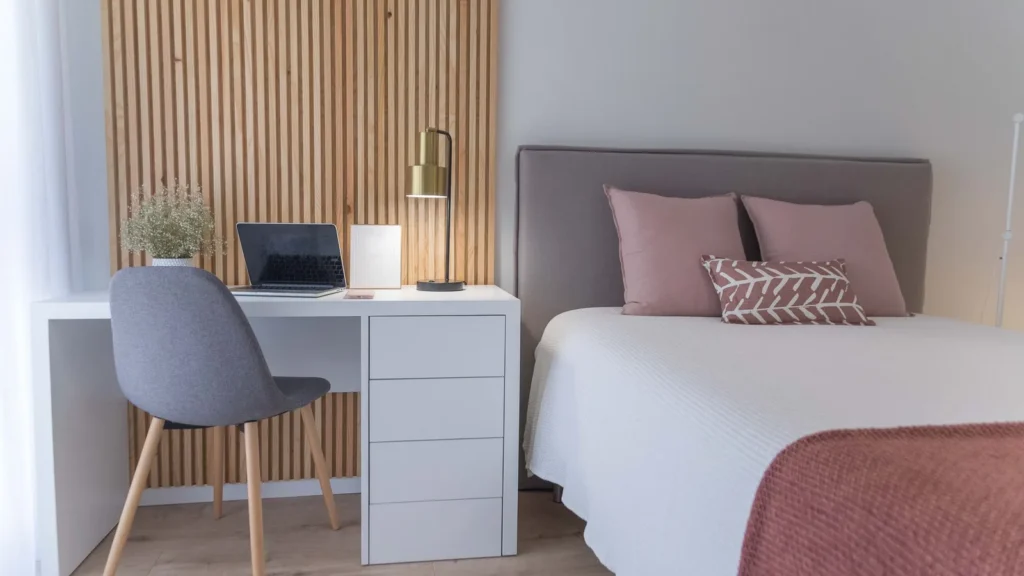
A bedroom corner can hold a workspace while leaving the rest of the room usable. These small home office ideas for a bedroom corner start with the full work-and-movement footprint, then offer an optional closing routine. The aim is a usable room, not a promise of better sleep or productivity.
A useful layout must work while you are seated, when you stand and when the desk is not in use.
Key takeawaysFour decisions before you buy a desk
- Measure the whole task: desk, chair movement, legroom, doors and required access all matter.
- Try a workable direction: consider glare, privacy, comfortable use and circulation; facing away from the bed is optional.
- Plan power and privacy: suitable cable routes and secure papers come before hiding clutter.
- Choose a safe stopping state: an optional short routine must respect equipment ventilation and household needs.
A bedroom corner may already be part of a walkway, window opening or heater clearance. Before calling it spare space, check the room with the bed and other furniture in their normal positions. A different location may be better if a desk would obstruct essential access.
Work gear may spread onto another surface when the desk is too small, storage is awkward or the next task is unfinished. Those are possibilities to investigate, not proof of poor habits. A short closing routine is one option, not a requirement to hide everything each night.
This guide covers desk shape, chair movement, basic workstation fit, power and cable planning, paper privacy and an adjustable closing routine. It does not assess your wiring, certify a wall-mounted desk or provide medical sleep advice.
Plan for the hours and people who actually use the room. Evening lighting, shared access and the view from the bed may matter, but the layout does not need a seasonal deadline or a shopping trip to begin.
Which small home office ideas work in a bedroom corner?
Consider the task before the desk shape. A straight compact desk may fit one wall; a corner or L-shaped desk may offer more surface but occupy more circulation space. Check both the seated setup and the full chair movement rather than assuming the smallest desktop is best.
A wall-mounted or folding desk is an option only when the exact product, wall and fixings permit the intended load and use. A board and two brackets are not a generic desk specification. Follow installation and anti-tip instructions; ask a suitable installer if support is unclear. If you rent, check the terms and obtain any required permission before drilling.
A secretary or folding desk can reduce visible work gear when the manufacturer permits it to close around the stored contents. Check hinge and pinch hazards, open projections, device ventilation and cable movement. Never force a door or folding panel against a cable or equipment.
Choose a surface that accommodates your work and comfortable posture, not merely a laptop’s footprint. The OSHA desk guidance emphasizes suitable monitor and input-device placement and clear legroom. A setup that forces reaching or twisting is not resolved by a smaller desk or tidier cables.
How do you measure a bedroom corner for a desk?
Measure your own room and intended equipment; a photo cannot establish the fit. Include all door and drawer movements, comfortable working positions and required heater or equipment clearances. Your measurements are planning notes, not an ergonomic or building-code assessment.
The four planning measurements below are a starting checklist, not a complete safety standard. Also check comfortable desk and chair height, screen position, legroom, outlet suitability and exact product instructions. Do not modify desk legs or supports as an improvised fit correction.
Take them with the bed and other furniture in their usual positions, since moving them later changes every number.
Use a tape or laser measure, ask for help if useful, and record the figures in a way that works for you. Consider the seating or mobility equipment you plan to use.
- Corner width: measure along each wall from the corner to the nearest obstacle, such as a window frame, a radiator, a door, or the bed.
- Desk depth: allow suitable screen and input-device placement as well as the surface footprint; check comfortable use and the chair movement behind it.
- Seating and transfers: measure the space needed to approach and use the seat and leave it, including any wheelchair, mobility aid or transfer space. Check that the route behind the seat remains usable in its working position.
- Access routes: check doors, opening windows and movement around the bed with the chair in use and pulled back. Do not obstruct an exit or assume a measured gap meets local requirements.
Record those measurements and compare the complete desk-and-chair arrangement before buying. A narrower desk may help only if the work still fits comfortably. Keep exits and opening doors and windows available, including a clear route to the bedroom window. If it is needed for emergency escape, keep it operable and accessible. If the intended location blocks access, choose another layout rather than squeezing through.
Check the intended power location without opening an outlet or doing electrical work. The CPSC household extension-cord guidance says extension cords are for temporary use and must not run under carpets, through doorways or under furniture. Do not plan a permanent bedroom office around a trailing extension cord. Ask a qualified electrician or landlord about a suitable long-term supply if needed. For electric space heaters, CPSC advises plugging directly into a wall outlet, never a strip or extension cord, keeping at least three feet from bedding, furniture, papers, curtains and other combustibles, and turning the heater off when sleeping. The same CPSC guidance recommends working smoke alarms inside bedrooms.
How do you separate work from sleep in one room?
A visual boundary may help you recognize the work area, but it is a preference to try rather than a sleep or focus treatment.
A rug, screen or shelf can mark a zone only if it remains stable and does not create a trip, tip-over or access hazard. Check the particular product’s instructions, keep cords out of walkways and avoid running them under rugs. A separate boundary is optional; the room may work better without one.
Try a desk direction that suits screen glare, comfortable working position, privacy and circulation. Facing away from the bed is one option, not a rule. Do not sacrifice those practical requirements just to copy a photograph.
Check the actual views from both the chair and the bed. You may prefer a less visible screen, but also consider what another household member or a video call can see. Do not display sensitive work or personal papers where others can read them.
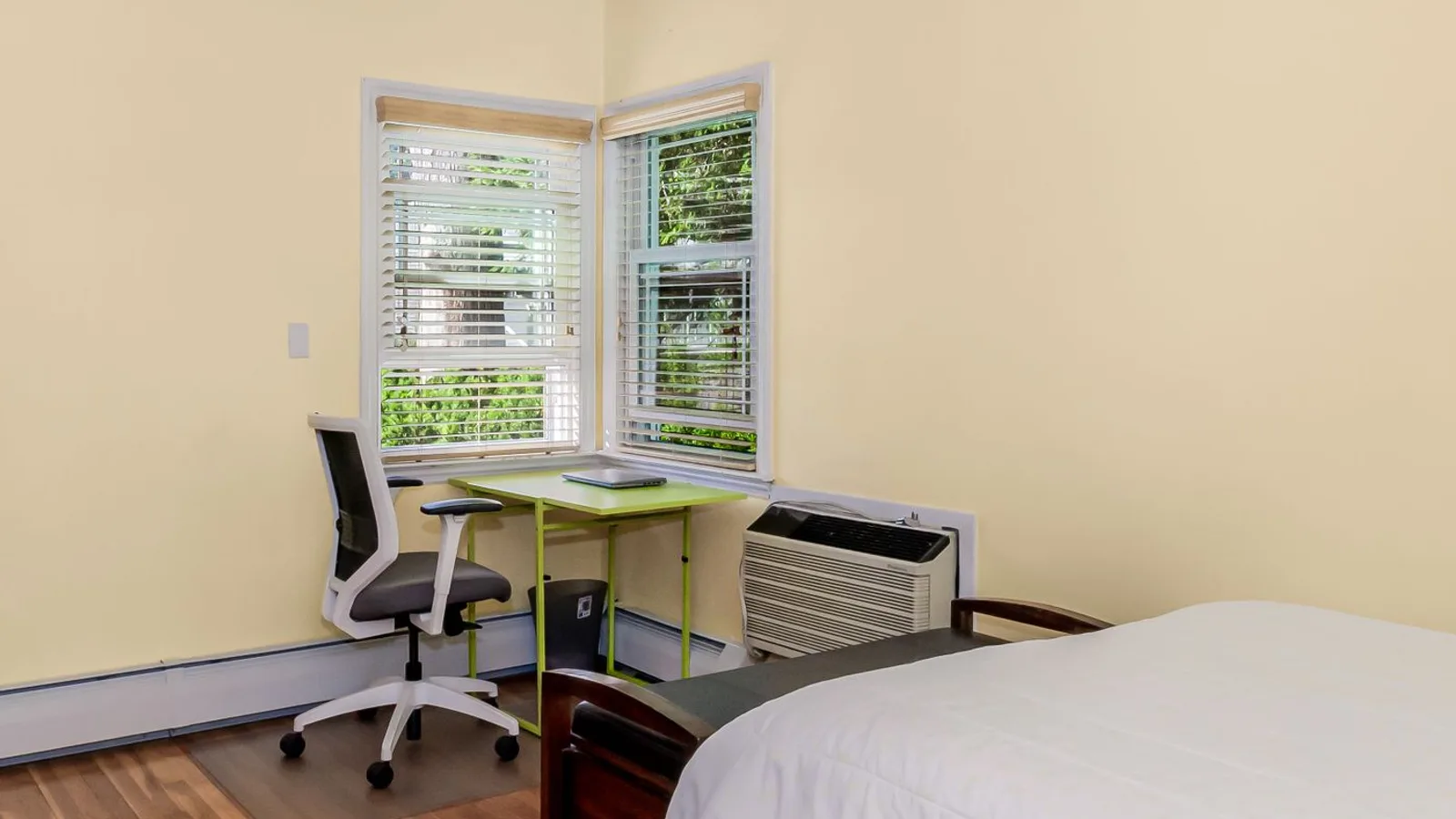
If you use a divider, check stability, any anchoring requirements, heater clearance and access to doors and windows. Do not turn an open shelving unit into a partition without checking its intended use. Keep plants and other objects away from electrical equipment and choose household-appropriate items.
A suitable task lamp can light the work area without requiring every room light to be on. Choose a stable position and follow lamp and bulb instructions, keeping bedding, curtains and other combustible items away. Do not trade away the light needed to move safely through a shared room.
Where should cables and papers go in a bedroom office?
Cable clips can guide a permitted route when they do not damage insulation, pinch leads or restrict necessary ventilation. Use accessories suitable for the cord and intended installation; do not nail, staple, knot or tightly force cords behind furniture.
A power strip is not automatically suitable for under-desk mounting. Follow its exact instructions, permitted loads and mounting method; keep it accessible and ventilated. Check that you can reach the switches and frequently used items comfortably from your working position, without compromising a safe cord route. San José Fire Department guidance advises against overloading and plugging extension cords or power strips into one another. A strip is not a substitute for suitable fixed wiring, and extra sockets do not mean extra circuit capacity.
For paper, choose a small system that preserves privacy and obligations, rather than a rule that every sheet must fit this week’s tray.
Active nonsensitive papers can use a tray if appropriate. Keep confidential material in suitable secure storage and follow employer policies and any retention requirements. Check ownership, deadlines and required records before recycling or shredding; use an appropriate secure disposal method for sensitive documents. Lock your screen when stepping away and follow your employer’s device-security policies.
A drawer may hold papers and unplugged accessories, but it is not automatically secure storage or a charging compartment. Keep the intended legroom clear. Apple’s Mac-laptop temperature guidance calls for a stable ventilated work surface, not bedding or a covered keyboard. Follow your own device and charger instructions; do not hide operating or charging equipment in an ordinary closed drawer or beneath a cloth or basket.
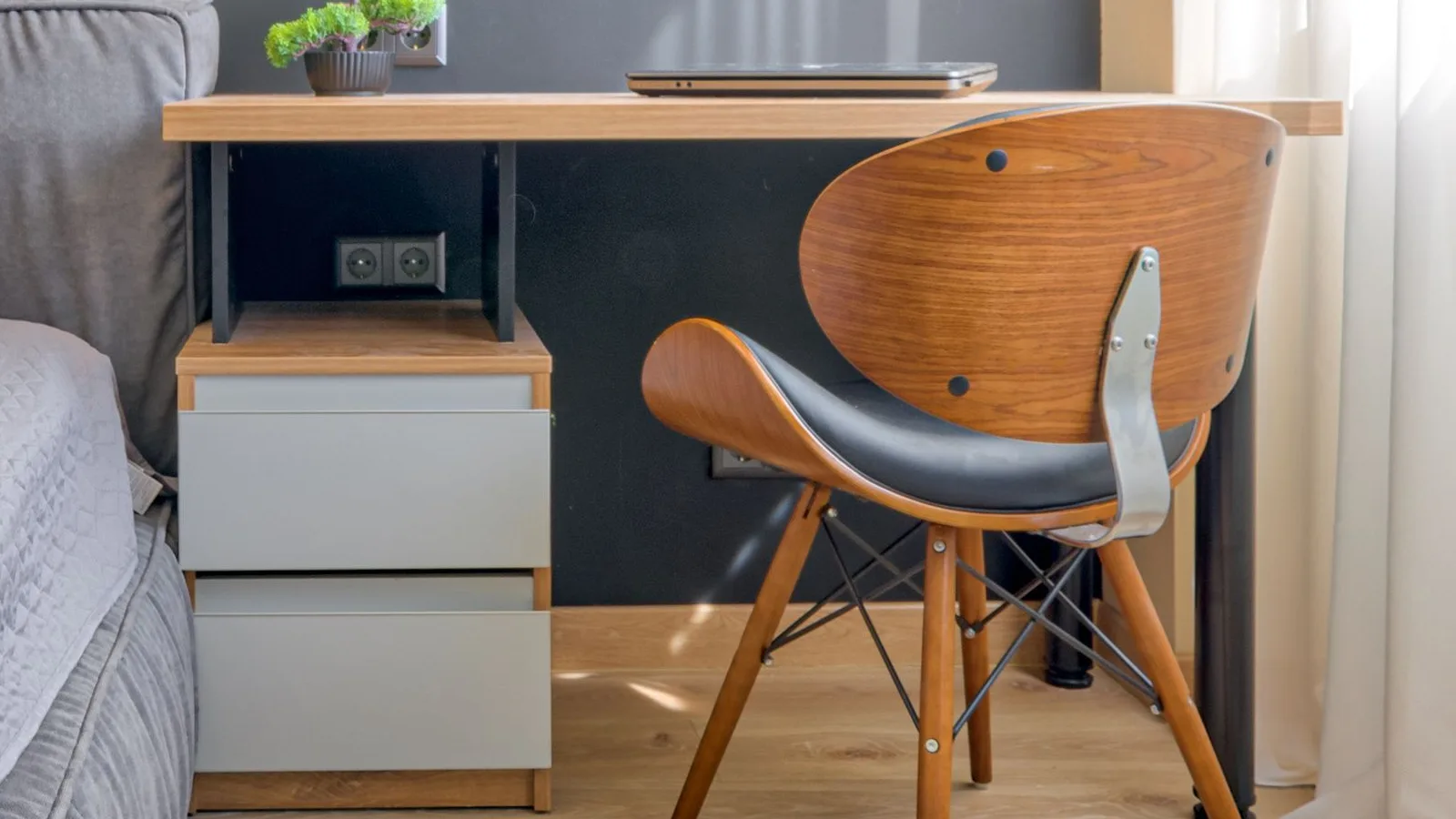
Keep only what the work needs nearby where practical, without imposing a one-week document limit. If papers accumulate, check the pending decision or privacy requirement before moving the pile. A different secure location may be appropriate, but only with the document owner’s or employer’s agreement.
An adjustable evening shutdown
The closing routine below is an optional SetsQuick planning suggestion, not an expert standard. Choose a time box if useful, not as a completion deadline or measure of how the day went. Leave equipment in its required safe state even if that takes longer.
Choose a stopping point that suits the household and the work. Link the routine to the last task if helpful, but change or skip nonessential steps when circumstances differ. Another person’s schedule or needs may require a different arrangement.
- Review active papers, protect sensitive information and check retention or ownership before filing or disposing of anything.
- Save work and follow the device’s shutdown and storage instructions. Keep operating or charging equipment on a suitable ventilated surface, not inside an ordinary closed drawer.
- Disconnect accessories as directed before putting them away; never force cables into a closed compartment.
- Return only items that have a suitable place. Keep ventilation, essential work and secure records intact rather than requiring a perfectly bare surface.
- Where the seating allows, position it so the route stays open; check that the arrangement still meets access and transfer needs.
Close a folding desk or doors only as the exact product instructions allow, with equipment in an appropriate safe storage state and no trapped cords. Do not drape cloth or place a basket over operating or charging devices to hide them. Turn off an unneeded lamp when safe, but keep the light necessary for movement.
A safe stopping state comes before a tidy surface
Protect papers, save work and follow device instructions. Keep operating or charging equipment ventilated. Put away only disconnected accessories suited to the storage, and leave routes clear.
What goes wrong with a bedroom corner office?
If work spreads onto the nightstand or bed, look at the moment an item stopped returning to its intended place. The surface may be full, a drawer may be awkward or a task may still be active. Try one bounded change; the pile is not proof that someone failed to follow a routine.
Check the chair in ordinary use and at night, not only when pushed in for a photo. It must not block an exit or create a difficult route around the bed. A different layout may be needed; a smaller chair is not a good fix if it no longer supports comfortable work.
Review glare, useful task light, nighttime movement and shared-room needs together. A lamp is an option, not a guarantee of rest. Keep lights and cords as their instructions require, away from bedding and other combustible materials.
Check a small home office layout against the actual task, body, room and equipment. Keep required access clear, use suitable power and storage, and treat the closing routine as an adjustable tool rather than a rule.
For more ways to fit storage into tight rooms, browse the small space organizing guides. You can also use the free reset checklist to plan the corner before the desk goes in.
Check both room states
During work: comfortable equipment placement, suitable power and clear access. After work: secure records, appropriate device storage and a usable route around the bed. No cloth over a running or charging laptop.
Frequently asked questions
How do you fit a desk in a bedroom corner?
Measure both walls, desk projection, the intended seated position and full chair movement. Check legroom, equipment placement, door travel, exit routes and power requirements. A compact, corner or wall-mounted desk is suitable only if the complete arrangement meets those needs and its installation instructions.
Which way should a desk face in a bedroom?
Choose the direction that supports comfortable equipment placement, manageable glare, privacy and clear circulation. Facing away from the bed may suit your preference, but there is no universal direction that guarantees better work or sleep.
How do you hide a desk in a bedroom at night?
Use closed storage only where the furniture and equipment instructions allow it. Secure papers appropriately and put away accessories after disconnecting them as directed. Do not enclose or cover a running or charging laptop to make the room look tidy. A stable divider is optional and must not block required access.
How do you manage cables for a bedroom desk?
Follow the exact strip and cable instructions rather than assuming under-desk mounting is permitted. Do not overload, daisy-chain, pinch, staple or hide leads under rugs or furniture. Keep the route out of walkways; ask a qualified electrician if the fixed outlets do not meet your needs instead of creating a permanent extension-cord run.
Written by the SetsQuick Team. First published .
© SetsQuick. This article and its images may not be copied or republished without permission. To report reuse, see our DMCA page.
Was this guide helpful?
Save it for later or send it to someone