
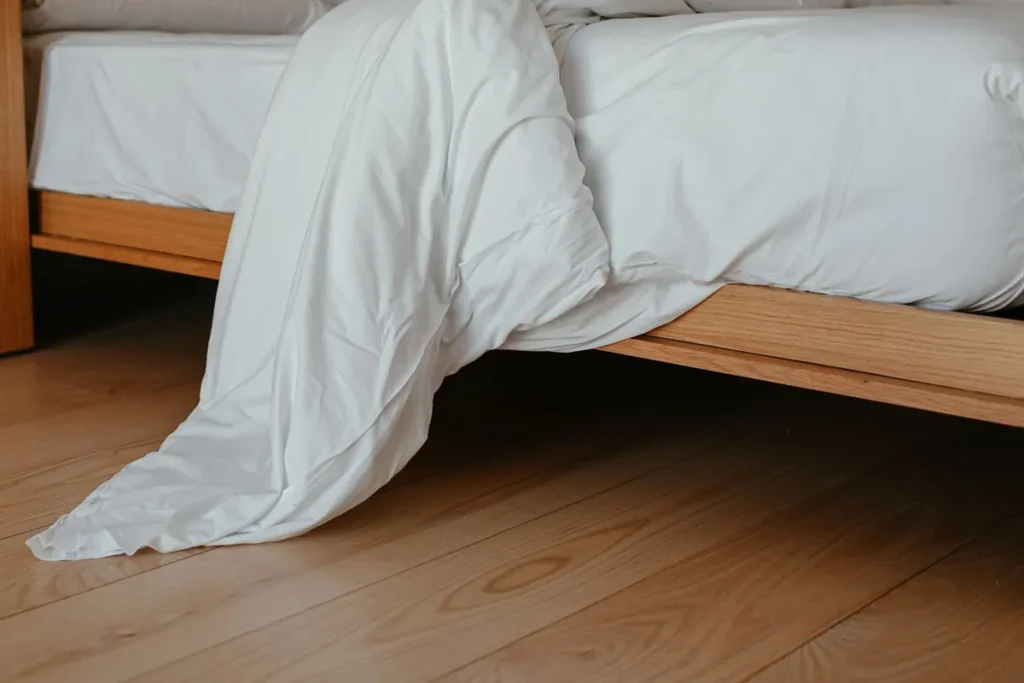
Under bed storage ideas for small bedrooms work only when the bed permits storage and the container can be removed without forcing it past supports. Start with the frame you have, the belongings you want to keep and a clear route beside the bed. These ten ideas are planning options, not tested products or approval to modify a bed.
Three checks before choosing an idea
- Permitted use: read the exact bed instructions. Do not remove supports, improvise a lifting mechanism or raise a bed just to fit a container.
- Actual fit: record the lowest opening, spaces between supports, complete filled-container dimensions and the room needed to pull it out and open it.
- Access: keep regularly used items where the intended person can retrieve and return them comfortably. Do not block doors, windows or the route around the bed.
How do you measure without changing the bed?
Measure only from a safely accessible position; do not crawl beneath the bed or lift the frame to measure. Check the lowest accessible opening, not merely the decorative side rail. Center legs and rails may divide the space into smaller lanes.
Compare those lanes with the container’s complete external dimensions, including lid, handles, feet and wheels, and the shape when filled. Then check the pull-out and lid-opening space beside the bed. A drawer that fits underneath can still be unusable if it cannot open past a dresser.
There is no universal “subtract one inch” clearance rule or seven-inch threshold that proves a bin fits safely. For example, a filled soft bag can bulge beyond its empty dimensions. Choose a smaller container or another location if it would press against the frame, obstruct access or require removing a support.
Under-bed measurement record: write down the bed model and permitted use, lowest accessible opening, narrowest lane, filled container size and removal route. Mark uncertain dimensions as unresolved rather than testing them by forcing a loaded box under the bed.
Four options for an open frame
1. A lidded rolling bin
Useful for: clean, dry clothing or bedding when its care instructions permit the storage conditions. Check: complete height with wheels and lid, support positions and the floor surface. Skip it if: wheels catch, the box presses against the frame, or retrieval blocks the walkway. A lid may reduce dust exposure; it does not create a moisture-proof environment.
2. Two accessible rows
Useful for: keeping frequently used items nearer the edge and less-used items farther back, if both remain retrievable. Check: room to move the first bin without lifting awkwardly or blocking an exit. Skip it if: getting to the back row requires crawling underneath or moving the bed. One accessible row can be better than two tightly packed rows.
3. A lightly filled zippered fabric bag
Useful for: spare textiles whose care instructions allow this storage. Check: the filled height, zip movement, handles and condition of the storage space. Skip it if: the bag bulges against supports or conditions are damp. Do not compress an overfilled bag into a structural gap.
4. A shallow shoe drawer
Useful for: shoes you want to keep visible in one layer. Check: your actual pairs, full drawer travel and the clearance needed to lift them out. Skip it if: daily use is awkward or the shoes are wet; dry and store them as their care instructions require. The right depth is based on your shoes and drawer, not a fixed extra-inch formula.
If another location is more accessible, compare an over-door shoe organizer with a shoe rack before committing the space beneath the bed.
Two options for a low frame
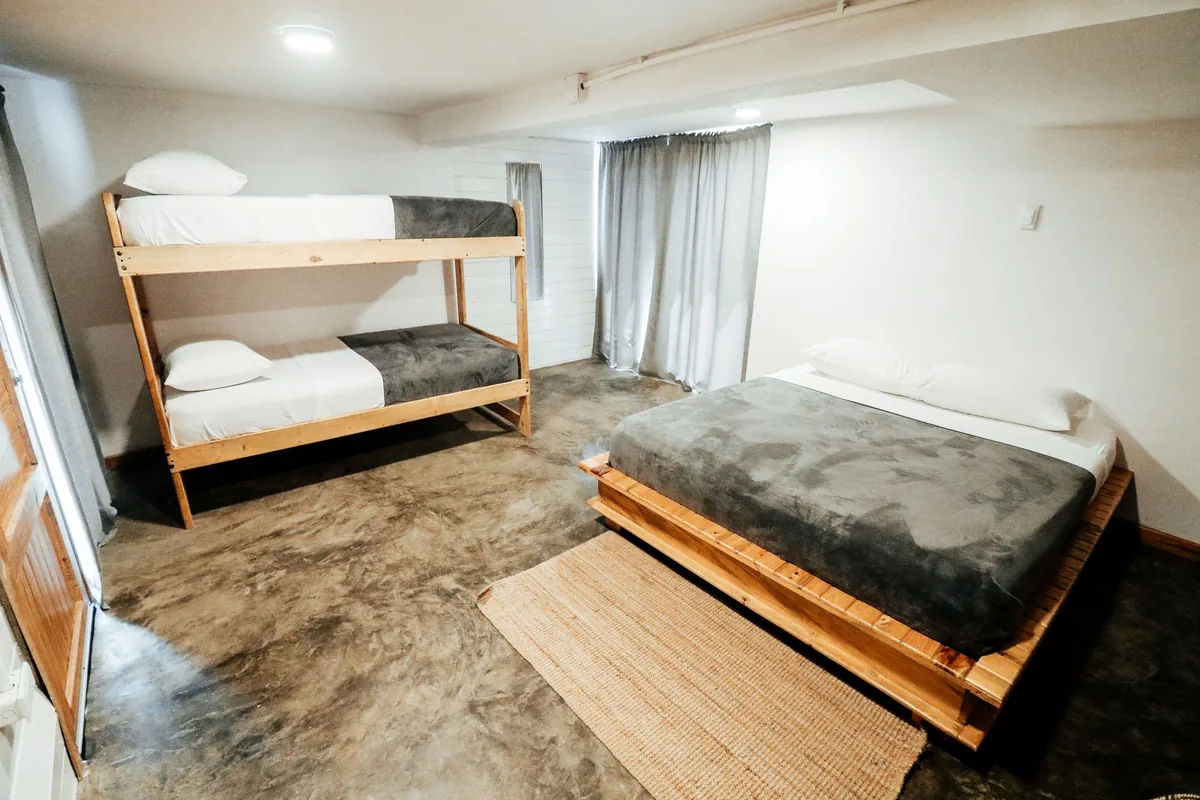
5. A shallow removable tray
Useful for: flat items in an accessible lane, if the bed permits storage. Check: the assembled tray, any wheels and the actual flooring. Skip it if: the tray drags, needs forcing or interferes with supports. Do not add improvised casters or structural changes as a shortcut to fit.
6. A compression bag, only when the textile permits it
Useful for: selected infrequently used textiles when both their care instructions and the bag instructions permit compression. Check: material and filling restrictions, complete filled size and the possibility that the bag expands. Skip it if: care guidance is unclear or regular access would mean repeated difficult repacking. Vacuum packing is not a universal recommendation for down, quilts or every winter coat.
Do not treat bed risers as a routine storage fix. This guide has not established a compatible bed-and-riser combination. A leg fitting inside a cup or a stated riser load does not prove the whole bed is suitable. Do not improvise, stack supports or remove center legs; ask the bed manufacturer before any proposed height change. Choose less storage if compatibility is unresolved.
Two built-in options, only when a bed change is already planned
7. A bed with side drawers
Useful for: accessible storage designed as part of the frame. Check: drawer opening space, documented drawer loads and the exact assembly instructions. Skip it if: the room blocks full travel or safe use. Closing drawers can reduce exposure, but does not guarantee dust-free or moisture-free contents.
8. A manufacturer-designed lift-up storage bed
Useful for: permitted storage in an exact model designed for that purpose, not an improvised conversion. Check: assembly, mattress specifications, operating instructions and all lifting-mechanism warnings before use. Frequency of access is only one consideration; mechanism safety comes first.
For example, IKEA’s UK MALM standard-double model 304.048.20 has a 40 kg maximum for the full/double mattress shown in its assembly instructions (page 33). Respect the exact model’s limit and warnings: an unsafe lifting mechanism can cause injury. This is not a general storage load rating.
Follow the instructions for the bed you actually own. Keep children away from the mechanism during operation, never crawl beneath a raised deck, and do not repair or adjust lifting parts as a storage project. If support, operation or compatibility is uncertain, stop and contact the manufacturer rather than trying it with a load.
Two ideas for a suitable child’s or guest bed
9. A small toy category in an appropriate bin
Useful for: an age-appropriate toy group that the intended child can access safely, where the exact bed allows storage. Check: bed type, bin instructions, small parts, reach and the space needed to remove it. Skip it if: it creates a climbing step, an obstruction or access to unsuitable items. Do not transfer ordinary adult-frame advice to a crib, bunk or loft bed.
Use a simple picture label if it helps the child identify the contents, but choose the number of categories together rather than imposing a fixed three- or four-bin rule. This is an organizing suggestion, not a medical claim that a particular bin reduces allergies.
10. A labeled guest-bedding set
Useful for: a clean, dry guest set that can be found without searching through unrelated belongings. Check: the filled container, textile care and accessible removal. Skip it if: the space is damp or the lid cannot be opened comfortably. Store only the set that belongs there, with room to return it after use.

What should you keep elsewhere?
Do not use the space for chemicals, hazardous supplies or anything whose label requires a different storage arrangement. Choose a suitable secure location for sensitive papers or valuables rather than assuming a lidded box protects against pests, water or unauthorized access. Do not store damp textiles or food as a way to free another cupboard.
Everyday clothing is not automatically wrong under a bed. The question is whether the intended person can retrieve and return it safely and comfortably. If it stays on the floor because the drawer is awkward, consider an easier location rather than blaming the person.
How do you choose one idea without filling every gap?
- Start with permitted use and the actual accessible lanes, not an assumed bed category or clearance band.
- Try one suitable container with a manageable amount; do not fill the whole area before checking ordinary retrieval.
- Keep frequently used belongings accessible, but do not store rarely used items where you must crawl to reach them.
- Label contents and choose a review time that suits the household. Not using something for one season is not a reason to discard it automatically.
- Keep ventilation, exits, opening doors and windows, and the route around the bed available. If the space is unsuitable, leave it empty.
Use the closet organization hub for another storage location, or the free home reset for a smaller starting task. None of these options requires changing the bed.
These are planning ideas sized to common bed heights. Stock photos are illustrative, not proof of a bed’s suitability. See how we test.
Frequently asked questions
How much clearance do you need for under-bed storage?
There is no single minimum for every bed and container. Check the bed’s permitted use, lowest accessible opening, supports, complete filled container and removal route. An extra inch or a seven-inch category is not a universal fit standard.
Can you put risers under a low bed?
Do not assume so. This guide has not verified any bed-and-riser combination. Ask the bed manufacturer about the exact proposed arrangement; a cup shape and load figure do not establish whole-bed compatibility. Keep supports unchanged and choose another storage location if permission is unclear.
Are lift-up beds suitable for all spare bedding?
Check the exact model’s operating instructions, mattress requirements, compartment limits and textile care. A storage compartment is not permission to overload or adjust the lifting system. Keep children away during operation and never crawl beneath a raised deck.
How do you reduce dust in under-bed storage?
Suitable closed containers may reduce exposure, but do not make contents dust-proof or resolve damp conditions. Clean the accessible area as appropriate without moving structural supports, and follow textile care instructions. This guide does not make an allergy-treatment claim.
Written by the SetsQuick Team. First published .
© SetsQuick. This article and its images may not be copied or republished without permission. To report reuse, see our DMCA page.
Was this guide helpful?
Save it for later or send it to someone