
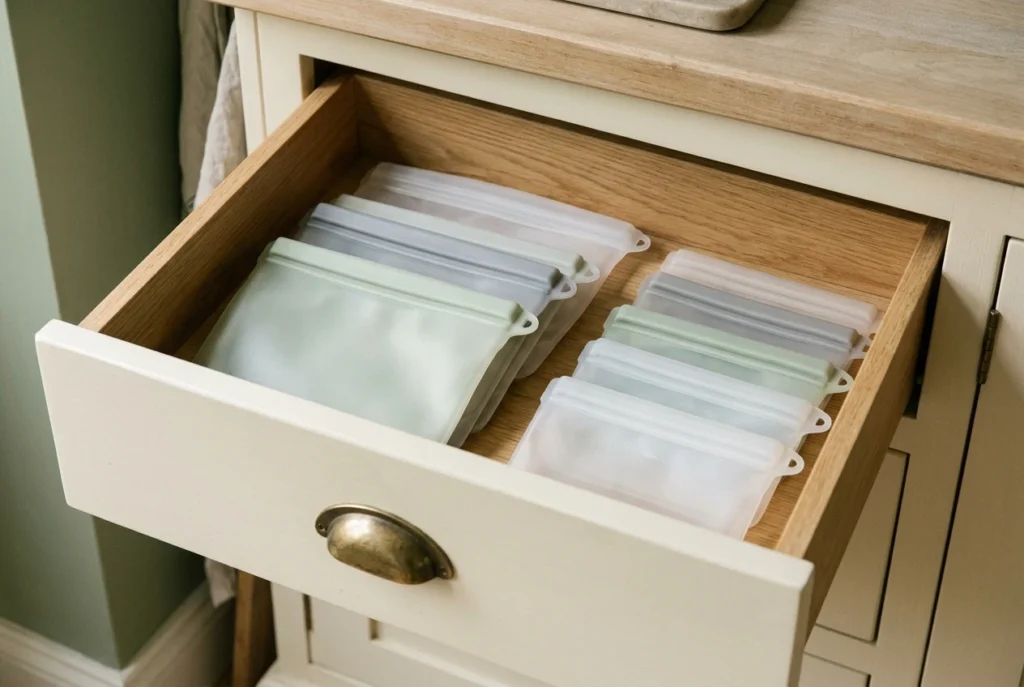
To organize reusable food storage bags, clean and fully dry them according to their maker’s instructions, separate them by useful size or purpose, and choose either a flat stack or an upright file that fits your drawer or cabinet. Keep the drying area separate from the ready-to-use storage area. The goal is to retrieve one bag and put it back without reorganizing the whole collection.
Cover image: AI-generated illustration of empty reusable bags, not a tested arrangement or evidence of cleaning effectiveness.
Start with the return path, not a new organizer. Dry completely, sort only the bags you use, measure the actual space, and try the simplest layout with a container you already own.
This guide covers empty reusable food bags, not reusable shopping bags or food-filled freezer packages. It draws on one manufacturer’s published guidance and includes an original retrieval-and-return worksheet. We have not tested the layouts or products in a home.
What should you check before putting reusable bags away?
Identify the material and find the care instructions for your actual bags. “Reusable” is not a single material specification: a silicone bag and a lined fabric bag may have different cleaning and drying requirements. Do not transfer one manufacturer’s dishwasher, heat, freezer, or sanitizing claims to another product.
For its own silicone bags, Stasher’s storage guide says to clean them after use and allow them to dry completely before storage. It also describes flat storage in shallow drawers, upright storage in deep drawers, and bins grouped by size or purpose. Those are the sourced options considered here; they do not establish universal care instructions for every reusable bag.
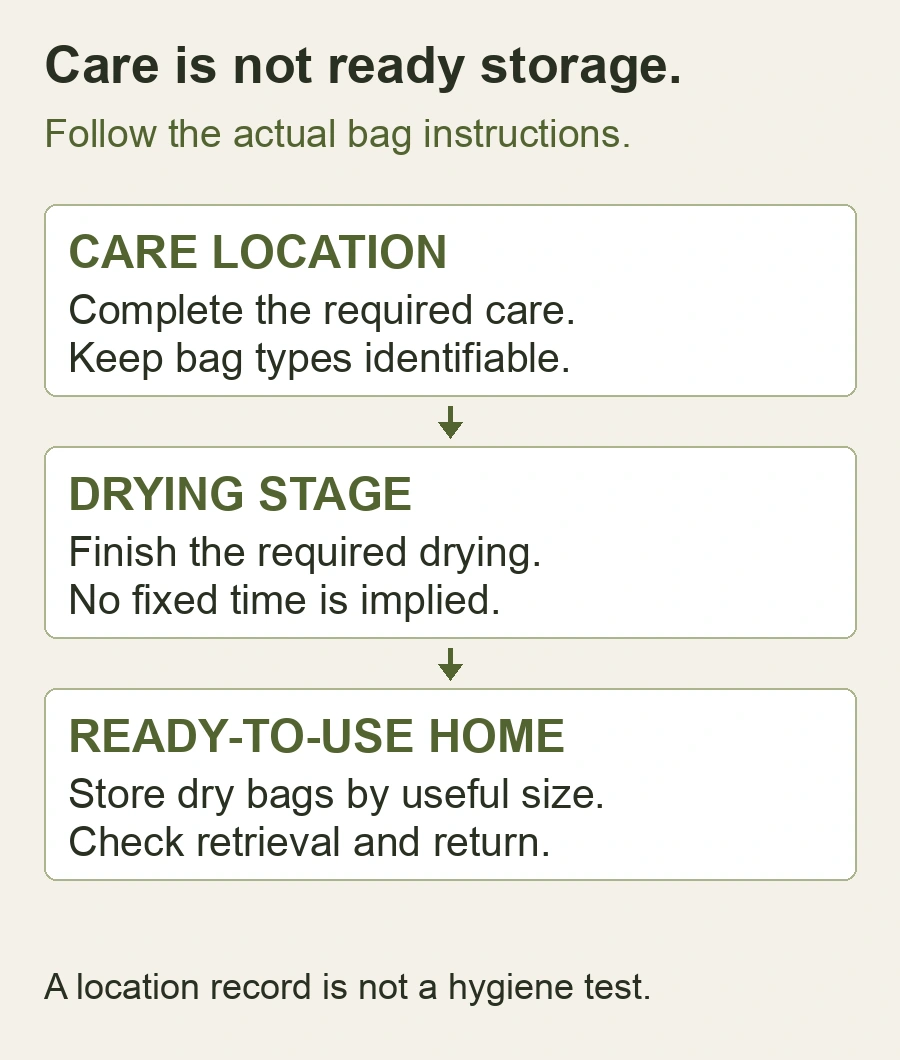
How do you separate drying from storage?
Give bags that are still drying a different place from bags ready to use. Follow the maker’s drying method and inspect the inside before moving a bag to its storage home. A towel placed inside a storage bin is not a substitute for completing that process.
For this storage task, you do not need to invent a new cleaning routine. If a bag is damaged or its care instructions are missing, resolve that with the manufacturer before treating it as ready for food use. This guide does not set food-storage temperatures, cleaning chemicals, or replacement intervals.
How should you sort the bags you already own?
Lay out the clean, dry bags and sort them by the decision you make when reaching for one. That may be size, shape, or the activity—such as packing lunch—rather than the brand name.
- Keep useful sizes visible. Small bags should not disappear behind the largest ones.
- Keep any required parts together. If your bags use separate closures, check the product instructions and make their matching pieces easy to identify.
- Separate bags with different care requirements. Keep the maker’s instructions available rather than assuming every bag can follow the same routine.
- Set unresolved items aside. A damaged seal or unknown care requirement is a question to resolve, not something an attractive bin fixes.
Do not choose a universal limit such as “everyone needs six.” Base the active collection on your actual uses and how often you clean the bags. You can put an occasional-use size in a separate, clearly identified place without mixing it into the everyday stack.
Should reusable food storage bags lie flat or stand upright?
Choose the orientation your space and bags support, not the one that looks neatest in a photograph. Start without purchasing a divider.
| Layout | When to try it | What to watch for |
|---|---|---|
| Flat groups | A shallow drawer or a short cabinet opening | Finding a small size may require lifting the group above it |
| Upright file | A deeper drawer where bags can stand without interfering with movement | Flexible bags may slump or catch if packed too tightly |
| Removable bin | A cabinet where bringing the collection forward helps access | The bin itself uses space and must pass through the opening |
These drawbacks are reasons to check your own setup, not results of a comparative product test. An upright file is not automatically better than a flat group. If one shallow stack lets you choose the right bag easily, a more elaborate organizer may add work.
When is a shallow drawer the simpler choice?
Try flat groups with the size you use most near the front. Avoid turning one tall pile into the only way to reach every size. Use a divider you already own only if it keeps the groups separate without bending, pinching, or catching the bags.
When does an upright file make sense?
Try it when the closed drawer has sufficient usable height and the bags stand without pressure from the surface above. Keep the bag you reach for visible. If the group collapses whenever one bag is removed, change the support or return to a flat layout rather than forcing more bags into the space.
If the same drawer also holds rigid containers, treat those as a separate storage problem. Our guide to organizing container lids in a deep drawer addresses lid-and-container matching, not flexible food bags.
What measurements matter before you buy a bin?
Measure the usable space inside the storage area and the route through its opening. Drawer fronts and cabinet doors do not tell you the usable width, depth, or clearance. Consider the largest bag in the intended orientation, the space taken by a closure, and how your hand will retrieve it.
Illustrative measurement example—not a product specification: suppose a drawer’s usable interior is 12 inches (30.5 cm) wide, 16 inches (40.6 cm) deep, and 4 inches (10.2 cm) high. A proposed bin’s outside dimensions must fit within that usable space and pass through the opening, while its inside dimensions must suit the bags. Those drawer dimensions do not tell you how many bags fit or prove that an upright bag will clear the moving drawer.
Do not assume a container advertised as “12-inch” has a 12-inch usable interior. Check the maker’s complete dimensions and any projections such as handles. Do not apply a universal clearance deduction: drawer hardware, closures, bag shapes, and access needs vary.
How do you test the layout without buying an organizer?
Use this retrieval-and-return check with the storage space and a clean, dry container you already have. It evaluates convenience, not food safety or product durability.
- Choose one routine. For example, packing a sandwich or collecting a small snack.
- Retrieve the matching bag. Note whether you have to lift unrelated sizes or move the whole collection.
- Remove it and look at the remaining group. Check whether bags fall flat, conceal each other, or interfere with the drawer.
- Try the return step with a ready-to-store bag. Can you place it in its group without rebuilding everything?
- Change one thing. Adjust the grouping or orientation before shopping for another container.
What should you write down?
| Your bag-storage record | Fill in your answer |
|---|---|
| Everyday use and size | ________________ |
| Actual material and care source | ________________ |
| Drying location | ________________ |
| Ready-to-use location | ________________ |
| Usable space and opening | ________________ |
| Current retrieval problem | ________________ |
| One change to try | ________________ |
Keep the first version simple. If the problem is that dry bags are returned to several different drawers, a single agreed location may help more than buying a specialized rack.
What should you avoid when organizing reusable food bags?
- Putting damp bags into the ready-to-use group. Complete the maker’s drying process first.
- Hiding small sizes under a mixed pile. Try a separate group or a different orientation.
- Assuming every bag shares the same care rules. Keep material and manufacturer requirements distinct.
- Buying a rack before measuring. Check both storage fit and retrieval access.
- Turning storage into an unsupported safety claim. A tidy drawer does not establish safe food-use conditions, cleaning effectiveness, or a working seal.
Frequently asked questions
Can you store reusable silicone bags flat?
Stasher lists flat storage as an option for its silicone bags, including grouping sizes in shallow drawers. Follow the requirements for your own bags and avoid a layout that catches closures or makes the size you need hard to retrieve.
Do reusable food bags need a special organizer?
Not necessarily. Start with a suitable drawer, shelf, or clean and dry container you already own. Buy an organizer only when it solves a problem you have identified and fits the usable space.
Should food bags be stored with reusable grocery bags?
For this system, give ready-to-use food bags their own identifiable group. Grocery bags perform a different job and may not be suitable for direct contact with food. Use bags intended for food storage. Follow the care and storage requirements of each actual product.
How many reusable bags should you keep in the everyday drawer?
Keep the sizes and quantities you actually use within the space you can access comfortably. There is no evidence-based universal number in this guide. Store occasional-use bags separately if that makes the active collection easier to manage.
What should you do next?
Your next step: choose one everyday bag size and one storage orientation. Run the retrieval-and-return check before buying anything. Keep the arrangement only if it works for both taking a bag out and putting a clean, dry one back.
Written by the SetsQuick Team. First published .
© SetsQuick. This article and its images may not be copied or republished without permission. To report reuse, see our DMCA page.
Was this guide helpful?
Save it for later or send it to someone