
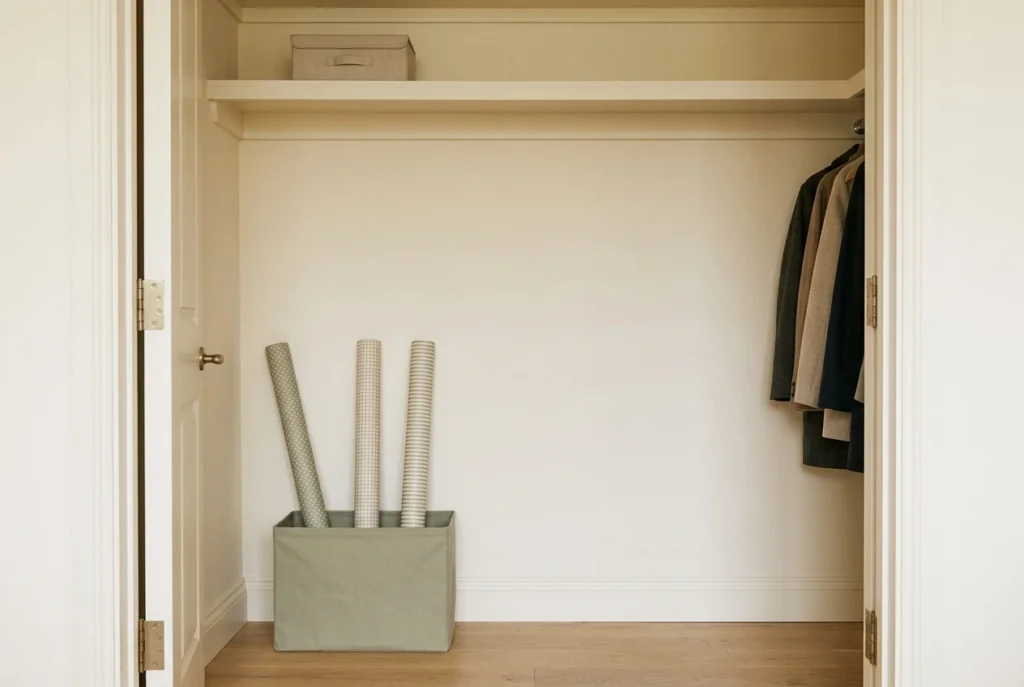
To store long wrapping paper rolls in a small closet, measure the longest roll, check the usable space and the route in and out, and choose a position that supports the rolls without crushing them or blocking access. Keep gift bags, ribbon, and tools in a separate, manageable group. A narrow gap is not useful storage if you have to empty the closet every time you wrap a gift.
Cover image: AI-generated conceptual storage illustration, not a tested holder, measured fit or stability approval.
Make three decisions before buying gift-wrap storage: the roll length you need to accommodate, where you can retrieve it comfortably, and how to keep tools separate from the paper. Check the container’s inside dimensions—not just “fits most rolls.”
This planning guide draws on general paper-care guidance and original editorial tools. The fit record and measurement example are original editorial tools, not evidence of a tested product, load rating, or installation method.
Why do long wrapping paper rolls need their own storage plan?
A roll may fit a closet’s height but still be awkward to lift out. A long container may fit across a shelf but fail to pass through the door opening. The practical problem is both storage and retrieval.
The Library of Congress’s paper-care guidance recommends a clean, relatively dry, stable environment and supportive storage for works on paper. It does not test wrapping-paper holders. The method here starts with your own rolls and available space rather than a product recommendation.
What should you sort before measuring?
Bring together the wrapping supplies you intend to keep, without turning the closet into a permanent staging area. Separate the rolls from flat paper, gift bags, ribbons, and tools.
- Long rolls: measure the longest actual roll, including any core extending beyond the paper.
- Short rolls: consider whether they can share the same holder without disappearing below the taller ones.
- Flat supplies: keep usable sheets, tissue, and gift bags from being crushed beneath rolls.
- Tools: store scissors and other sharp tools appropriately for the people who can access the area, following their safety instructions.
Do not set an arbitrary maximum number of rolls. Keep what you expect to use, and decide whether a damaged remainder is still useful before buying storage for it. You may be able to use the existing supply before adding another organizer.
Which measurements tell you whether a holder will work?
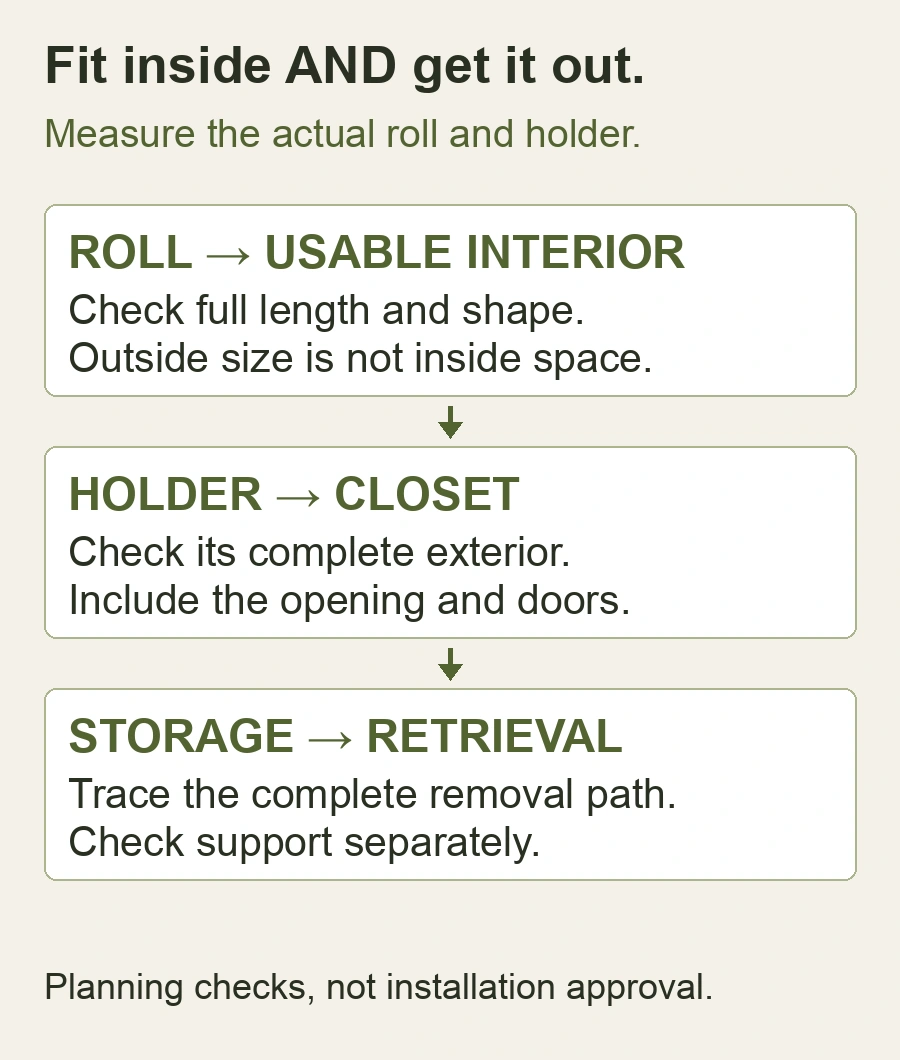
Write down the roll’s full length and the space you can actually use. Then check the proposed container in both roles: its outside must fit the closet, while its inside must accommodate the paper.
| What to record | Why it matters |
|---|---|
| Longest roll, end to end | Sets the minimum usable length required inside an enclosed container |
| Roll widths and intended group | Shows the shapes the holder must accommodate; it does not establish capacity from length alone |
| Closet opening and usable location | A container can fit inside but fail to pass through the opening |
| Door, clothing, and shelf movement | Stored rolls must not become an obstruction |
| Retrieval path | You need a practical way to remove the roll or bring the holder out |
What does a useful measurement example look like?
Illustrative example: your longest roll measures 40 inches (101.6 cm). A box advertised as 40 inches long on the outside does not establish that the roll fits inside; wall thickness, handles, hinges, and its closure may reduce the usable length. Even a verified longer interior is only one check: the loaded box still needs to pass through your opening and be retrievable.
This is a length comparison, not a universal clearance formula. Do not assume an extra inch guarantees fit or infer the number of rolls from the box length. Ask for missing manufacturer dimensions before purchasing.
Should wrapping paper rolls stand upright or lie flat?
Choose between the access problems you can actually solve. Neither orientation is the best choice for every closet.
When is an upright holder worth trying?
Consider it when you can reach the rolls comfortably, the holder is stable in its intended use, and you can remove a roll without catching clothes or moving everything above it. Follow the holder’s instructions, including any applicable support or mounting requirements.
The tradeoff is retrieval height: a roll that stands neatly in a tall, narrow holder may still need substantial room above or beside it to come out. Do not treat wedging a tall container into a gap as a substitute for suitable support.
When is a flat box more practical?
Consider a flat container when you can bring it forward or remove it without dragging rolls past clothing and hardware. A cover may help contain supplies, but check the actual product’s construction and intended use rather than assuming any box is crushproof or moistureproof.
The drawback is its long footprint. It may occupy the only usable shelf, or require you to move unrelated belongings before opening it. Avoid placing heavier items on top unless the container’s instructions support that use.
What if the only space is behind a door?
Do not assume a door organizer is compatible with the door, hinges, surrounding clearance, or rental agreement. Check the exact organizer’s installation and load requirements and verify that the door can function normally. If that evidence is unavailable, choose a non-mounted alternative rather than improvising hooks or adhesive.
If the closet simply has no workable location, move the supplies to another suitable storage area instead of forcing the fit. Our closet organization guide can help you decide which categories actually belong in the closet. This article addresses the long-roll problem, not a complete closet redesign.
How do you keep rolls and accessories from becoming one pile?
Give the rolls one home and the smaller supplies a separate, clearly identified group. They can be adjacent without being mixed. Use a container you already own if it suits the items and storage conditions.
- Gift bags and flat sheets: choose a position where the usable pieces remain visible and are not supporting a pile of heavier rolls.
- Ribbon and tags: group by the choice you make while wrapping, rather than buying many tiny categories you will not maintain.
- Tape and tools: store them according to their instructions and household access needs; “all supplies together” does not override safe tool storage.
For partially used rolls, use a retainer intended for the task and compatible with the paper, or an existing sleeve that works without crushing it. Try the method on a scrap first if it might mark or crease the surface. Avoid applying adhesive directly to decorative paper unless you accept the possibility of damage.
How do you check access before committing to a storage spot?
Use this storage-and-retrieval record before purchasing an organizer. It is a convenience check, not a furniture stability or structural test.
| Your gift-wrap fit record | Fill in your answer |
|---|---|
| Longest actual roll | ________ inches / ________ cm |
| Proposed location and orientation | ________________ |
| Verified usable container dimensions | ________________ |
| Opening and retrieval route | ________________ |
| What would need to move first? | ________________ |
| Separate home for accessories/tools | ________________ |
| Missing manufacturer information | ________________ |
Use your own measurements and check access without creating an unstable arrangement or forcing doors or containers. If the plan requires removing everyday clothing to retrieve a roll, consider a different spot. If your remaining question concerns mounting, loads, or furniture stability, get the relevant product instructions rather than treating a successful measurement as approval.
Frequently asked questions
How do you store wrapping paper without buying an organizer?
Start with a suitable container or sleeve you already own, if it supports the rolls without crushing them and fits your chosen space. Check the full roll length and retrieval route. There is no need to purchase a dedicated organizer when the existing option does the job.
Can wrapping paper go under a bed?
Only consider it if the bed and storage product allow that use and you can retrieve the container without interference. Measure supports and openings as well as height. Under-bed space is not automatically usable, and this guide does not approve modifying a bed or adding risers.
Is an outside box length enough to confirm a long roll will fit?
No. Verify the usable interior length and any closure that intrudes into it. Then check the outside dimensions, closet opening, and access route. A nominal size alone does not establish the complete fit.
Should all gift-wrapping tools stay in the same container?
Not necessarily. Keep supplies easy to find, but give sharp tools appropriate storage for the household. A nearby, separate tool location can be more suitable than putting everything into an open roll holder.
What should you do next?
Your next step: measure your longest roll and record one possible location. Resolve both “does it fit?” and “can I get it out?” before buying storage for the rest of the collection.
Written by the SetsQuick Team. First published .
© SetsQuick. This article and its images may not be copied or republished without permission. To report reuse, see our DMCA page.
Was this guide helpful?
Save it for later or send it to someone