
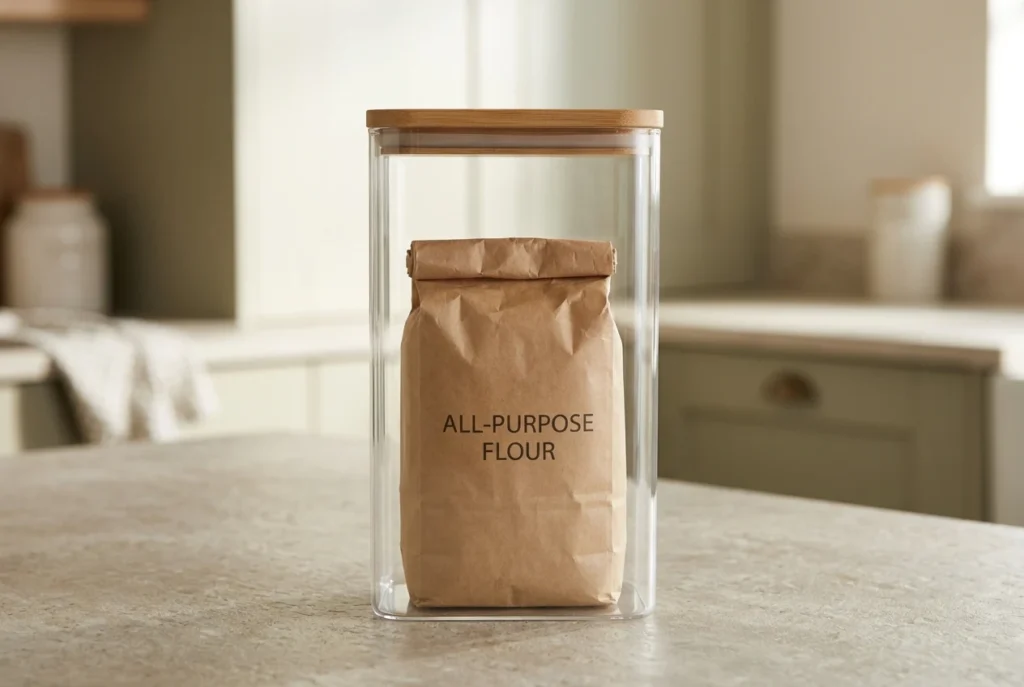
To store opened flour bags, first check the instructions for each flour, then place each identifiable bag in an appropriate airtight outer bag or container when those directions allow it. Keep the printed date, lot code, ingredient information, and preparation directions available. Choose a location by the flour type—not just by the empty space on your pantry shelf.
Cover image: AI-generated conceptual bag-and-container illustration, not an actual product or proof of airtightness, food suitability or measured fit.
Use three checks: flour, packaging, and location. First, check the flour type and its instructions. Second, check the package and outer container. Third, check the storage location and access. Follow raw-flour safety guidance throughout.
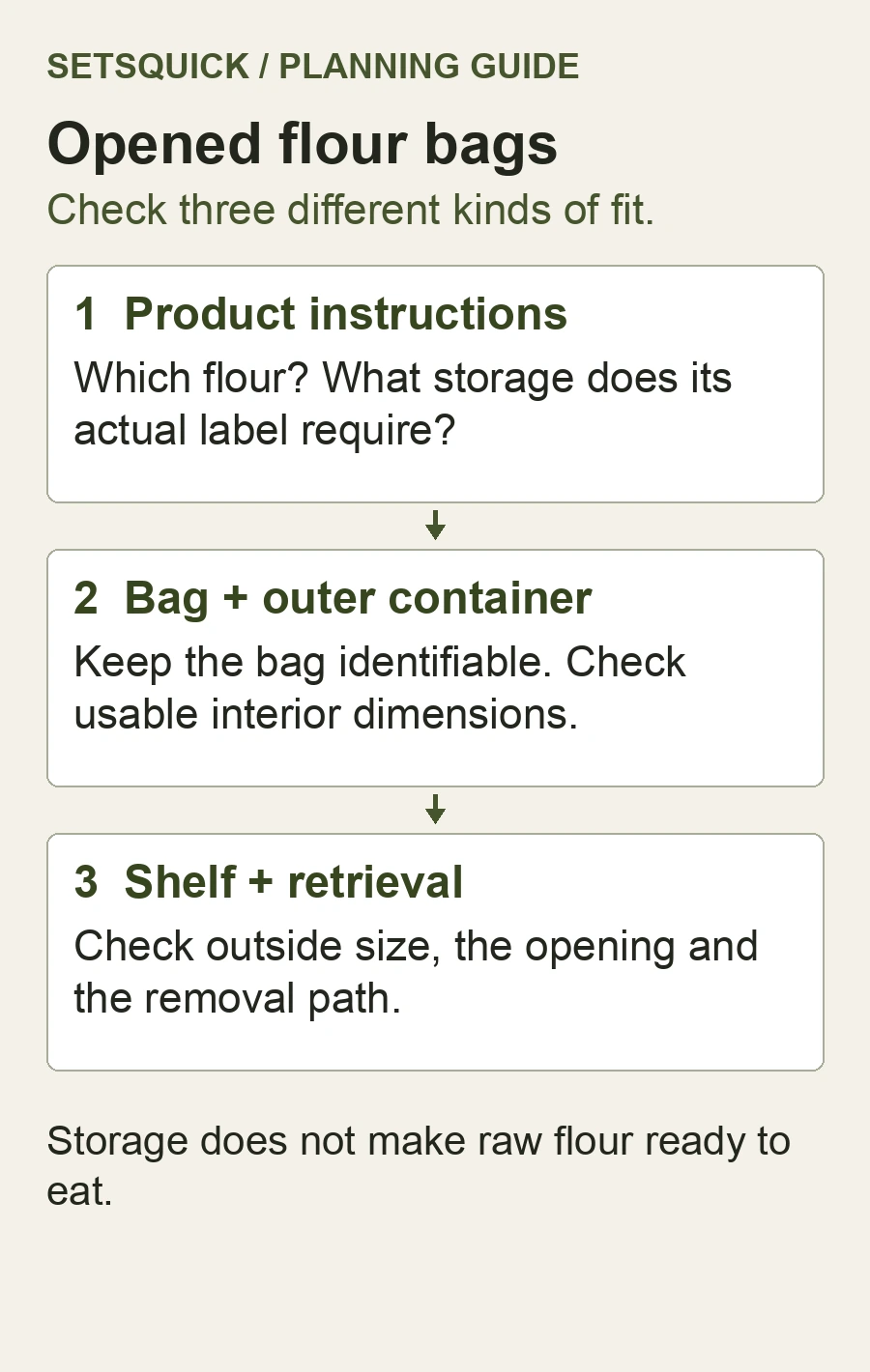
This guide focuses on managing a bag after opening. It is not a ranking of flour containers or a universal shelf-life chart. The examples and package record are original editorial tools; we have not run a storage or food-safety experiment.
Can flour stay in its original paper bag after opening?
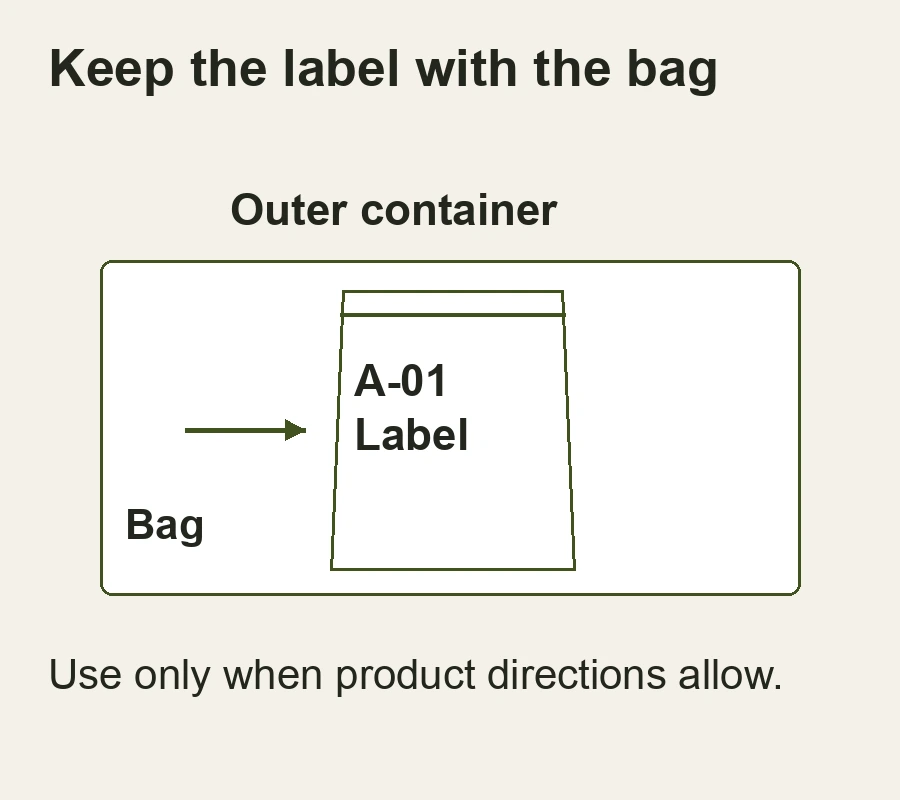
The original bag keeps product information together, but it may need additional protection. In its flour-storage guide, King Arthur Baking recommends an airtight container or bag and specifically describes sliding the flour bag into a large resealable bag or a flour container. The guide notes that retaining the bag keeps its best-by date accessible.
That is a practical alternative to immediately pouring everything into a new canister. Follow the packaging directions for your actual flour, especially a blend or specialty product with different requirements. Do not assume a folded paper top, decorative tin, or organizer bin creates an airtight closure.
What should you check before adding an outer container?
- Package condition: do not use an organizer to conceal a damaged or otherwise unsuitable product.
- Product identity: confirm the exact flour type and ingredients before separating it from any information.
- Closure: check that the intended outer bag or container closes properly with the actual flour bag inside.
- Cleanliness and dryness: follow the container’s care instructions and use storage suitable for the intended food use and conditions.
Which label information should you preserve?
Keep the actual package available where practical. If a transfer is appropriate, retain a legible external copy of the information rather than putting cut paper into the flour.
- Exact product name, flour type, and brand.
- Ingredients and allergen information from the current package.
- Printed date and lot or batch code, where provided.
- Storage directions and preparation or cooking instructions.
- A separate note of when you opened the bag, if useful to your routine.
An opening-date note does not replace the printed date or create a new safe-use period. Two pale powders can look alike, so a clear canister still needs an exact name. Our clear versus opaque pantry-container guide addresses visibility; visibility alone does not identify the contents or their history.
Where should you store opened flour bags of different types?
King Arthur distinguishes white flour from whole grain and nut flours, which contain fats and have different storage considerations. Its guide recommends freezer storage for whole grain or nut flour that will not be used before the best-by date, and describes an airtight container as protection from refrigerator moisture and odors when using that location.
Use that as a reason to check the product’s requirements, not as a universal instruction to put every flour bag on the same pantry shelf. A specialty blend may have its own directions. This guide does not set a refrigerator temperature, freezer treatment time, or guaranteed shelf life for your flour.
What if there is no suitable space for the flour you bought?
Resolve the product’s storage requirement before trying to make a pantry bin fit. A smaller purchase or a different suitable location may be more practical than keeping more flour than you can store as directed. A label saying “backstock” does not override the conditions on the package.
How do you check whether the outer container fits?
Check three separate things: the flour bag inside the container, the closed container inside the storage space, and the movement needed to retrieve and open it.
- Bag-to-container fit: measure the actual filled bag in its intended position. Allow its closure to work normally rather than squeezing it under a lid.
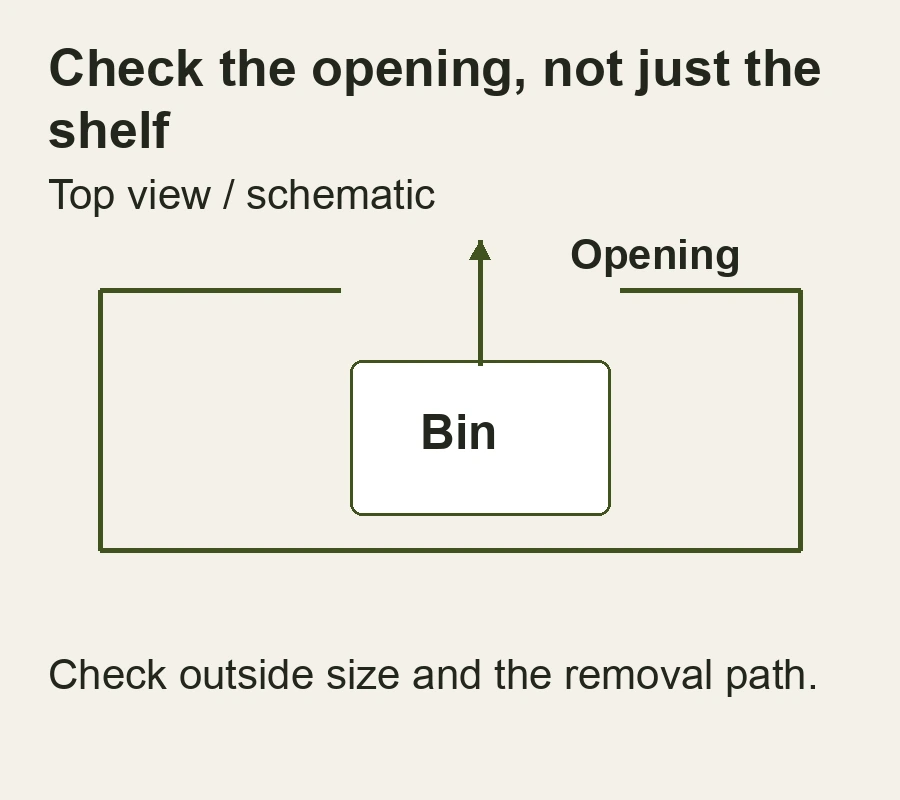
- Container-to-shelf fit: compare the complete outside dimensions with the usable shelf space and opening. Handles and lids may be part of that outside size.
- Access fit: consider whether you will bring the container to a work surface or use it in place. Do not assume that a container fitting below a shelf can also open there.
Illustrative example: an outer container that is 11 inches (27.9 cm) high cannot stand upright in a space with only 10 inches (25.4 cm) of usable height. Its capacity in quarts does not change that conflict. This comparison is not a specification for a flour bin or a claim that a slightly smaller one will necessarily work.
Package weight is not a container-capacity measurement. Before buying, verify the maker’s usable interior dimensions and intended use rather than assuming that a pictured bag matches your product. Our pantry container selection guide covers choosing a broader set; this article’s job is the opened bag and its information.
How do you handle a second bag before the first is empty?
Keep the second bag separately identified and follow its own directions. For a simple traceable system, do not continuously top up one anonymous flour container from several packages.
If two bags are already open, record both. Decide which to use according to their actual labels and suitability, not just which is easier to reach. A stock record can tell you what you own; it cannot certify that a questionable bag is safe.
What should an opened-flour record look like?
| Opened-flour record | Your entry |
|---|---|
| Exact flour and brand | ________________ |
| Package reference | ________________ |
| Printed date and code location | ________________ |
| Current storage instructions | ________________ |
| Opened date, if recorded | ________________ |
| Outer container and location | ________________ |
| Other separately labeled bags | ________________ |
When the active package changes, update the record rather than retaining an old flour name on a reused container. Follow the container maker’s cleaning and drying directions before changing its contents.
What does good storage not tell you about raw flour safety?
A clean-looking bag, a fresh opening-date label, or an airtight container does not make raw flour ready to eat. The FDA’s flour-safety guidance explains that processing raw grains into flour does not kill harmful bacteria. It says not to eat or taste raw flour, dough, or batter, and to follow package cooking directions.
The FDA also advises keeping raw flour separate from ready-to-eat foods, washing hands with soap and running water and cleaning utensils and surfaces with warm, soapy water after handling it, and discarding recalled flour. Do not use a smell or appearance check as proof of safety, or interpret cold storage as a treatment that makes flour safe to eat raw. This organization guide provides no home heat-treatment method.
How would two people manage two opened bags?
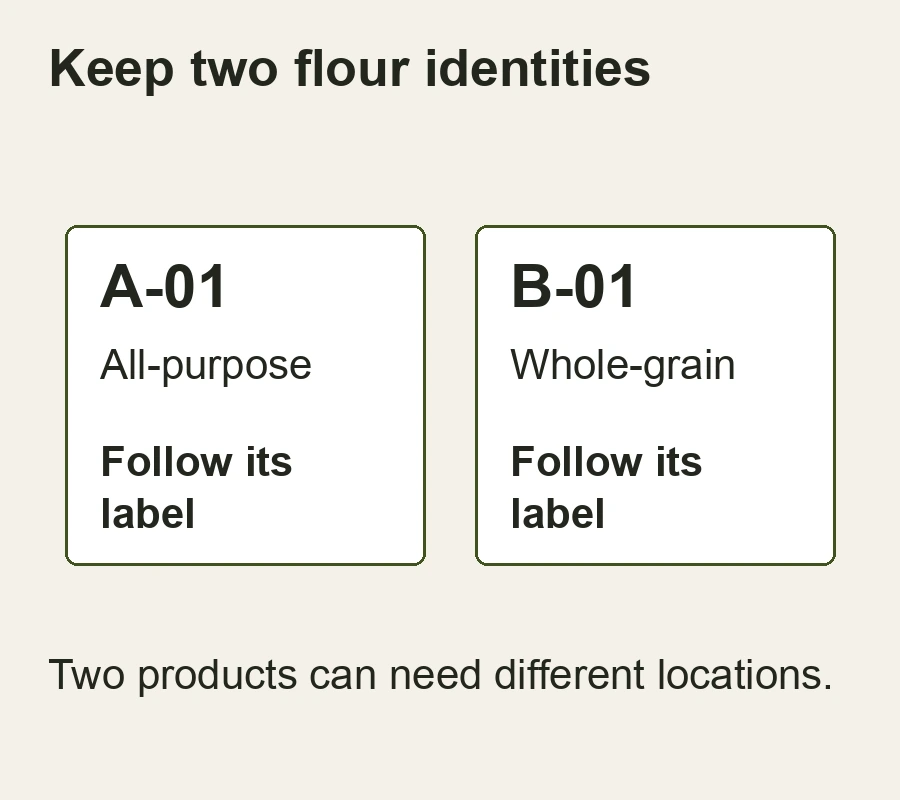
Fictional planning example: A-01 identifies an opened bag of all-purpose flour and B-01 identifies an opened whole-grain flour. Each keeps its original product information. These references are location aids, not dates, safety ratings, or a recommendation to open two bags.
The first person records the actual directions and chosen location for each package. If an outer container is needed and appropriate, they check its usable interior space, its outside dimensions, and the route back out. The record names the location actually used; it does not place both flours on the same shelf merely because their containers look alike.
The second person starts with the recipe and the package identity, not the appearance of the outer container. After use, they return the correct bag and its information to the recorded location. If a package changes, they update that entry instead of copying the previous bag’s printed date onto the new one.
Missing product information or an unsuitable available location is a reason to resolve the storage question with the maker, not improvise a shelf-life rule. When a bag is empty, close its record and check any remaining separately identified bag on its own terms. This example demonstrates a handoff; it does not certify food as safe or replace cooking instructions.
Frequently asked questions
Do you have to pour flour out of its paper bag?
No. King Arthur describes keeping the flour bag inside a suitable airtight outer bag or container. Check the actual flour and container instructions. Retaining the original bag can also keep its printed information accessible.
How long can an opened bag of flour stay in the pantry?
This guide does not assign one time period. Flour type, package directions, and storage conditions matter. Follow the current product’s information rather than replacing it with a generic opening-date rule.
Can you top up a flour container from a new bag?
For the traceable workflow here, keep packages separately identifiable instead of mixing their histories in an anonymous refill. Use the product and container directions, and preserve the label information for the flour actually inside.
Does freezing flour make it safe to eat raw?
Do not treat freezer storage as permission to eat raw flour. The FDA advises against eating or tasting raw flour, dough, or batter and says to follow appropriate cooking directions. Storage and safe preparation are separate decisions.
What should you do next?
Check the directions on one opened bag. Keep its identity and label information together, choose a suitable outer container if needed, and confirm the intended storage location before buying another bag.
Written by the SetsQuick Team. First published .
© SetsQuick. This article and its images may not be copied or republished without permission. To report reuse, see our DMCA page.
Was this guide helpful?
Save it for later or send it to someone