
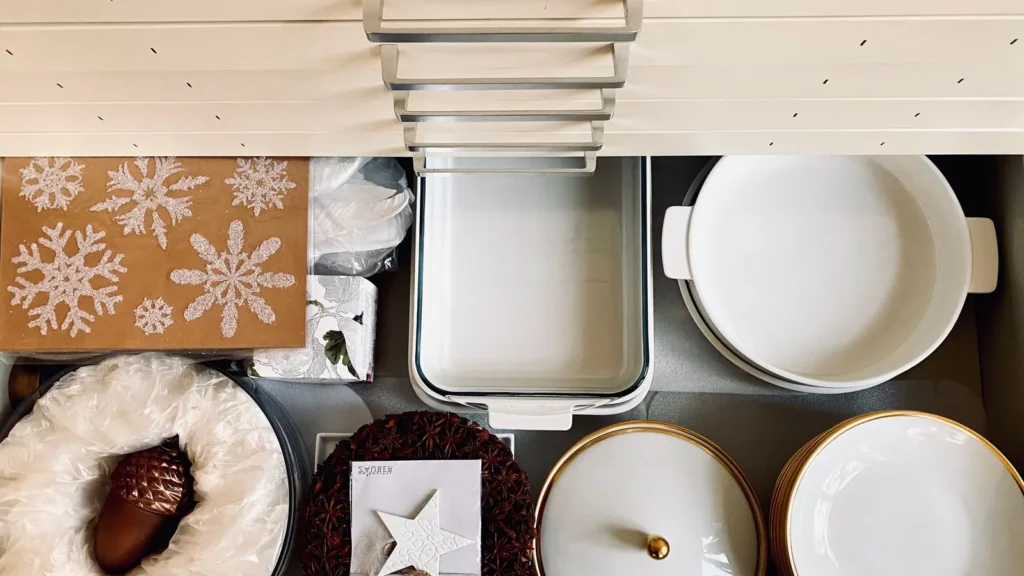
You opened the deep drawer, and every lid and bowl slid into one tilted heap. Drawer dividers can help when the arrangement suits the contents, drawer and load. This guide covers measurements, divider types and signs that an arrangement needs attention.
Key takeawaysDecide these before you buy dividers
- Measure the inside height, from the drawer floor to the lowest part of the counter frame above.
- Check stability and clearance: Use a divider designed for the actual contents; no height ratio alone guarantees support.
- Choose a divider designed for the contents and load. Heavy pots need a compatible support system within the drawer and slide limits, not an assumption that any fixed or pegged divider is sufficient.
- Consider storing lids, trays and boards on edge only when a suitable rack supports them securely.
- Leave one section open for the item you have not bought yet.
Why do deep kitchen drawers get messy so fast?
A deep drawer has height but no structure. Drawer movement can shift loose contents, especially when stacks or upright items lack support.
Stacking makes it worse. In a deep drawer, the easy move is to pile things. A pile works until you need the item at the bottom. Then you lift out the whole stack, take one thing, and put the stack back less neatly than before.
Suitable dividers can separate groups of items and limit movement. A compatible rack may also keep flat items on edge and easier to reach.
Some dividers are intended for shallow utensil drawers or light contents. A divider not designed for heavy pots may lean or slip under load.
That is why the best choice for a deep drawer is not the most popular one. It is the one that matches the height of your drawer, the weight of what goes inside, and the way the drawer moves every day.
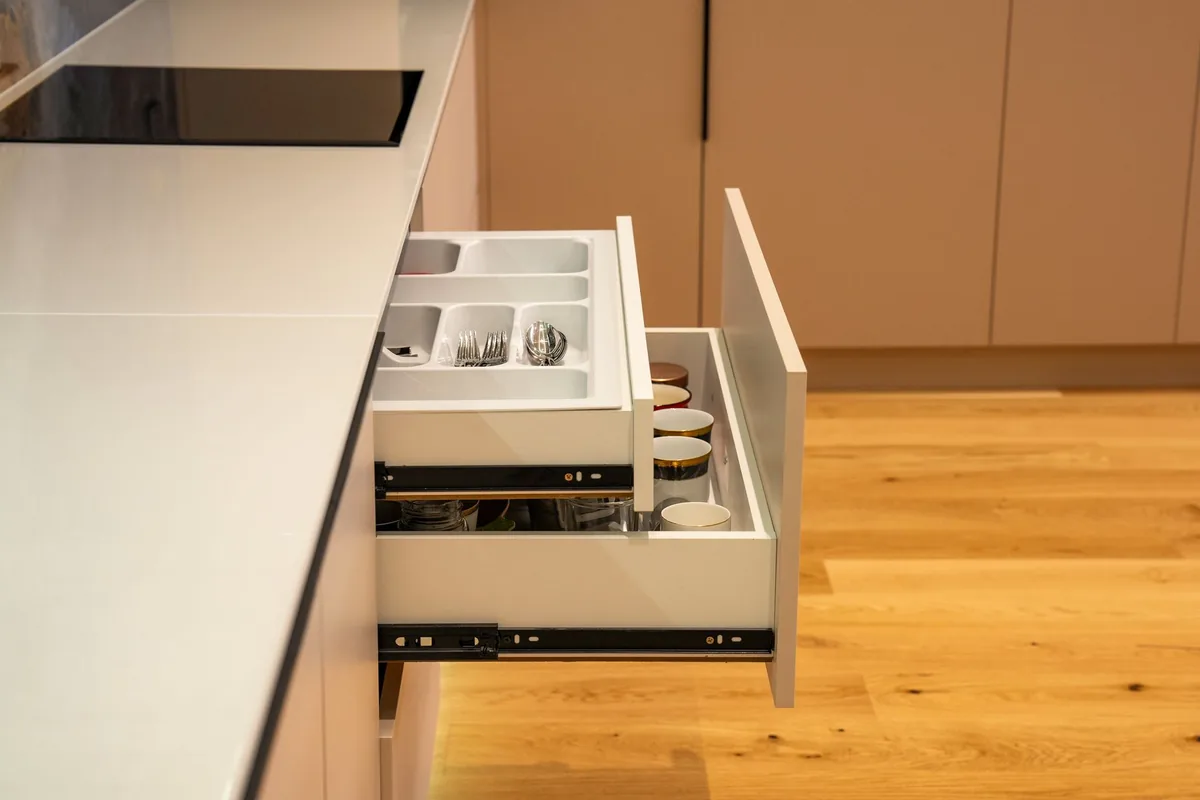
So the plan starts with the drawer, not the product. Measurements narrow the choices, but the product’s intended use, support and load instructions also matter.
How do you measure a deep drawer for dividers?
Take three measurements with the drawer empty. Open the drawer and use a suitable measuring tool; record the narrowest usable dimensions and any obstructions.
- Usable inside width, checking the top and bottom and noting obstructions.
- Usable inside depth, from the interior front to the interior back.
- Clear height, from the drawer floor to the lowest part of the frame above when the drawer is shut.
The third number is the one people miss. The drawer box may be tall, but the counter frame or the drawer above can sit lower. A divider that fits the box can still catch the frame when the drawer closes. Identify the lowest obstruction along the drawer’s travel and allow the required clearance. Keep fingers and measuring tools out of the closing path; follow the cabinet maker’s instructions if the clearance is difficult to determine.
Next, measure your tallest items. Stand a pot, a lid and a stack of bowls on the counter and measure each one. These measurements help you judge whether the items and a suitable support system fit with clearance.
Check the weight of the contents against the drawer box, slides and organizer’s stated limits, including any distribution requirements. Do not estimate capacity by appearance or assume a stronger divider makes an overloaded drawer safe. If the limits or configuration are unknown, check with the manufacturer. Follow the cabinet and divider instructions before drilling or attaching anything. Runner capacities vary by model; for example, Blum lists different load classes for its TANDEM runners. Those figures do not establish the rating of your complete drawer.

Write the three drawer numbers and your tallest item on a note. You will use them twice: once to pick the divider type, and once to choose the height and spacing of each section.
How tall should drawer dividers be in a deep drawer?
There is no universal divider-height ratio that guarantees stability. The item’s shape, weight, center of gravity, support and drawer motion all matter. Choose a product designed for the contents, with its specified clearance and load limits.
The available clearance also sets an upper limit. The divider must stay below the clear height you measured, with a little room to spare. If it is too tall, it will catch the frame above as the drawer closes, and it can pop out of place.
A taller divider is not automatically stronger or safer. Choose a compatible system that supports the actual items and clears the frame throughout the drawer’s travel.
Spacing matters as much as height. Set each section just wider than the items it holds. A section that is too wide lets items lean. A section that is too narrow makes it hard to lift one out. Allow enough space to remove items without forcing them, while keeping them properly supported.
Bowls are the exception. Nest compatible bowls if their maker permits it and the stack is stable and within the drawer’s limits. A snug section does not guarantee that a tall or heavy stack cannot tip.

For lids and trays, think of a file drawer. If the rack is designed for the items, stand lids or trays on edge within its specified spacing and load. Keep glass lids protected and supported so they cannot fall or collide.
Which drawer dividers work best in deep drawers?
These five organizer types may suit a deep drawer, depending on the specific product, contents, drawer and load.
Drawer dividers for deep drawers
- Pegboard drawer system. Potential use: compatible pots, pans and bowls within the system’s limits. Holds position: depends on the base, pegs, item shape and load; check the product instructions. Height: fixed by peg length. Watch for: a base board that does not fit the drawer exactly.
- Fixed-slot dividers. Check the exact product’s height, support, fixing and load instructions. Do not screw rails into a drawer unless the cabinet and divider manufacturers permit that installation.
- Tension dividers, tall version. Best for: light containers and plastic ware. Holds position: depends on spring tension, drawer construction and load. Height: medium to tall. Watch for: slow slipping under heavy loads.
- Open bins without lids. Best for: small loose items like spice packets. Holds position: depends on fit and the items inside. Height: short to medium. Watch for: gaps between bins that trap items.
- Vertical lid racks. Best for: pot lids and container lids. Holds position: check that the rack and lids are supported and stable. Height: set by the rack. Watch for: racks too wide for your lids.
Read the list with your load in mind. Heavy items need a system designed for their shape and load, and a drawer and slides rated for the total load. Light items may suit tension dividers if the product and drawer makers allow that use.
Choose materials that clean easily. Bamboo and wood look warm and are strong, but they need to stay dry. Plastic cleans quickly. In a drawer near the stove or sink, where drips happen, a wipeable surface saves time every week.
What goes wrong with drawer dividers?
A tension divider can slip or lean when it does not suit the drawer or load. A gap at an end or a leaning divider is a reason to stop and reassess the arrangement.
If a tension divider gaps, leans or slips, stop using that arrangement and remove the load safely. Reconfigure within the exact product instructions. Use pads or another fixing only where the drawer and divider manufacturers permit them; added grip does not establish load capacity.
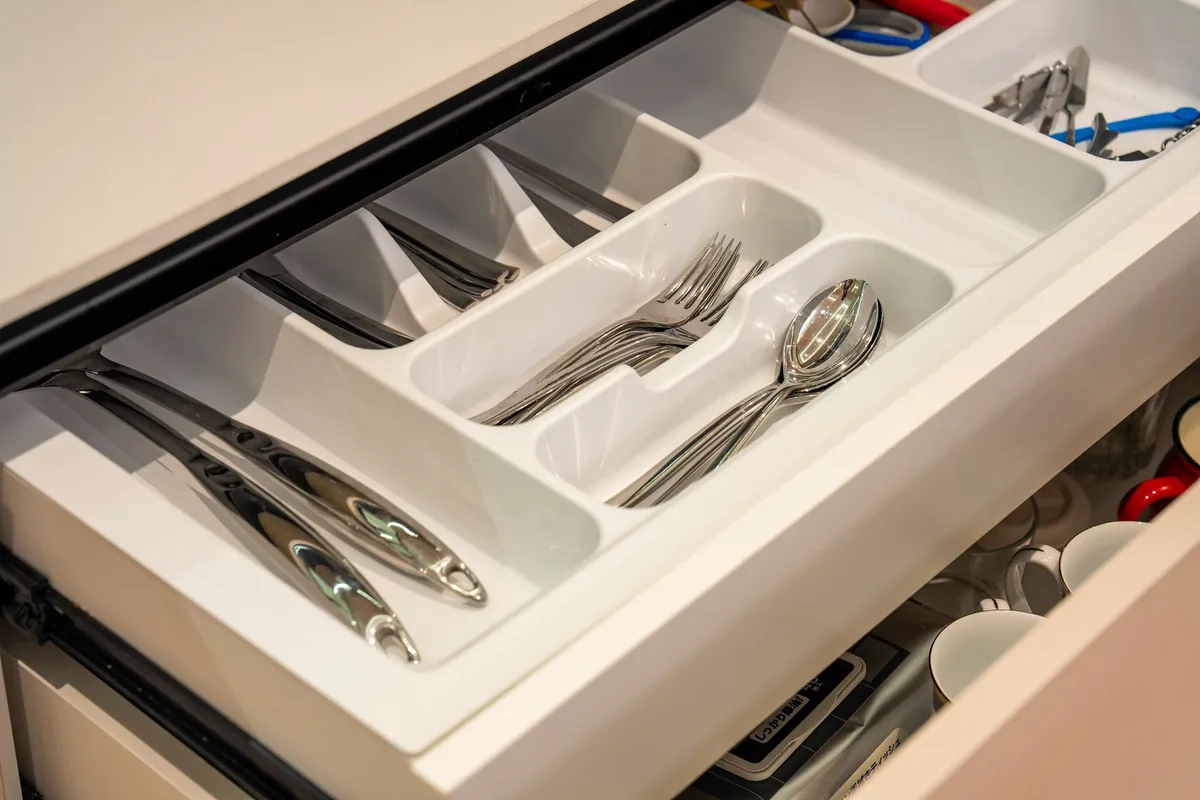
If an item tips over a divider, stop and change the arrangement. A taller divider may help only where it is designed for that load and fits the closed drawer. Do not assume height alone fixes instability or add unapproved drilled rails to the cabinet.
The third failure is a divider that catches the frame. If the divider is taller than the clear height, it hits the frame as the drawer closes. That can knock it out of place or scratch the frame. Check the lowest clearance along the drawer’s path without putting fingers or tools in the closing path.
The fourth failure is overfilling. A deep drawer with dividers can still fail if every section is packed. Items jam, and taking one out pulls the next with it. Leave a little space in each section, and edit what you keep.
How do you set up a deep drawer in one pass?
Once your dividers arrive, follow the drawer and organizer instructions as you plan the layout.
- Empty the drawer and wipe it clean. Add a liner only if suitable for the drawer and organizer materials.
- Plan the placement of heavier items according to the drawer and slide makers’ load and distribution instructions.
- Install a compatible organizer according to its instructions and confirm it is designed for the items.
- Stand lids, trays and boards on edge only where a compatible rack supports them securely.
- Add other items and dividers only within the product and drawer limits.
- Check movement gently without forcing the drawer; stop if anything catches, moves or leans.
A gentle movement check may reveal contact or sliding, but it does not prove capacity or long-term stability. Follow the drawer and organizer instructions and stop immediately if anything catches, moves or leans. Do not use repeated loaded movement as a stress test.
This is also a good time to edit. Consider whether pots and lids stored together are still useful. Match every lid to a pot or container. Lids with no partner can go. A smaller load can make the drawer easier to use, but it does not make an unsuitable divider safe.
If your deep drawer holds plastic containers, lids are usually the hardest part. Our guide on how to organize tupperware lids in a deep drawer walks through that one problem step by step.
If the containers themselves need a rethink, see the best pantry organization containers set. Matching sets stack and nest better, which makes any drawer easier to divide.
For more kitchen guides built on measurements, visit the kitchen and pantry hub. If the whole house needs a reset, the free 30-Day Home Reset puts sorting before any shopping.
That is the SETS method: Sort, Edit, Type, then Store. Drawer dividers belong to the last step. They work best in a drawer that already holds only what you cook with.
One more tip helps deep drawers stay neat. Put the items you use most at the front, where the drawer opens first. Items used once a month can go at the back. Drawer extension varies; arrange items around the access your own drawer provides.
Check the drawer again after one month. Look for gaps at the ends of tension dividers, tipped lids and jammed sections. Safely unload and correct anything that moved, following the product instructions. Keep occasional essentials you still need; inspection frequency depends on use and condition.
A deep drawer that works feels calm to open. Everything stands where you left it, and one item comes out without the rest moving. If yours feels like that after a month, your drawer dividers are right.
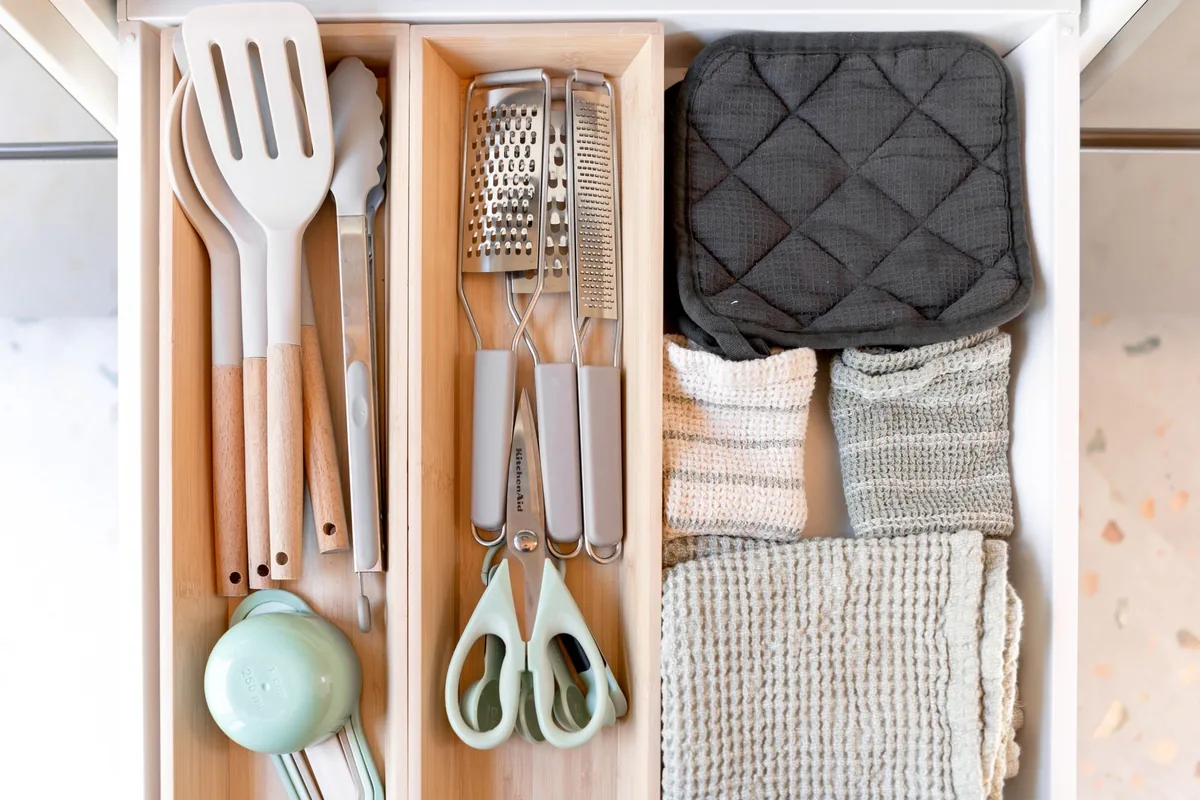
If the arrangement does not work, unload it safely and change one thing at a time within the product instructions. Check for contact gently; repeated loaded opening and closing is not a capacity or durability test.
Small changes are easier to judge. If you move everything at once, you cannot tell which change fixed the problem, and the drawer drifts back to a heap.
Frequently asked questions
What are the best dividers for deep kitchen drawers?
Choose a system designed for the actual items and load. Pegboards, fixed slots, tension dividers and lid racks differ by product; verify support, installation, clearance and the drawer and slide limits before use.
How do you keep tension drawer dividers from slipping?
Use only dividers rated and configured for the intended contents. If one slips or leans, stop and reconfigure safely. Do not assume added pads or switching to a fixed divider makes the load safe; check the exact divider, drawer and slide limits and permitted fixings.
How tall should drawer dividers be?
Start with the exact divider’s intended items, height, support and load instructions. No height ratio by itself proves that tall items cannot tip. Confirm the lowest closed-drawer clearance and do not drill into the cabinet or drawer unless both manufacturers permit that fixing method.
How do you store pot lids in a deep drawer?
A slotted section or lid rack can hold lids on edge if it is designed for their size and weight. Follow its spacing and support instructions, protect glass lids from collisions, and ensure the drawer closes without contact.
Are pegboard drawer organizers worth it?
A pegboard can be useful for organizing compatible items, but pegs in holes do not guarantee that a heavy or tall item cannot move. Check the exact system’s instructions, drawer fit and load limits before use.
Written by the SetsQuick Team. First published · Last updated .
© SetsQuick. This article and its images may not be copied or republished without permission. To report reuse, see our DMCA page.
Was this guide helpful?
Save it for later or send it to someone