
How deep should pantry shelves be? Choose enough usable depth for the assigned items while the intended user can see, remove and return them comfortably. 12–14 inches (30.5–35.6 cm) is a published eye-level planning example, not a universal pantry standard. Check the actual contents, handling route and shelf system before buying bins or changing storage.
Key takeawaysFive checks: contents, access, movement, support and the complete purchase decision.
Separate three questions: what fits while stored, what space it needs while moving, and what the shelf system is permitted to support. A container can sit inside a closed cabinet yet be difficult to retrieve. A deeper board does not resolve an obstructed door, an unsuitable support or a load the user cannot control.
How deep should pantry shelves be for your setup?
Use five checks before choosing a depth. Keep the records for each shelf rather than copying one measurement throughout the pantry:
- Contents: record the actual packages or containers, including their widest projections and any required storage orientation.
- Access: identify who must see, grasp, remove and return those contents at the proposed height.
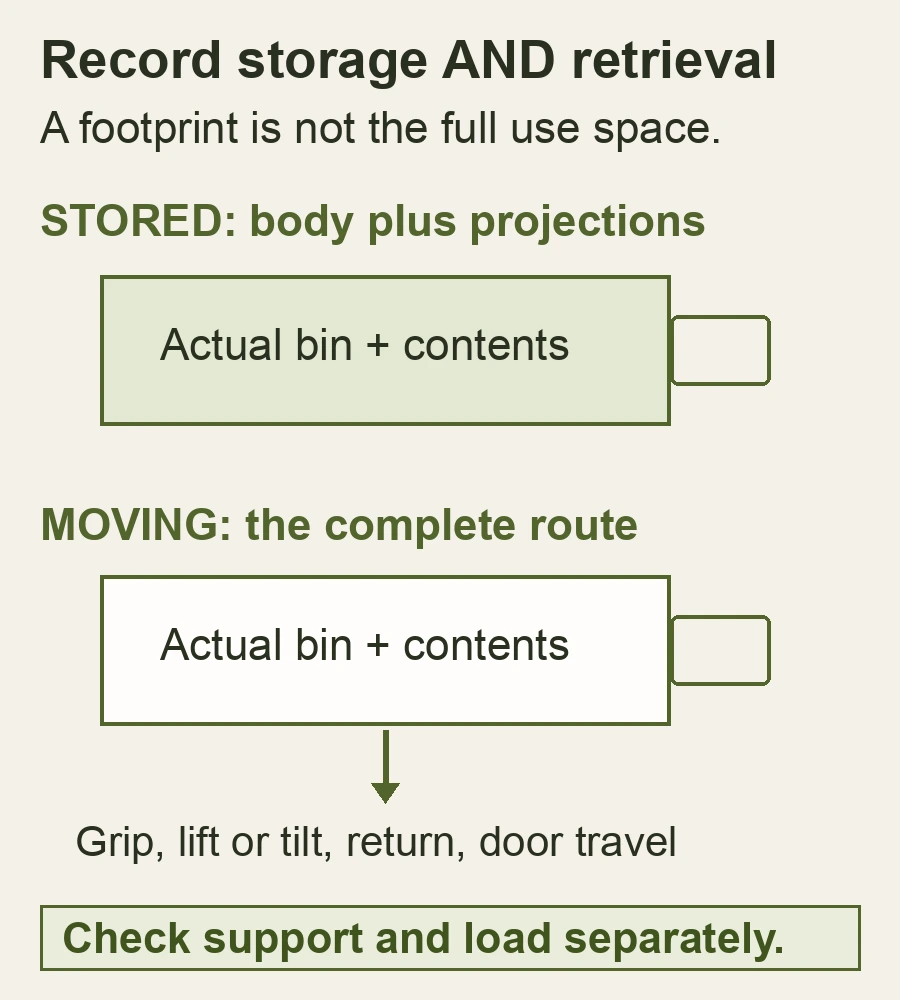
- Movement: record the full item, lid, bin, hinge and door route, not just the footprint with everything closed.
- Support: confirm the exact shelf, span, brackets, fixings and applicable load requirements before changing the arrangement.
- Purchase decision: compare the complete proposed setup with those records; leave missing fit or support details unresolved rather than assuming a standard allowance.
This Old House’s pantry planning guide suggests the eye-level example above and 16–18 inches (40.6–45.7 cm) for lower bulky-item shelves. The Kitchn’s interview with a ClosetMaid product specialist instead describes 16–20 inches (40.6–50.8 cm) for many shelves and roughly 12 inches (30.5 cm) at the top. These describe different planning arrangements, not one interchangeable specification. Do not average the ranges or turn shelf height into a load rating.
Why can the same depth work differently at another height?
A shelf can be visible from one position and hidden from another. Record the intended user’s normal approach, sightline and grasp at each level. Consider other users too; a layout that works for the person measuring may not serve someone shorter or with different mobility.
Compare the items assigned to that level. A deep appliance and a short package do not occupy or leave the shelf in the same way. Usable depth includes the permitted placement of each item, but selecting the narrowest possible footprint is not a substitute for a comfortable handling route.
Graduated depths are one option, not a requirement. Uniform shelves can also be usable when the contents, reach and support suit them. Before replacing existing shelves, consider assigning a different category or location. Do not place heavy items high merely because their footprint fits, or assume a low shelf automatically makes lifting manageable.
What does a front-row access check tell you?
On an existing sound surface with established support requirements, check a manageable set of items from the normal use position. Can the user identify what is behind the front row, grasp it and return it without awkward reaching? Do not use an unsupported temporary board, climb the shelving or load an uncertain system to discover its limit.
If access is poor, consider these alternatives independently:
- Reassign the items to a location that already provides suitable access and support.
- Choose a different shelf depth only within the storage system’s permitted configuration.
- Consider a handled container when the complete loaded unit is manageable and its removal route is clear.
- Consider a riser or pullout only when its own dimensions, support, loading and movement requirements are met.
One visible row is not an approval of shelf strength, and a hidden rear row does not automatically require a purchased organizer. Buy only for the specific access problem you have identified. A paper outline can help flag an obstruction; it cannot reproduce the weight, grip or rigidity of a loaded product.
What should you measure before buying bins?
Record each intended location without removing required liners, dismantling hardware or altering supports. Note whether a measurement refers to the board, clear enclosure or product requirement. Uneven walls, frames and brackets can change the usable space between levels.
- Measure clear width at the intended placement and along the entry/removal route.
- Measure usable depth with the actual back obstruction, front lip and permitted door positions identified.
- Measure clear height where the tallest contents and any proposed organizer must stand and move.
- Record door and hinge projections throughout their required movement, not only when closed.
- Record actual item and bin exteriors, including lids, handles, flared sides and packaging seams.
- Compare the actual lift, tilt, grip and return space with any explicit manufacturer minimum; do not substitute a generic added margin.
A lid may need room to open even when the container itself is easy to lift out. A pullout may need clearance beyond the shelf front. Keep each required space with the movement it serves, so a clear closed-door footprint is not mistaken for a complete fit check.
How is usable depth different from board depth?
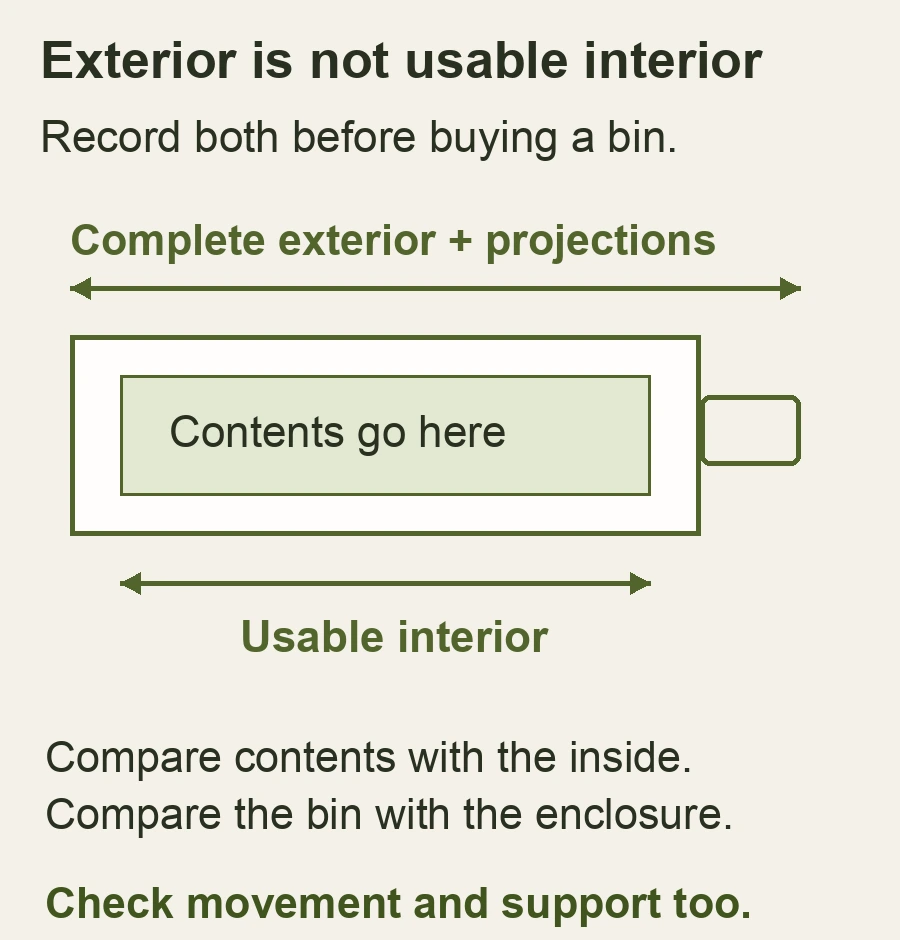
A bin advertised at the same depth as a shelf may still be unsuitable. Its handle can project beyond the body, a hinge may interrupt the path, or its sloped sides may leave less usable interior space than the exterior suggests. Check the exact product’s labelled dimensions rather than using packaging or shipping measurements.
A non-load-bearing outline of the complete exterior can flag a collision before purchase. Move it without forcing the door or reaching into a moving mechanism. Passing this check does not establish that the loaded bin can be gripped, lifted or supported. Confirm the actual product’s requirements separately; do not add weight to an outline or improvise a trial shelf.
How should the contents change the depth decision?
Cans and jars
Measure the actual cans or jars and consider how the next item will be retrieved. Counting containers across the empty depth does not establish usable rows. A riser also adds height and may change access to the back; include the containers on every intended tier and follow its loading instructions.
Cereal and tall boxes
Check the largest packaging you actually buy, including the opening and refill method. A box that fits upright may need more space to tip or grasp. Adjustable shelving can offer flexibility, but repositioning pins or adding holes must follow the exact system’s instructions; adjustability alone does not establish safety.
Baking supplies and snack packets
A manageable bin can group small packages, but loose bags do not automatically need a deep handled container. Compare the complete loaded bin with the intended retrieval route. For decanted dry goods, our clear vs opaque pantry container guide covers visibility and material choices; the container set buying checklist covers the individual containers. Keep package information and follow the food’s storage directions.
Small appliances
Record the appliance’s full stored shape, including permitted cord and attachment storage, and the handling needed to move it. A rollout adds its own load and installation requirements; it does not guarantee easier lifting or protect an unsuitable shelf. This is storage planning, not approval to operate a hot or powered appliance inside a pantry.
Corner shelves
A corner may have space that is hard to reach. Before choosing installed rotating hardware, record the actual cabinet, doors and model requirements, including mounting and loaded movement. Our 36 inch corner cabinet Lazy Susan guide explains those checks; nominal cabinet size alone does not select a shelf.
What if the existing shelves are already too deep?
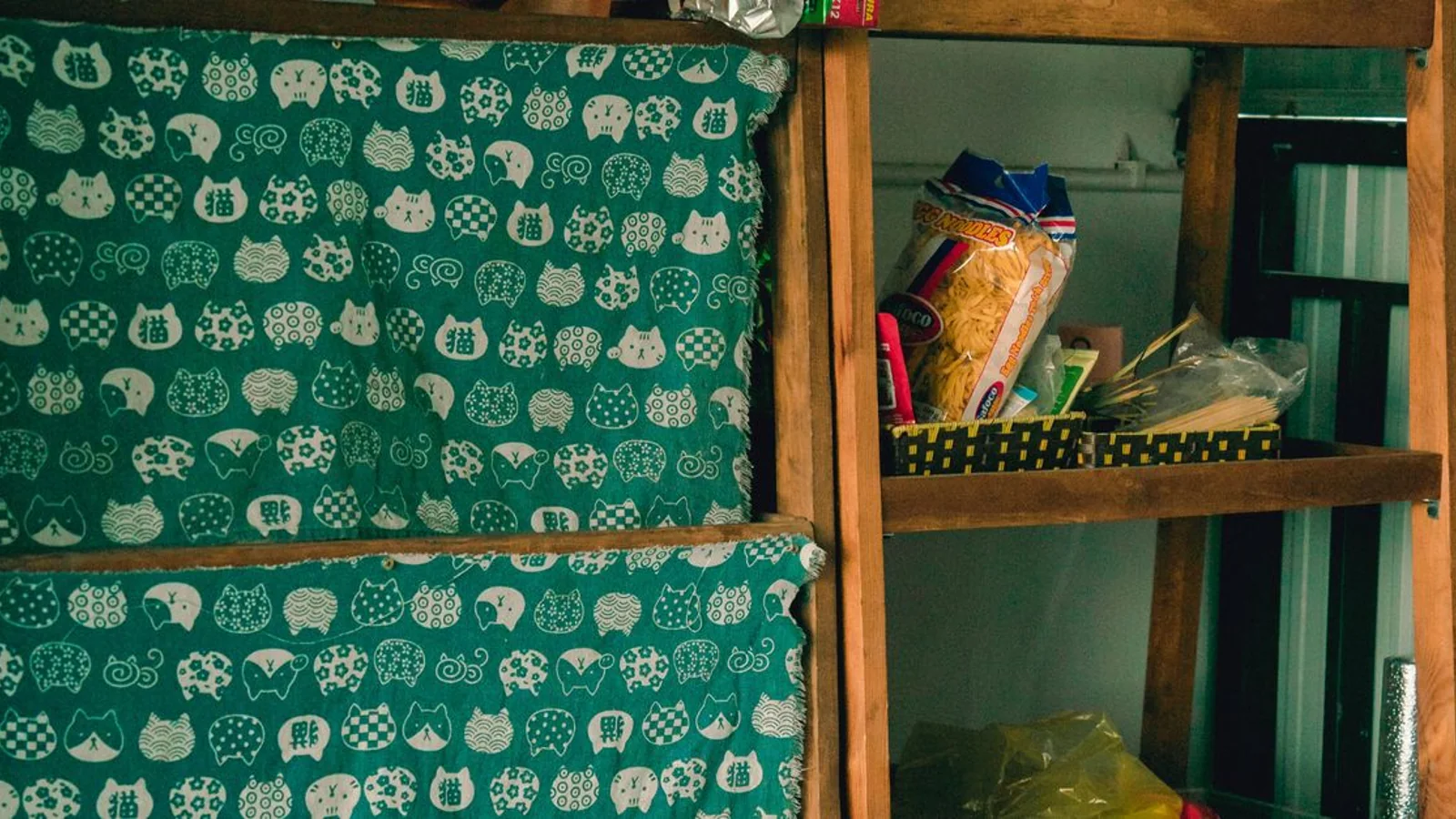
Keep suitable existing storage where possible. First determine whether the problem is visibility, grip, retrieval space or support. Changing categories may help without new hardware. If the arrangement moves, sags or no longer functions as instructed, stop using the affected setup and obtain an appropriate manufacturer or qualified assessment.
- Handled tray: compare the complete loaded unit and removal route, not just whether it covers the full shelf depth.
- Riser: check actual loaded height, stability, permitted use and access to every intended position.
- Turntable: check the complete loaded rotation, projecting contents and retrieval; a rim or an empty circle is not a fit guarantee.
- Install a rollout only if the exact cabinet, slide and organizer instructions support the dimensions, fixings and loaded weight. Use a qualified installer when the support or fixing method is uncertain.
- Additional shelf: confirm the system allows its location and supports the revised arrangement; an empty vertical gap is not installation approval.
For sorting and maintaining the shelves you already have, use our guide to organizing deep pantry shelves. It addresses existing storage, while this guide focuses on choosing depth and recording fit before a purchase or alteration. Neither a deeper bin nor a different tool is an automatic remedy for an unresolved support problem.
What should go in your shelf-depth record?
| Record | What to include |
|---|---|
| Location and user | Shelf level, approach, intended users and any access constraint |
| Assigned contents | Actual items, storage directions, largest projections and loaded weight |
| Stored space | Usable enclosure versus complete item/bin exterior |
| In-use space | Opening, grip, lift/tilt, return and full door/organizer movement |
| Support and decision | Exact system requirements; keep, change or hold, with the unresolved detail named |
For example, a tall cereal box may sit inside the enclosure but need to tilt under the shelf above during removal. That points to a height-and-handling question, not automatically a need for deeper shelving. A packet bin may fit with its handle tucked in but obstruct the door when the handle is in its normal position. Record the intended use, not an artificially compact position chosen only to make a measurement pass.
Frequently asked questions
Is 24 inches too deep for a pantry shelf?
Not automatically. A 24-inch (61.0 cm) shelf may be usable for some arrangements and difficult to access in others. Check the actual items, user, height and handling route. A drawer or rollout is a separate candidate with its own installation and loaded-use requirements, not a mandatory solution selected by depth alone.
Is 12 inches deep enough for pantry shelves?
It may be enough for some items, but a 12-inch (30.5 cm) label does not establish usable space. Record the actual package or bin, projections, door movement and retrieval. Choose a different location or product when those requirements are not met rather than assuming this depth works throughout the pantry.
Should all pantry shelves be the same depth?
No single arrangement is required. Graduated depths may help some users and contents; uniform shelves may work well in others. Check each proposed height and its assigned items. Neither shelf height nor placing weight lower establishes the system’s permitted load or the user’s lifting ability.
How much clearance should be above pantry items?
The Kitchn and This Old House publish a two-inch (5.1 cm) planning allowance, but that is not a universal fit rule. Record the actual opening, grip, lift or tilt and any product-specific minimum. A closed container fitting under the shelf does not establish that it can be opened or removed there.
Sources and scope
Sources checked November 1, 2026. This Old House supplies the height-specific depth examples; The Kitchn’s interview supplies a different planning arrangement. Both are editorial planning references, not installation documents for your shelving. Their numerical suggestions do not establish fit, permitted load or a universal reach limit. Centimeter equivalents are rounded conversions.
SetsQuick has not tested shelf loads, constructed these arrangements or measured user reach for this guide. Use the current instructions for the exact storage system and the actual contents. Stock photos are illustrative, not demonstrations of the named checks.
Featured photo by Kaboompics.com on Pexels.
Written by the SetsQuick Team. First published · Last updated .
© SetsQuick. This article and its images may not be copied or republished without permission. To report reuse, see our DMCA page.
Was this guide helpful?
Save it for later or send it to someone