
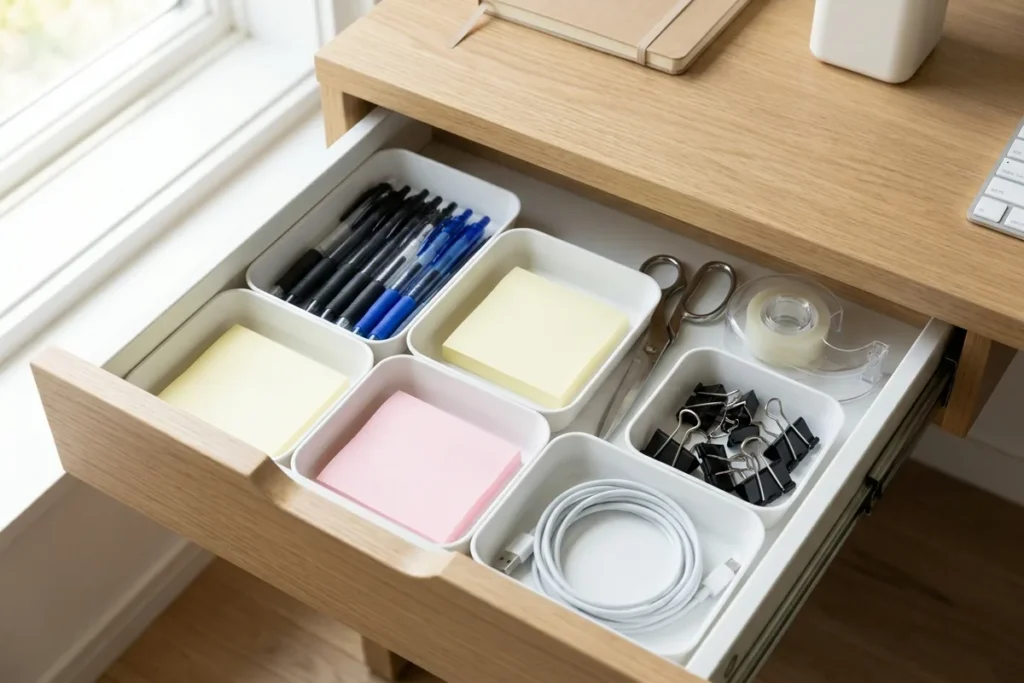
Office drawer organization begins with a simple question: what do you actually use at this desk every day? Pens, sticky notes, and chargers deserve the top drawer, while backups and paperwork belong lower down. When each drawer matches a task, supplies stop piling up and work starts faster every morning.
Give frequently used supplies an accessible home, and adapt the layout to your space.
Key takeawaysFour rules for desk drawers that stay tidy
- Top drawer for daily tools: pens, notes, and chargers within one reach.
- Middle drawer for projects: active files and current materials only.
- Bottom drawer for backups: spare supplies and reference papers.
- No unnecessary duplicates up front: keep the quantities you actually use close, and store extra supplies elsewhere.
Desk drawers collect clutter faster than almost any other storage in the home. Every stray pen, rubber band, and receipt gets swept into the nearest drawer whenever the desktop needs clearing.
In a small home, the desk often doubles as a dining table, a craft station, or a bedroom corner. That shared use means the drawers must hold more variety in less space.
The result is familiar. Dried out pens hide working ones, cables knot together, and important papers vanish beneath takeout menus and expired coupons.
This guide explains how to sort, edit, and arrange office drawers so every item has a clear home. It follows the SetsQuick method, Sort, Edit, Type, Store, and ends with a monthly routine.
Why do office drawers get cluttered so quickly?
Desk drawers become catchalls because they sit right next to where clutter appears. Clearing the desktop takes one sweep of the arm, and the drawer quietly absorbs everything without complaint.
Small supplies multiply over time. Free pens, extra paper clips, and promotional notepads arrive constantly, and few people throw them away, so the collection grows far beyond what anyone needs.
Mixed categories create confusion. When office supplies share space with batteries, mail, and personal items, finding anything specific means sifting through unrelated objects every single time.
Cables add their own chaos. Chargers, adapters, and earbuds tangle together, and unlabeled cords make it nearly impossible to know which cable belongs to which device.
Paper is another source of trouble. Bills, receipts, and notes get stacked flat in a drawer, and the stack quickly becomes too thick to search through without pulling everything out.
Without a plan, even a large desk feels cramped. Thoughtful office drawer organization assigns a purpose to each drawer, which stops random items from settling in and keeps supplies easy to reach.
How do you start office drawer organization?
Empty one drawer at a time onto a clear surface. This reveals duplicates without overwhelming a small workspace. Follow the desk maker’s stability and anchoring instructions, and avoid opening multiple loaded drawers at once.
Clean the drawers while they are empty. Vacuum crumbs and dust from the corners, wipe the surfaces, and let them dry completely before anything returns.
Sort everything into broad groups. Writing tools, paper supplies, desk tools, electronics, paperwork, and personal items each get their own pile on the table.
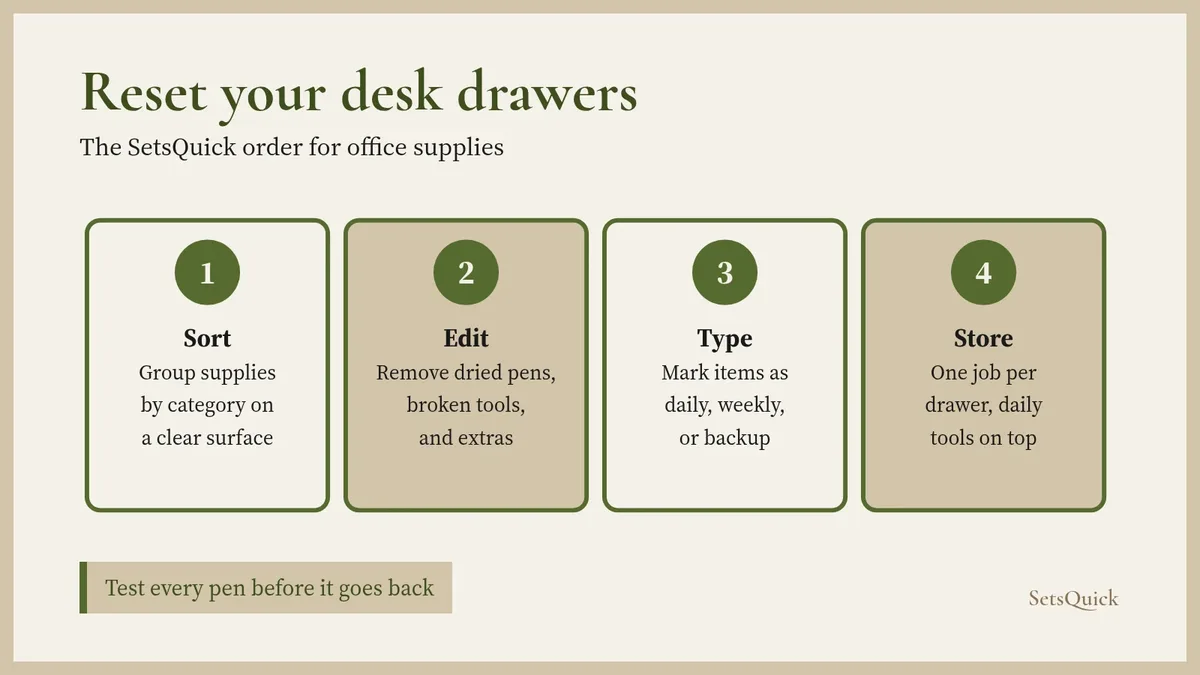
Next, edit each group carefully. Test every pen and marker, discard dried ones, and remove broken staplers, empty tape dispensers, and anything that no longer works properly.
Look closely at duplicates. Most desks need two or three pens, one pair of scissors, and one stapler, so extras can move to a backup bin or be donated to a school.
Relocate items that belong elsewhere. Kitchen utensils, toiletries, and stray toys should return to their proper rooms, so the desk drawers hold only work related items.
Keep records you still need in secure storage. For documents containing personal or account information, use an appropriate secure-destruction method and follow local recycling and record-retention rules. Not every collection service accepts shredded paper.
The steps below apply the SetsQuick method to each drawer.
- Sort: group every item by category on a clear surface.
- Edit: remove dried pens, broken tools, and extra duplicates.
- Type: label each item as daily, weekly, or backup.
- Store: give each item a place, with daily tools easy to reach.
Once editing ends, count what remains in each group. Those counts tell you how many compartments each drawer needs and how large each tray should be.
What should go in each desk drawer?
The top drawer holds daily essentials. Pens, a pencil, sticky notes, a small notepad, scissors, tape, and a phone charger belong here, within easy reach from the chair.
Arrange the top drawer by frequency. Place the tools you use most at the front, and push occasional items like a ruler or a calculator toward the back.
The middle drawer suits current projects. Keep active folders, notebooks, and materials for ongoing work here, so they stay close without cluttering the desktop surface.
The bottom drawer works best for backups and reference. Spare notebooks, refill packs, extra printer paper, and long term documents belong in this deeper space.
If the desk has a file drawer, use it for hanging folders. Vertical files keep paperwork organized and visible, which makes it much easier to find a specific document quickly.
Successful office drawer organization depends on these clear zones. Desks with only one drawer need careful priorities. Keep daily essentials in that drawer, and move backups to a nearby shelf, a rolling cart, or a labeled box under the desk.
Make the layout fit your desk: Keep frequently used tools close and put backups farther away. If you have only one drawer, divide it into zones; you do not need a separate drawer for every task.
Personal items deserve a small zone too. A lip balm, hand cream, or pair of reading glasses can occupy one small tray, so they do not wander among office supplies.
Which organizers work best in office drawers?
Small, separate trays offer the most flexibility. Unlike a single fixed insert, individual trays can be rearranged whenever your needs change, and they adapt to unusual drawer sizes.
Measure each drawer before buying anything. Record the inside width, depth, and height, and note any slides or stops that reduce usable space at the back.
Choose shallow trays for small supplies. Paper clips, binder clips, and push pins disappear in deep containers, while shallow trays keep everything visible at a glance.
Use long, narrow trays for writing tools. Pens and pencils lie side by side in a single layer, which makes choosing the right color simple and prevents tangling.
Label tray sections when several people use the desk, so supplies return to the correct spot. Select a deeper container for bulkier items. A stapler, a tape dispenser, or a hole punch fits better in a taller section, keeping it from crushing smaller supplies nearby.
Drawer liners add stability. A thin, nonslip liner stops trays from sliding when the drawer opens, which keeps the whole layout neat and quiet.
Clear trays help in deep or dim drawers. Transparent sides let light reach the contents, so you can identify supplies without lifting each container out.
Avoid buying organizers in bulk before planning. A large matching set looks efficient, yet half the pieces often go unused, and those leftovers become clutter themselves.
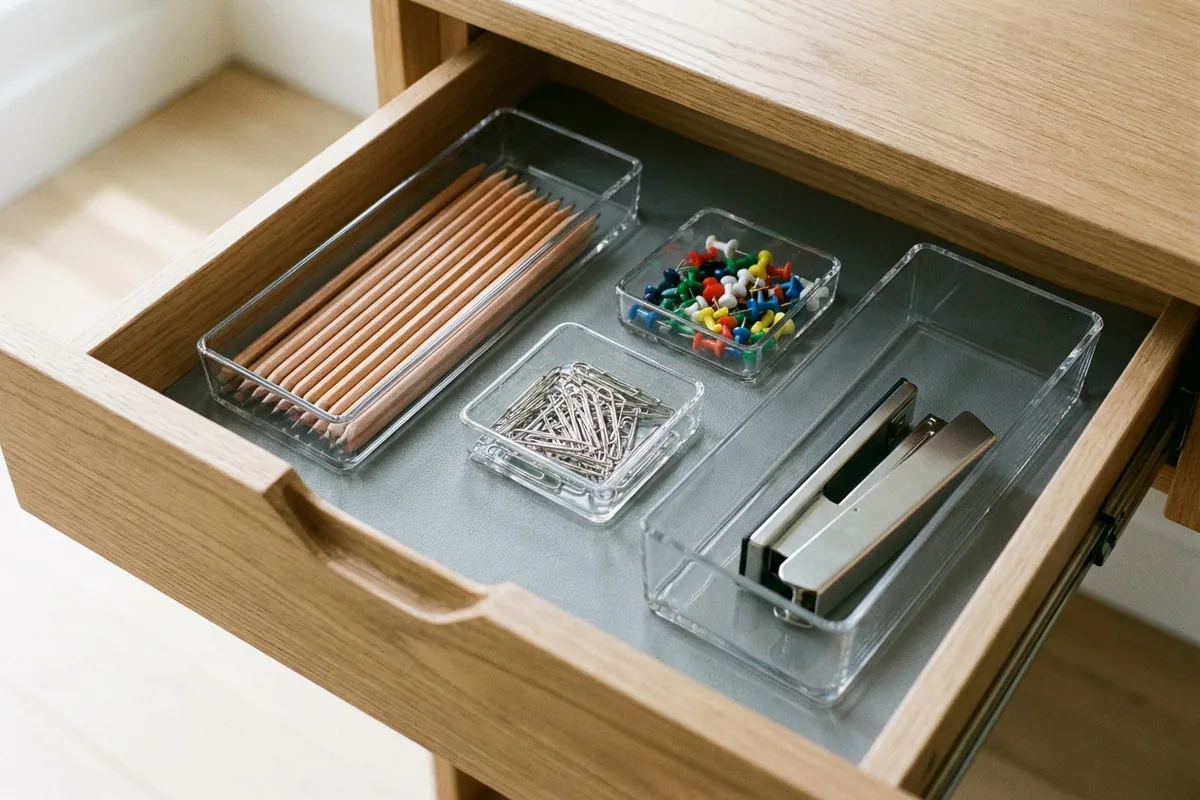
Consistent office drawer organization benefits from matching trays. When containers share one color and height, the drawer looks calm, and missing items are easier to notice.
How do you organize cables and chargers in a desk?
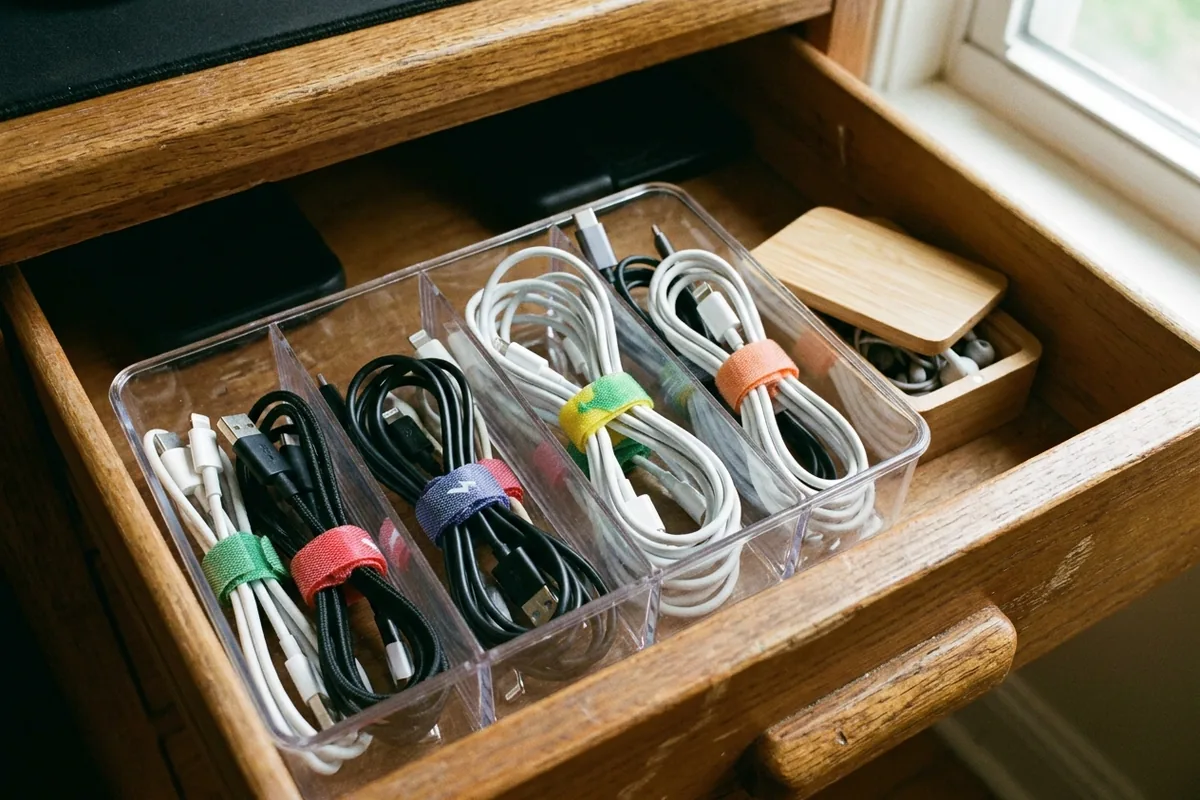
Cables need their own system, because they tangle with everything they touch. Giving each cord a defined spot prevents knots and saves time when you need a specific charger.
Follow the cable or device manufacturer’s storage and bend-radius guidance. Avoid sharp bends, crushing, tension and tight ties; coil only where appropriate for that cable and do not force a loop size. Keep damaged cables out of use and use a compatible replacement.
Label cables at both ends. A small tag showing the device name removes all guesswork, which is especially helpful when several chargers look nearly identical.
A divided container can separate spare cables. Coil only those for which the manufacturer permits it, without forcing a bend or using tight ties.
Group earbuds, memory cards, and flash drives in a small lidded box. Store spare batteries separately in their original packaging or a suitable battery case, protecting terminals from contact with metal and other batteries. Keep button and coin batteries securely out of children’s reach; see CPSC guidance.
Do not operate a power strip or extension cord in a closed drawer or under a covering. Use equipment according to its instructions and ratings, do not overload or daisy-chain power strips, and remember that extension cords are temporary, not permanent wiring.
Keep frequently used chargers outside the drawer. A charging station or a small dock on the desk keeps daily devices powered, while spare cords stay neatly stored inside.
For cables or adapters you no longer need, check local electronics collection or reuse programs and their acceptance rules. Keep damaged or unsafe accessories out of use; do not assume every charger belongs in ordinary household recycling.
How do you keep office drawers organized?
A short routine keeps the system working. At the end of each workday, return tools to their trays and clear any papers that landed in the drawers during the day.
Schedule a monthly reset. Test pens, toss dried ones, file loose papers, and check backup supplies so you know what to restock before anything runs out.
Use a one in, one out rule for new supplies. When a new stapler or notebook arrives, remove an older one, so drawers never exceed their capacity.
Process paper promptly. Sort mail and receipts right away into action, file, or recycle, and the drawers will never fill with forgotten documents again.
Keep a short restock list taped inside the top drawer. When a supply runs low, write it down immediately, and the next shopping trip will cover everything without guesswork or duplicate purchases.
Celebrate small wins along the way. A clear drawer at the end of the week reinforces the habit, and the routine soon feels automatic rather than like another chore.
Review the layout each season. Work patterns change, and a quick look shows which trays sit unused and which supplies need more room, so the drawers keep matching your routine.
How do you organize a small or shared desk?
Small desks demand stricter priorities. When drawer space is limited, keep only daily essentials inside, and move everything else to a wall shelf, a pegboard, or a slim rolling cart beside the desk.
Vertical space extends a tiny desk. A wall rail with small cups or a monitor stand with a shelf underneath can hold supplies that would otherwise overcrowd the drawers.
Shared desks need clear boundaries. Assign each person a separate drawer, or divide one drawer into labeled halves, so nobody borrows supplies without returning them.
Desks that double as dining tables need portable storage. A lidded caddy holding daily supplies can move to a shelf at mealtime, then return when work begins again.
Students and remote workers often share space at home. A simple color code, with one tray color per person, makes office drawer organization obvious for everyone in the household.
Whatever the desk size, the principle stays constant. Daily tools sit closest, backups move farther away, and each drawer keeps one purpose, so the workspace remains clear and functional.
For more ideas in tight spaces, browse the small space guides and the whole home guides, or start with the free reset checklist.
Frequently asked questions
How do you organize office desk drawers?
Empty one drawer at a time, sort by category, and remove unusable or unnecessary items. Keep daily tools within reach and backups farther away. Use trays or a liner if useful; a single drawer can hold several labeled zones.
What should be in the top drawer of a desk?
The top drawer should hold daily essentials such as pens, a pencil, sticky notes, a small notepad, scissors, tape, and a phone charger. Place the most used tools at the front, and keep occasional items like a ruler or calculator toward the back of the drawer.
How do you store paperwork in a desk drawer?
If space permits, use hanging folders in a file drawer or an upright file box in a sufficiently deep drawer. Sort papers into action, file, and secure-destruction or recycling groups, following retention and local disposal rules.
How do you keep cables organized in a desk?
Store each cable according to its manufacturer’s bend and storage instructions, without crushing or tightly tying it. Label its device and keep it separately if useful. For unwanted cables and adapters, use a local collection route that accepts them; damaged accessories should not be put back into use.
How often should you clean out desk drawers?
A quick daily tidy keeps tools in their trays, and a monthly reset keeps the system working. During the monthly reset, test pens, file loose papers, and check backup supplies. A seasonal review helps adjust the layout as your work routine changes over time.

Written by the SetsQuick Team. First published · Last updated .
© SetsQuick. This article and its images may not be copied or republished without permission. To report reuse, see our DMCA page.
Was this guide helpful?
Save it for later or send it to someone