
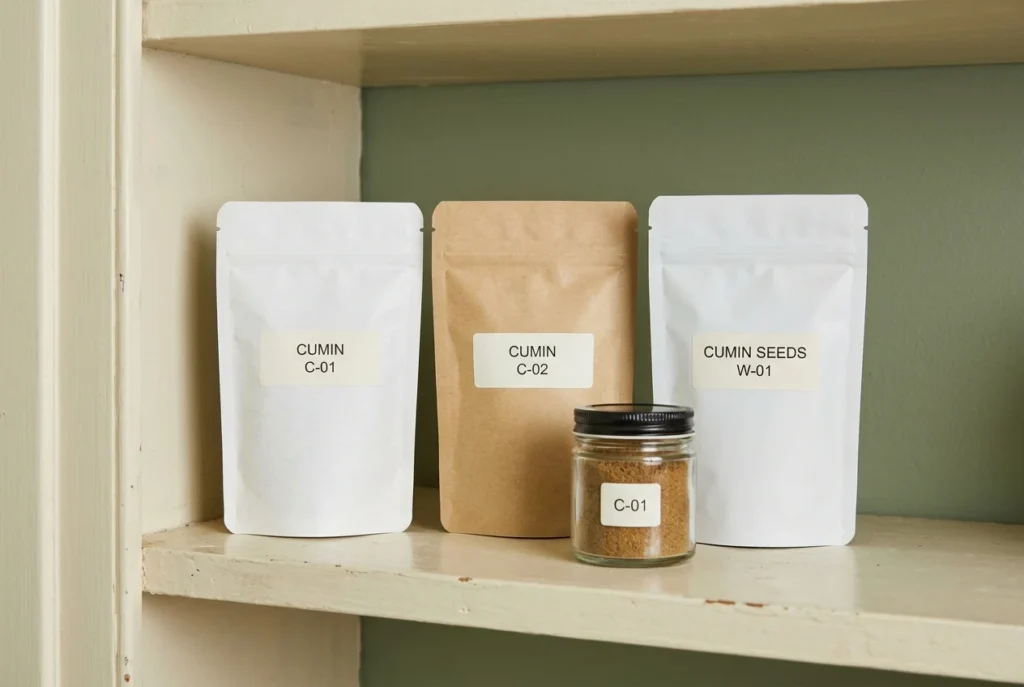
To organize spice refill bags, keep each product identifiable, choose one opened package to use at a time, and store the remaining packets in a separate, easy-to-check backstock group. Keep the original ingredient and date information with each package. A small bin can keep packets together, but it does not replace the package closure or the manufacturer’s storage instructions.
Cover image: AI-generated fictional inventory example. Simplified references do not reproduce complete package labels; retain the actual ingredients, dates and product directions.
Use three decisions: identify, assign, and record. Identify the exact spice or blend, assign the packet to “in use” or “unopened reserve,” and record where it lives. Do not pour unrelated batches together just to make a storage bin look tidier.
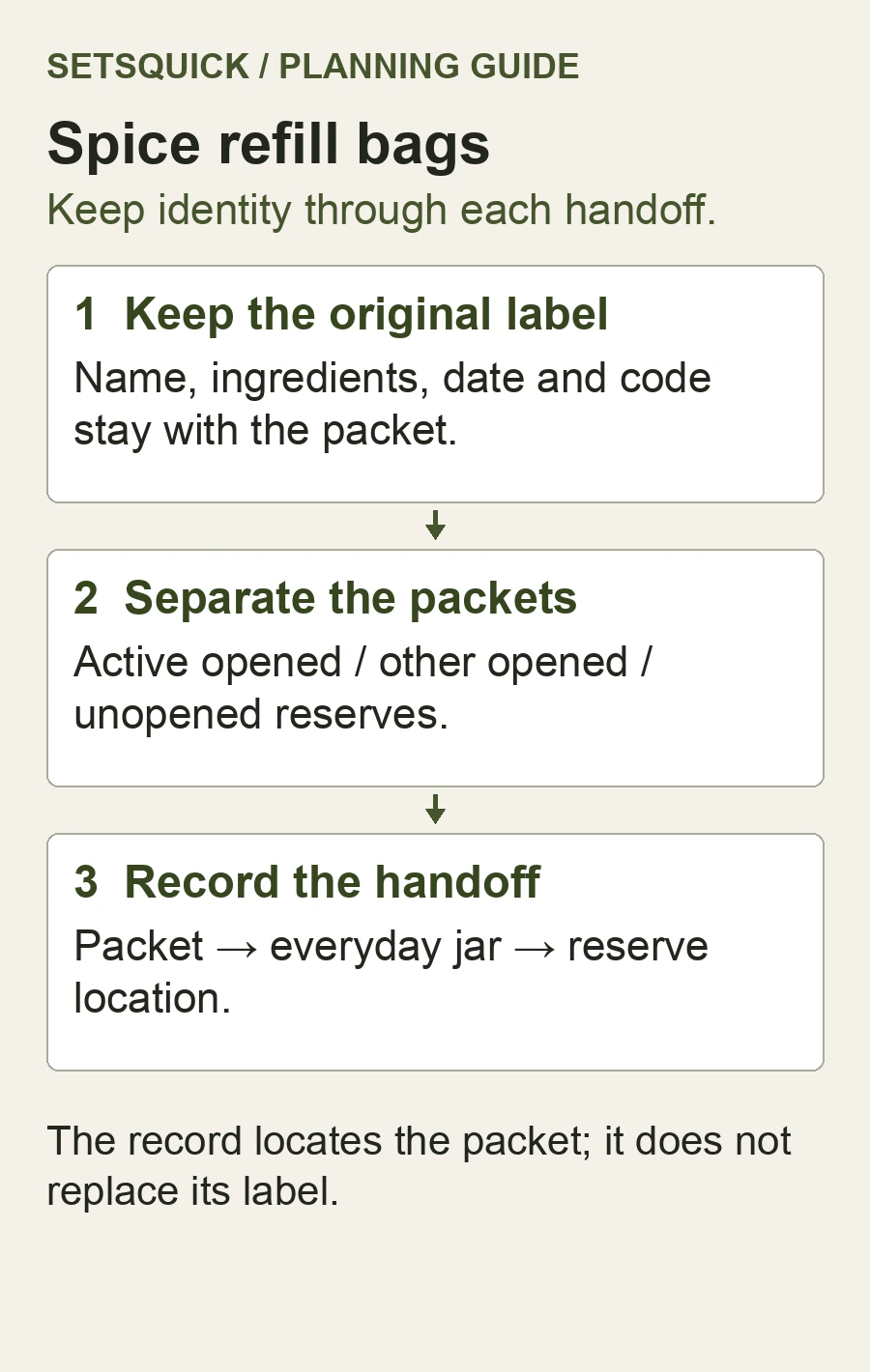
This guide addresses refill packets and the handoff between backstock and an everyday spice container. For choosing a cabinet rack or arranging the jars you cook from, see our small-kitchen spice rack guide and spice drawer organization guide. The workflow and records below are original editorial tools, not a storage-life experiment.
What information should stay with a spice refill bag?
Before reorganizing, check that you can identify the actual product, not just the broad ingredient. Ground cinnamon, cinnamon sticks, and a cinnamon-containing blend are different entries. Two blends with similar names may have different ingredients.
- Exact name and form: whole, ground, flakes, or a named blend.
- Brand and package details: enough information to distinguish similar purchases.
- Ingredient and allergen information: retain the current package, not a label remembered from a previous purchase.
- Printed date and lot or batch code: preserve what is present rather than inventing a replacement date.
- Storage and preparation directions: keep any product-specific requirements readable.
McCormick’s ingredient and storage FAQ says to read the ingredient statement on the package at purchase because formulas may change. It also advises storing its herbs and spices in tightly capped containers away from heat, moisture, and direct sunlight. That is a reason to keep labels and follow actual product directions—not proof that every refill pouch provides the same protection as a sealed jar.
What if the product name is all you can still read?
Do not guess a blend’s ingredients or copy the date from a different package. Set the unidentified packet apart from the ready-to-use group while you resolve the missing information with the supplier. An organizer label cannot establish that an unknown product is suitable for someone’s dietary needs.
How do you organize spice refill bags by active use?
Start with the packages you already own. Make one group for a packet currently supplying an everyday jar, and another for unopened reserves. If you cook straight from an opened pouch, that pouch is the active package; you do not need a second jar just to follow this system.
Choose which package to use by its label, condition, and product instructions, not simply by which one you bought first. This is an inventory method, not permission to use a damaged, recalled, or otherwise unsuitable product.
What should you do with two already-open bags?
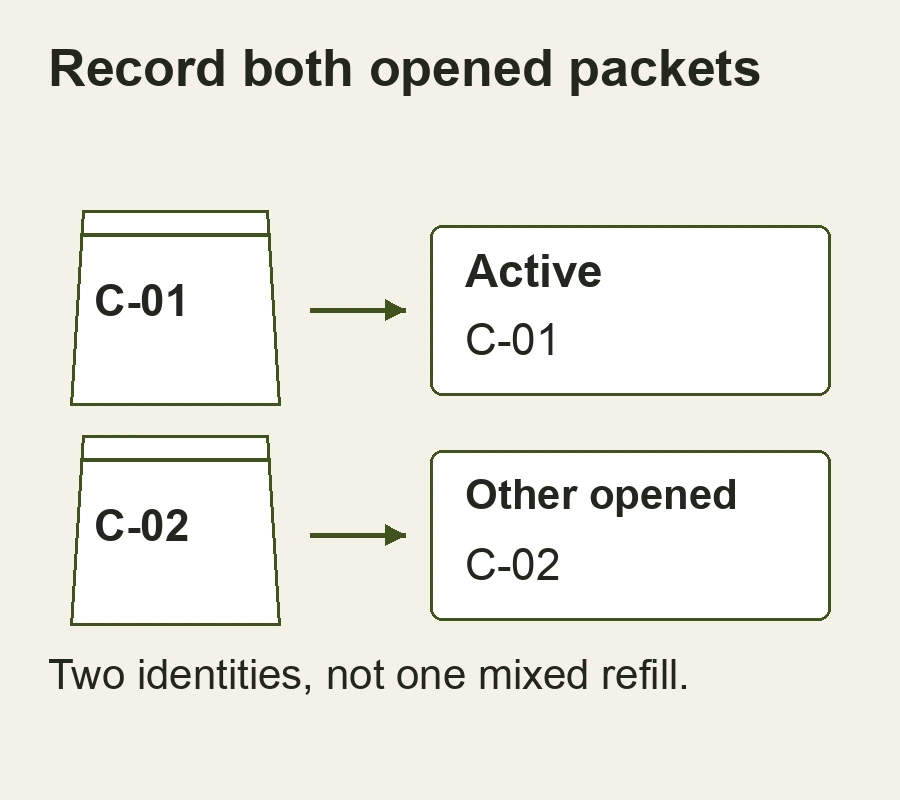
Keep them separately identified. Make a clear note of the package you are using now and the other package’s location. Do not combine them merely to create one full-looking bag or overwrite their different dates with a new “opened today” label.
The purpose is traceability: if you merge two packages, your simple record no longer tells you which contents came from which label. Choosing not to merge them is a practical workflow rule here, not a claim that a particular arrangement prevents contamination.
Should you file refill bags alphabetically or by cooking use?
Use the question you actually ask when looking for a packet. If you think “where is the cumin?”, an alphabetical group may be the simplest. If the collection is small and you usually retrieve baking ingredients together, a cooking-use group may be more natural.
- Alphabetical: useful when several people need to find one named ingredient. Its drawback is maintaining the order when a packet is returned.
- By use: useful for a clearly defined group such as baking. Its drawback is ambiguity when the same spice belongs in several kinds of cooking.
- One small visible group: useful when you own only a few packets. Its drawback is that the method stops being useful if the collection grows into a mixed pile.
There is no required number of zones. Choose one location per package. Do not divide a single reserve packet between several categories to make the categories appear complete.
How do you choose a bin without losing the labels?
Try a suitable container you already own before buying. Compare the usable inside dimensions with the filled packets in their intended position, and check the container’s outside dimensions against the shelf and opening. A stated capacity in liters or quarts does not tell you whether the tallest packet or its closure will fit.
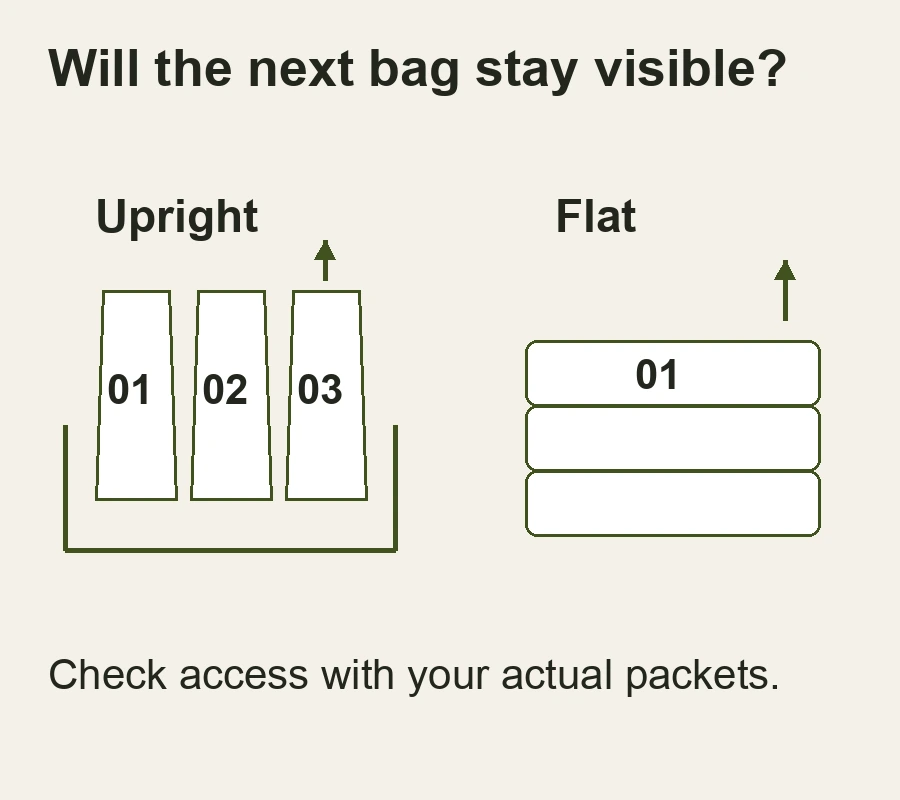
For upright storage, check whether the packets stay identifiable when the front one is removed. For flat storage, check whether selecting the bottom packet requires unloading the collection. Do not bend printed instructions out of sight or rely on a bin lid to close an inadequately sealed food package.
Keep the location compatible with the actual products’ directions. McCormick’s FAQ cautions against heat, moisture, and direct sunlight, including locations over the stove, dishwasher, or sink. This guide does not assign one storage location to every seasoning or override a product’s refrigeration requirement.
What should a refill handoff record contain?
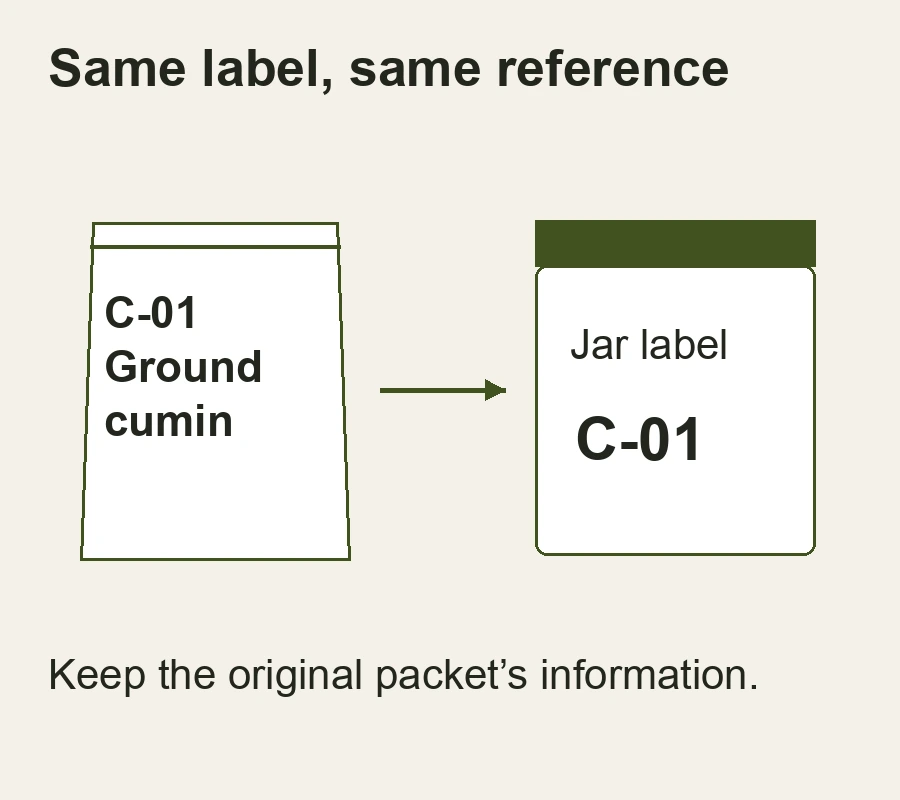
Give the opened package and its everyday container a matching reference. The reference is a location aid; it is not a substitute for the manufacturer’s label.
| Refill record | Your entry |
|---|---|
| Exact spice or blend and form | ________________ |
| Current package reference | ________________ |
| Original label and code location | ________________ |
| Opened packet location | ________________ |
| Other opened packets and identity notes | ________________ |
| Everyday container, if used | ________________ |
| Unopened reserves and their location | ________________ |
| Next action before buying more | ________________ |
What does a completed entry look like?
Fictional example: “Ground cumin; packet C-01; printed label retained on the packet; opened packet in the in-use group; everyday container marked C-01; one separately labeled unopened packet in the reserve group.” This demonstrates the link between locations. It supplies no expiry date, storage-life estimate, or tested refill quantity.
What should you check before refilling a jar?
- Match the exact product. Check the current package rather than relying on a familiar color or jar shape.
- Check the container and product directions. Do not refill a damp or dirty jar. Use only a container suitable for the intended food use.
- Keep identities separate. For this record system, do not top a different batch over an unidentified remainder. Resolve the earlier contents before assigning the jar to the next package.
- Retain the package information. Keep the original packet and its information readable. If transferring the contents is appropriate, retain the original label and product directions; an external record supplements them rather than replacing them. Do not put a paper label into the food.
- Update the locations. Note which packet now supplies the jar and what remains in reserve.
A matching record does not verify cleanliness, allergen control, or the quality of the spice. Follow the actual products’ requirements. Avoid making the storage system more complicated than the collection it supports.
How would this work with similar-looking packets?
Fictional planning example: you find two packets of ground cumin and one of whole cumin. You assign C-01 and C-02 to the ground packets and W-01 to the whole seeds. Those references distinguish packages; they do not establish freshness, safety, or an order of use.
C-01 is the opened packet currently supplying the everyday jar. Its original label stays with it, while the jar and location record carry the matching reference. C-02 remains separately identified in the reserve group. W-01 has its own entry because whole seeds and ground spice are not the same form, even when the spice name looks familiar.
A second cook can now check the jar reference, find its source packet, and read the actual information before refilling. If C-02 is opened while C-01 still exists, record both as opened rather than treating their contents as one anonymous refill. Update the active reference only after deciding which package is suitable to use.
The useful check is whether another person can follow the record without guessing. If they cannot distinguish the packages, improve the written identities before adding more dividers. This example is not a household test or a recommendation to keep a particular quantity.
Frequently asked questions
Can you keep spice refill packets in a drawer?
Only choose a drawer that suits the products’ storage requirements and lets you close, identify, and retrieve the packets without catching them. Its location and usable dimensions matter more than the fact that it is a drawer.
Do you need matching jars for every refill bag?
No. An appropriate original package can remain the active package when its instructions allow that use. The record simply identifies what you are using and where the reserve lives.
Should you combine spice packets with the same name?
For this workflow, keep separately labeled packages distinct rather than merging their identities. The same name does not establish matching ingredients, dates, or batch details. Check the actual labels and supplier guidance.
Does a storage bin make spices last longer?
This guide has not tested that. A bin organizes packages; it does not establish a new shelf life or replace product-specific packaging, closure, and storage instructions.
What should you do next?
Choose one spice with duplicate or refill packets. Identify every package, assign the one currently in use, and write one location record. Use the same simple method for the remaining packets only if it makes the next refill easier to understand.
Written by the SetsQuick Team. First published · Last updated .
© SetsQuick. This article and its images may not be copied or republished without permission. To report reuse, see our DMCA page.
Was this guide helpful?
Save it for later or send it to someone