
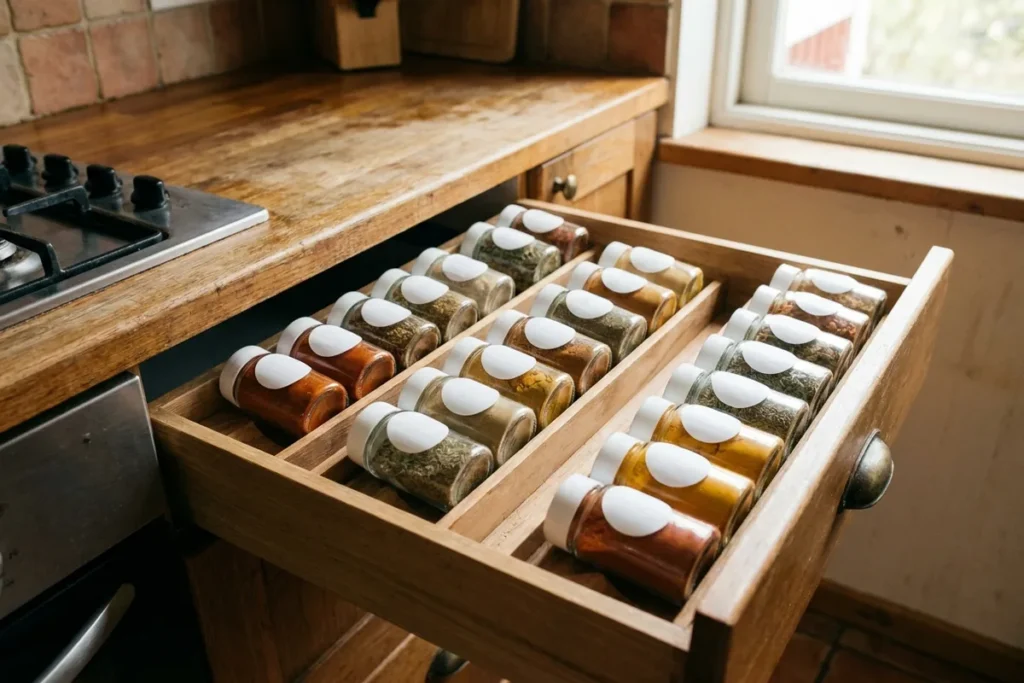
A spice drawer can make jars easier to see and reach. Label the surface visible in your chosen layout, whether the lids of upright jars or the sides of angled jars.
Make the visible label easy to read, and retain the original product information.
Key takeawaysFour rules for a readable spice drawer
- Label the visible surface: use lid labels for upright jars or readable side labels for angled jars.
- Choose a layout: alphabetize or group by cooking style and frequency.
- Fit the jar height: measure the drawer before choosing jars or inserts.
- Keep heat away: choose a cool, dry spot away from appliances and direct sun.
Spices tend to multiply quietly in most kitchens. A recipe calls for one jar, a gift set brings ten more, and soon the cabinet holds three half-empty jars of paprika hidden behind the cinnamon.
Moving them into a drawer changes how you see the collection. Instead of reading side labels on the front row only, you look straight down at every jar, which makes gaps, duplicates, and favorites obvious right away.
This guide covers how to choose the drawer, measure for jars, pick a layout, and label everything so the system stays readable. Each step follows the SetsQuick method, Sort, Edit, Type, Store.
Why move spices into a drawer at all?
Cabinets stack jars in rows, and only the front row is easy to read. Every jar behind it needs to be lifted out, checked, and put back, which turns a quick pinch of pepper into a small search.
That hidden back row is where duplicates come from. When you cannot see a jar, you assume it is missing and buy another, so the cabinet slowly fills with repeats of the same few spices.
A fully opening drawer may make labels easier to scan, but visibility depends on the drawer, jar height and insert.
A suitable drawer can make jars easier to reach. Gather spices before cooking so you do not leave a hot pan unattended while searching.
Not every kitchen has a spare drawer, and that is fine. Even a shallow drawer can hold the spices you use most, while slower ones stay in a cabinet nearby. Spice drawer organization can start small and grow later.
How do you set up spice drawer organization?
Start by choosing the right drawer. It should be close to where you cook, but not right beside the oven, since steady heat can dull spices faster than a cooler spot.
Next, empty every spice from the cabinet, the counter, and the pantry onto one table. Seeing the full collection at once is the only way to spot duplicates and plan the space honestly.
Set up the drawer: Check labels and condition, group jars in a way that suits your cooking, and label the visible surface. Smell and color indicate quality, not whether a spice is safe.
Check each jar’s label, condition and date. A faded color or weak aroma may indicate reduced quality, but normal smell or appearance does not prove a spice is safe. The FDA notes that harmful bacteria may be present even when food looks and smells fresh; follow recall notices and discard suspect or contaminated products.
Prefer finishing an older jar before opening another. Keeping products and lots separate preserves their dates, ingredient and allergen information and makes recalls easier to check. Do not mix suspect or contaminated contents with fresh spices.
The steps below apply the SetsQuick method to a single spice drawer, so the setup stays simple and repeatable.
- Sort: group jars into baking spices, savory spices, blends, and dried herbs.
- Edit: review labels and condition, use older stock first and keep products and lots identifiable.
- Type: rank each group by how often you cook with it.
- Store: place the most used group at the front of the drawer.
Keep the most used spices in the front rows. Salt, pepper, garlic, and the few spices you reach for weekly should sit closest to the drawer front, where your hand lands first.
Place less-used spices farther back if the drawer opens enough to reach them comfortably.
How do you measure a drawer for spice jars?
Measure the inside height of the drawer first. Then measure the height of your tallest jar, including its lid, since a jar that is too tall will catch the counter frame and stop the drawer.
Measure the inside width and depth next. Those two numbers tell you how many rows of jars will fit, and they help you compare inserts before buying anything for the space.
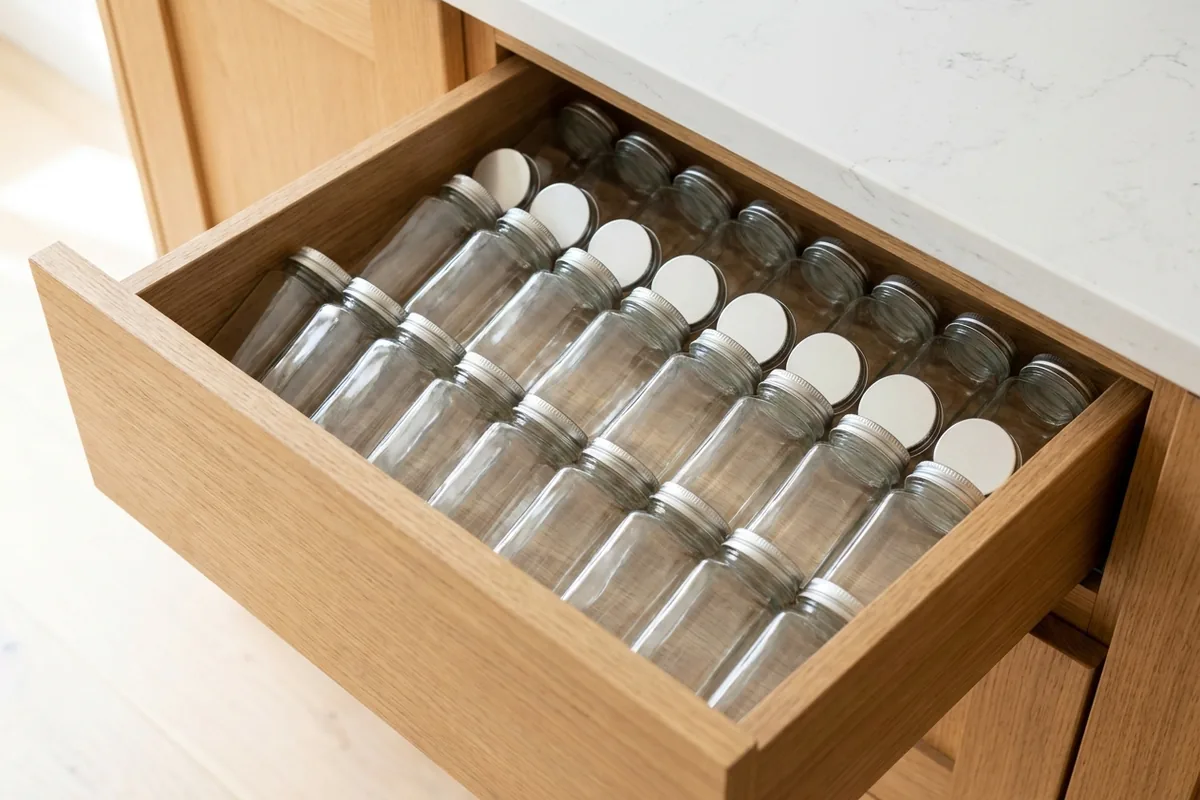
If jars are too tall to stand, a suitable angled insert may work. Check that closed jars fit and clear the frame, and keep the labels visible.
Test the fit with two or three real jars before filling the whole insert. Close the drawer slowly and listen for any lid scraping the frame above it.
If jars stand upright, a flat drawer liner can be enough. A thin, grippy liner keeps jars from sliding when the drawer opens and closes, and it costs far less than a full insert.
Expandable inserts help when the drawer is an unusual width. They slide open to fill the space edge to edge, which stops jars from drifting into the gaps along the sides of the drawer.
Matching jars make measuring easier but are not required. Mixed jar sizes work well when you group them by height, with the shortest jars in front and taller ones behind them.
Write your measurements down before shopping. Spice drawer organization goes faster when you can compare each insert against the real numbers rather than a guess made in the store aisle.
Which layout keeps spices easy to find?
Alphabetical order works well for large collections. It removes guesswork, since anyone in the house can find a spice by name, and it makes missing jars obvious at a glance.
Grouping by cooking style suits smaller collections. Baking spices sit together, savory spices sit together, and blends get their own row, so one recipe pulls from one area of the drawer.
Choose an order: Alphabetize the whole collection, group by cooking style, or reserve a separate front section for frequent choices and alphabetize the remainder.
A frequency-first layout puts frequently used jars at the front; a strictly alphabetical layout may place them elsewhere. Choose the trade-off that suits you.
A combined approach often works best of all. Group by cooking style first, then sort each group alphabetically, so the drawer stays logical while every row remains easy to scan.
Leave a small empty space at the end of each group. That gap gives a new jar a home right away, so it does not end up stacked on top of the others or forced into the wrong row.
Keep refill packages tightly closed in a cool, dry pantry according to their labels. Finish the existing jar before transferring a refill, and retain product, allergen, lot and date information; never add a refill to suspect contents.
Think about the people who cook with you as well. If a partner or older child often makes dinner, walk them through the layout once, so the system does not depend on a single person remembering it.
If the drawer is shared, write a short layout key on the drawer side or outside a container, away from food-contact surfaces. A simple note helps every cook in the house put spices back in the right row.
Good spice drawer organization depends on the layout matching how you actually cook. If you bake often, give baking spices the front, and if you cook savory meals nightly, put those first.
For a corner cabinet option, see the guide to the best lazy susan for a corner cabinet. Explore more kitchen and pantry guides, or begin with the free reset checklist.
How do you keep spices fresh in a drawer?
A drawer can be a useful storage place if it stays cool and dry. Freshness still takes some care, though. Good spice drawer organization keeps flavor in each jar, not just the jars in neat rows.
Pick a drawer away from the stove, the oven, and the dishwasher. Heat and steam from those appliances can cause spices to lose flavor faster and make powders clump. One cabinet of separation does not guarantee a cool location; check the actual conditions and appliance instructions.
Shelf-life figures are approximate quality guides, not universal safety deadlines. Follow the label and the producer’s guidance for the exact spice. McCormick’s storage and shelf-life guidance says to use product best-by dates and keep spices tightly capped, away from heat, moisture and direct sun. Other products and conditions may differ.
Write the date on each lid when you open a jar. A small label or a marker line is enough. When you reset the drawer, a quick look at the dates shows which jars to use up first and which to replace.
A weak aroma or faded color can suggest diminished flavor, but cannot rule out contamination. Check for recalls and discard products you suspect are contaminated; follow the producer’s directions.
Buy quantities that match your use rather than assuming a smaller jar guarantees freshness. Keep the product tightly closed as directed and retain its date and identifying information; do not refill a damp or dirty container.
Keep a short shopping list taped inside a nearby cabinet door. When a jar runs low, add it to the list right away. That habit prevents duplicate purchases, which are one of the most common reasons spice drawers overflow.
During each reset, wipe the drawer floor and the insert with a dry cloth. Spilled powder attracts moisture and pantry pests, and a clean drawer makes it easier to spot a lid that is not sealing well.
Consistent placement matters more than perfect alphabetical order, especially in a busy household. Return each jar to the same slot every time you cook. When the order stays fixed, a quick glance shows what is missing, and refills go straight back where your hand expects them. Over time, that steady order makes cooking noticeably faster.
Choose a cool, dry location: Avoid heat, moisture and direct sun. Distance alone does not prove a drawer stays cool; check the appliance instructions and conditions in your kitchen.
Frequently asked questions
How do you organize spices in a drawer?
Check labels and condition, then group jars in a useful order. Use older stock first and keep products and lots identifiable. Label the surface you can see and choose a suitable insert if needed.
Should spice jars stand up or lie down in a drawer?
It depends on the drawer height. Stand jars upright when the tallest jar, lid included, clears the counter frame with room to spare. If jars are too tall, lay them on an angled insert that tilts each row upward, so side labels stay readable while the drawer closes freely.
How do you label spices in a drawer?
Label lids for upright jars or the visible sides of angled jars. Retain the original ingredient, allergen, lot, date and storage information.
Where should a spice drawer be in the kitchen?
Choose a cool, dry drawer away from the stove, oven, dishwasher and direct sun. Check actual conditions and the appliance and spice manufacturers’ instructions; proximity alone does not guarantee a suitable temperature.
How do you keep a spice drawer organized?
Return each jar to its row right after cooking, and keep a small gap at the end of each group for new jars. Periodically check labels, dates, condition and recalls; replace spices that have lost flavor and discard suspect products. Smell alone cannot establish safety.
What if there is no spare drawer for spices?
Move only the spices you use most into a small drawer, and keep slower ones in a cabinet nearby. A shallow drawer still fits a handful of daily jars. For the cabinet, a turntable or a tiered shelf helps you see the back rows without lifting every jar.
Written by the SetsQuick Team. First published · Last updated .
© SetsQuick. This article and its images may not be copied or republished without permission. To report reuse, see our DMCA page.
Was this guide helpful?
Save it for later or send it to someone