
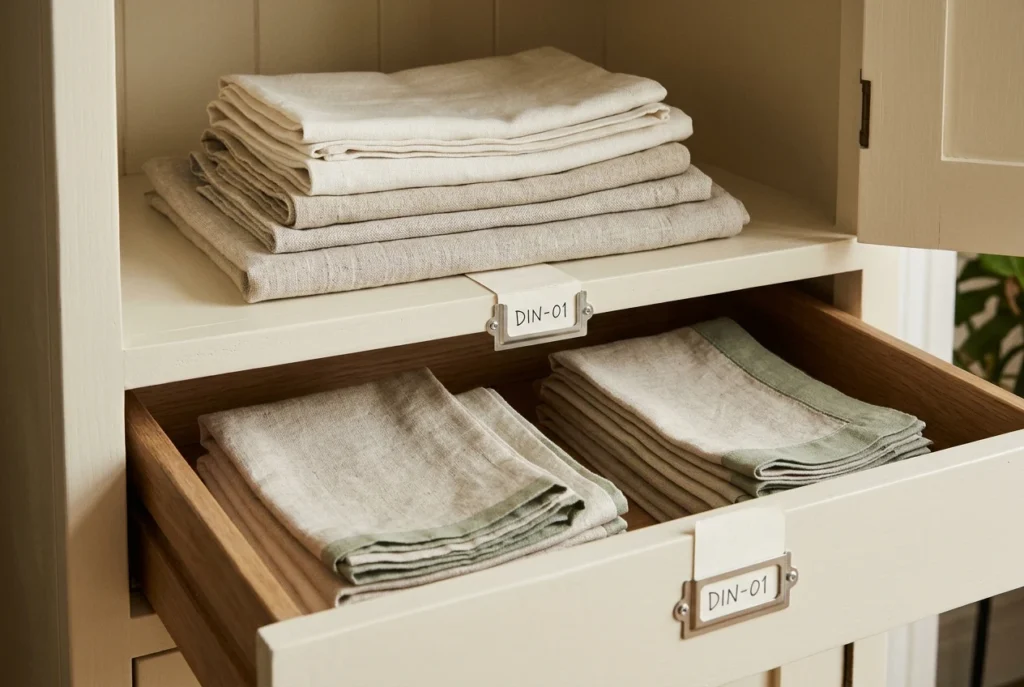
To store tablecloths and cloth napkins in a small home, start with the care instructions for the actual fabric, put away only clean and fully dry pieces, and group them by the table or occasion they serve. Choose folded, hanging, or rolled storage only when it suits those pieces and the space you can access. A simple set record keeps a tablecloth from becoming separated from its matching napkins.
Cover image: AI-generated fictional matching-set example, not a fabric-care or wrinkle-prevention test.
Store by a usable set, not just a neat stack. Record which table a cloth fits, where its napkins live, and whether every piece is ready to use. Matching pieces can share a record without being squeezed into the same storage container.
This household organization guide draws on manufacturer care guidance; it is not a fabric-care test or a promise of wrinkle-free storage. The set record and retrieval check below are original editorial tools. Heirloom, delicate, coated, and embellished textiles may need different care; the maker’s instructions take priority over a generic folding method.
What should you check before you store tablecloths?
Separate pieces that are ready to use from items that still need washing, stain assessment, repair, or complete drying. Do not let an attractive folded stack hide an unresolved care task.
In its linen care guide, SFERRA says to check the care label and describes letting linens air dry before storage after removing them from the dryer. That last step matters: fabric that is slightly damp for ironing is not necessarily ready for storage.
Reed Family Linen’s table-linen care guide likewise advises cleaning and thoroughly drying its linens before storage, with a cool, dry, well-ventilated location. These are manufacturer instructions for their linens, not one washing or drying recipe for every table covering.
What if the care label is missing?
Look for the manufacturer’s information or ask a suitable textile-care professional before choosing a treatment. Do not assume that a tablecloth can be washed, ironed, steamed, or rolled simply because another cloth looks similar. Keep uncertain pieces identifiable while you resolve their care needs.
How do you sort tablecloths without losing track of their fit?
Give each useful cloth a practical identity. You might use “everyday kitchen table,” “dining table with extension,” or the exact dimensions from its label or your measurements. “Large white cloth” becomes ambiguous when you own two.
- Table or use: name the actual surface or occasion for which you keep it.
- Shape and dimensions: distinguish a round cloth from a rectangular one; record inches and centimeters if you measure.
- Matching pieces: note the napkins or runner that belong with it.
- Care source: retain the label or the actual product’s care information.
- Ready status: distinguish a usable set from one waiting for a care task.
Do not infer the tablecloth you need from the napkin count alone. Seating arrangements, table size, extensions, and the look you want are separate decisions. This guide records what you own rather than prescribing one tablecloth drop or an ideal number of sets.
Should you fold, hang, or roll a tablecloth?
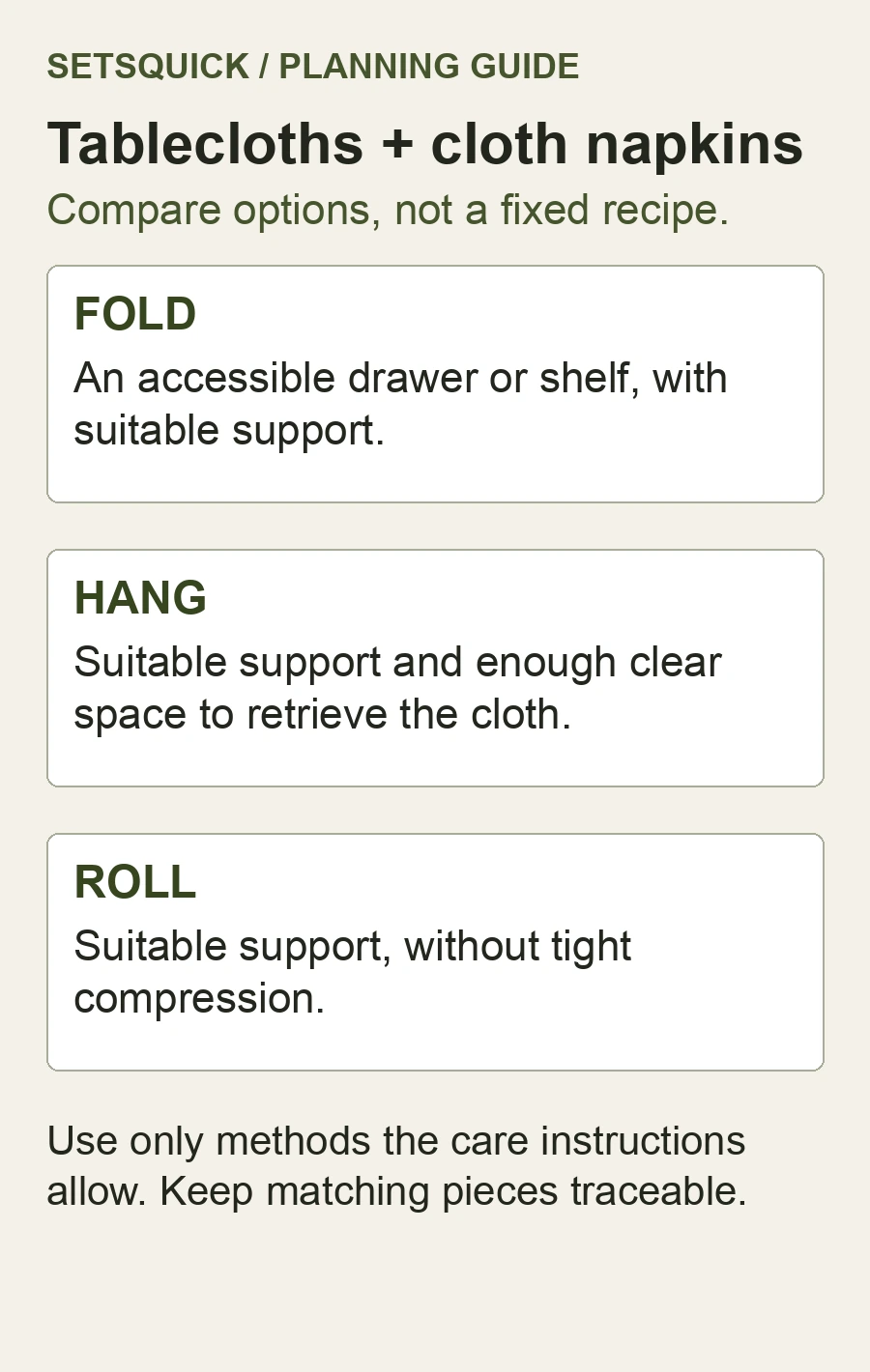
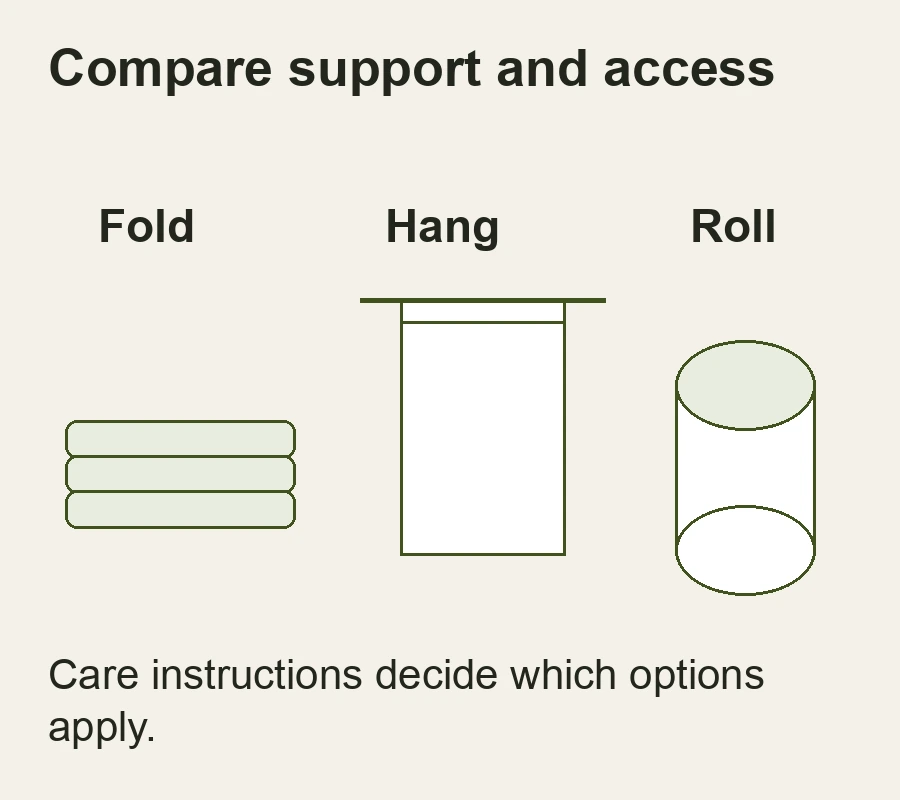
First follow the instructions for the actual piece. Manufacturer guidance is not identical: SFERRA discusses hanging or rolling its fine tablecloths to avoid set-in creases, while Reed describes neatly folded linen storage. Neither is a universal instruction for every fiber, finish, or embellishment.
When is folded storage worth considering?
Consider it for pieces whose care instructions allow it when you have a suitable drawer or shelf. Keep the group small enough to retrieve a cloth without pulling a heavy pile off the shelf.
The drawback is the fold pattern: the item may need care before it is used, and pressure from the stack can be a concern for delicate details. Do not promise that a particular fold prevents wrinkles. If a piece’s instructions favor a different method, do not force it into a drawer merely to match the rest.
When might hanging make more sense?
Consider it when the textile’s requirements, a suitable hanger, and an accessible hanging location support that method. Check the actual hanging arrangement rather than treating an open hook or door edge as a storage solution.
Its drawback is the space it uses, including the length of the hanging cloth and access around it. It may compete with everyday clothing. If you are evaluating that tradeoff, our closet organization guide helps decide what belongs in the closet before adding organizers.
What should you check before choosing rolled storage?
Verify the item’s care guidance, suitable support or packing materials, and the space required to retrieve the roll. If you consider rolling a piece, follow its maker’s guidance on support and wrapping materials rather than assuming any tube or paper is suitable. A storage method’s name does not establish that every material touching the cloth is appropriate.
The drawback is the long footprint and the possibility of losing track of what is wrapped inside. Keep an external identifier and a record of its location. For a fragile or valuable piece, get specific care advice rather than experimenting with pressure, adhesives, or improvised supports.
How do you group tablecloths and cloth napkins?
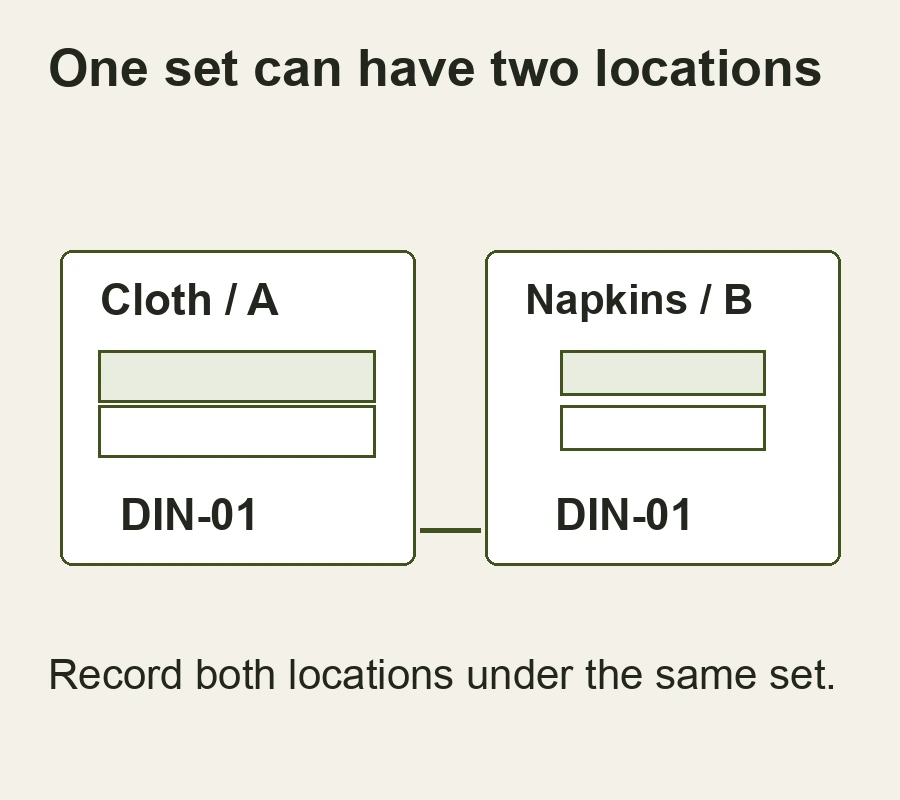
Match them in the record first. Store them alongside the cloth when appropriate, or give them a nearby separate location with the same set reference. Do not bundle pieces tightly just to make one package.
A simple reference such as DIN-01 can appear on an external shelf label and in your inventory. Keep adhesive labels off the textile unless its maker specifically supports that use. An inventory entry should not become a new care problem.
What would a set record look like?
| Table-linen set record | Your entry |
|---|---|
| Set reference and intended table | ________________ |
| Cloth shape | ________________ |
| Actual size as marked or measured | ________ in / ________ cm |
| Fabric and care-information source | ________________ |
| Napkins available for this set | ________________ |
| Cloth storage location and method | ________________ |
| Separate napkin location, if any | ________________ |
| Ready to use or care task pending | ________________ |
Fictional example: “DIN-01; dining table without extension; rectangular cloth; actual size recorded from its label; matching napkins in the adjacent drawer; cloth ready, two napkins awaiting care.” This is a record example, not a recommended quantity, an actual household test, or a guarantee that the set fits your table.
What storage conditions and covers should you check?
Choose a location compatible with the linens’ care instructions, and resolve dampness rather than covering it with a new storage bag. Both manufacturer guides favor a dry, ventilated location for the linens they discuss.
SFERRA recommends appropriate textile covers or acid-free tissue for its fine table linens and cautions against plastic and unsuitable storage materials. Reed also advises breathable fabric storage rather than plastic for its linen pieces. Do not turn that into a universal instruction for a coated tablecloth or another textile with different requirements.
This guide does not recommend scented sachets, cedar, chemical treatments, or a household humidity target. If there is a persistent storage-condition problem or a delicate item needs conservation advice, address that specific issue before reorganizing the collection.
How do you test whether the arrangement works?
- Name the next use. Pick the table and cloth you expect to use, not every item in the collection.
- Find the record. It should identify the cloth and napkin locations without guessing from color alone.
- Check access. Retrieve the suitable pieces without an awkward reach or an unstable pile. A layout check does not establish shelf or hanger load capacity.
- Check readiness. A set with an unresolved care task is not automatically ready because you found all its pieces.
- Return by the care instructions. After use and the required care and drying, update the record if the grouping changed.
How would this work with two table settings?
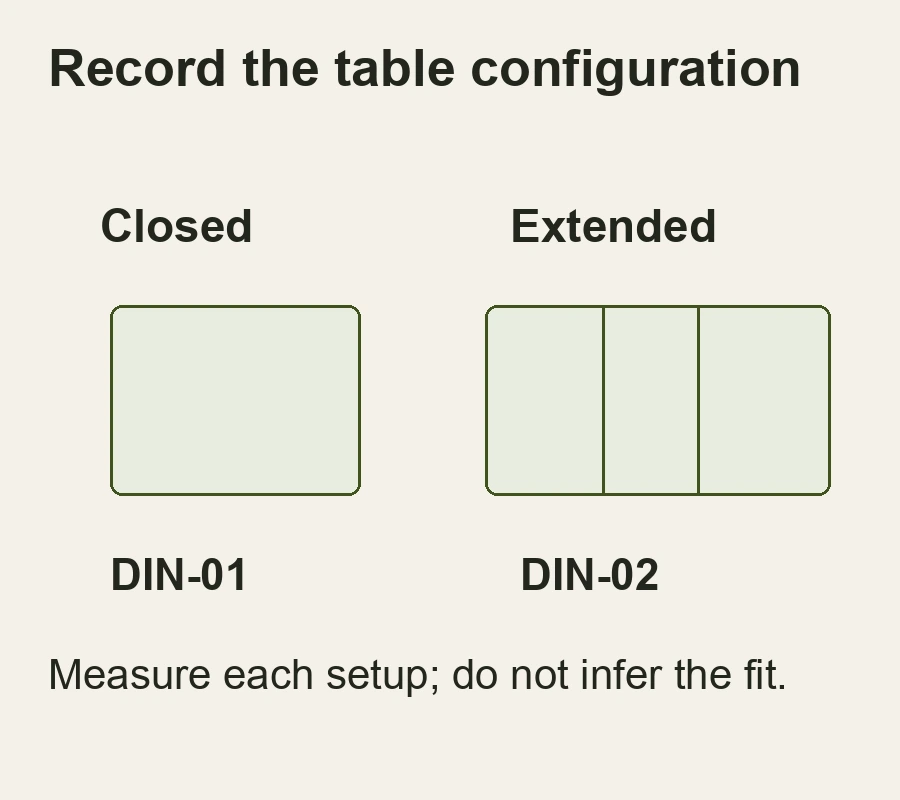
Fictional planning example: DIN-01 is the set intended for the closed dining table, while DIN-02 is intended for its extended configuration. Record the actual table setup and cloth dimensions for each. A shared color or collection name does not establish that one cloth fits both arrangements.
After checking the care instructions, you choose suitable storage for the DIN-01 cloth on shelf A. Its matching napkins have a suitable home in drawer B. The inventory and external storage labels share DIN-01, so a helper can find both parts without unfolding every cloth or assuming they must be bundled together.
The cloth is ready to use, but some napkins are awaiting care. Record that distinction rather than marking the whole set ready. When the napkins are prepared according to their instructions, update their status and confirm that the drawer location is still correct.
If the next meal uses the extended table, consult DIN-02 and check its actual fit instead of inferring coverage from DIN-01. The system succeeds when someone can identify the intended setup, retrieve its pieces, and return them appropriately. This is a record example, not a household test, a prescribed napkin count, or a recommendation for a particular fabric.
Frequently asked questions
Can you store cloth napkins with a tablecloth?
Yes, when the pieces’ care requirements and the storage arrangement suit that grouping. They can also have separate locations linked by one set record. There is no need to compress everything into a single bundle.
Should tablecloths always be hung instead of folded?
No single method applies to every tablecloth. Check its actual care instructions and available space. The manufacturer guides discussed here offer different methods for the linens they cover, so a generic rule would be misleading.
Can you put slightly damp linens away after ironing?
Complete the drying process required by the maker before storage. SFERRA describes air drying before putting linens away, and Reed says to thoroughly dry its linens before storing them. Do not confuse preparing fabric for ironing with storing it.
Do you need a dedicated linen closet?
Not necessarily. A suitable existing drawer, shelf, or hanging space may work if it meets the pieces’ requirements and allows safe access. Choose by care and usability rather than the furniture’s name.
What should you do next?
Choose one tablecloth and its napkins. Confirm their care requirements, record the actual pieces and locations, and test retrieval before buying storage for the rest of the collection.
Written by the SetsQuick Team. First published .
© SetsQuick. This article and its images may not be copied or republished without permission. To report reuse, see our DMCA page.
Was this guide helpful?
Save it for later or send it to someone